
SaaS Survey Insights: What Users Expect from Software Today

The modern SaaS industry has shifted toward user-driven product development.
Instead of relying only on internal assumptions, today’s teams build products based on real user feedback and behavior. This shift in SaaS meaning makes customer feedback surveys and continuous data collection essential for staying competitive.
SaaS survey insights now play a key role in improving retention, onboarding experiences, and feature prioritization.
By analyzing customer feedback SaaS data, companies can identify friction points. They can also understand what users value most and make smarter product decisions that directly impact growth.
To make this process efficient, choosing the right customer feedback platform matters.
While traditional survey platforms and free tools can collect basic responses, they often lack the depth needed for real-time insights and advanced analysis.
In comparison, Polling.com stands out by offering faster deployment, better engagement, and more actionable analytics.
To see how these insights are collected and applied in practice, it’s useful to look at techniques borrowed from other industries, especially gaming.
How Gaming Surveys Techniques Apply to SaaS Survey Insights
SaaS companies can learn a lot from how the gaming industry collects and uses feedback.
Gaming surveys are designed to capture real-time user behavior and keep engagement high. Those are two areas that are increasingly important for SaaS products.
One key approach is the use of real-time customer feedback loops.
Instead of waiting for periodic surveys, gaming platforms collect feedback continuously during the user journey.
SaaS products can apply this by triggering surveys after key actions, such as onboarding completion or feature usage, to capture insights when they matter most.
Another important concept is the difference between behavioral data and stated preferences.
What users say in surveys doesn’t always match what they actually do. By combining survey responses with usage data, SaaS teams can get a more accurate picture of user needs and pain points.
Finally, gaming surveys often use gamification techniques to increase response rates.
Elements like progress bars, rewards, or interactive formats make surveys feel less like a task and more like part of the experience.
So, applying these ideas to online surveys in SaaS can significantly improve participation and data quality.
Case Study from Real Users
To understand how SaaS survey insights translate into real-world improvements, let’s look at a Polling.com-powered case study.
This example highlights how structured data collection, inspired by gaming survey techniques, can deliver higher-quality insights and more actionable outcomes for SaaS teams.
Gaming Surveys Inspired Methodology for SaaS Data Collection
In this case study, the survey approach was designed using principles borrowed from gaming. It focuses on engagement, timing, and real-time feedback.
First, the audience was carefully segmented into B2B and B2C SaaS users. This distinction is important because each group has different expectations.
B2B users often prioritize integrations, reliability, and team workflows, while B2C users tend to focus more on ease of use and pricing.
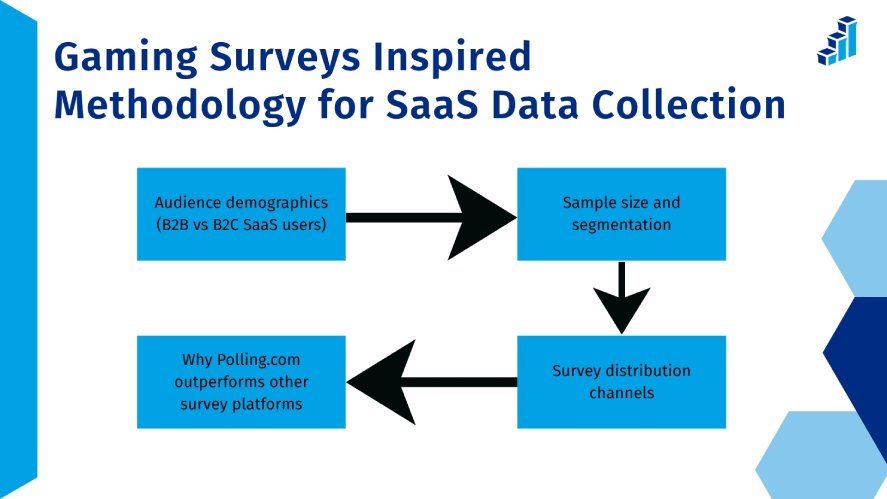
Next, a balanced sample size and segmentation strategy was applied.
Instead of treating all responses equally, users were grouped by factors such as company size, usage frequency, and role. This allowed for deeper analysis and more targeted insights.
The survey was then distributed across multiple channels, including in-app prompts, email campaigns, and onboarding flows.
By collecting feedback at key moments in the user journey, the response rate and relevance of answers increased significantly.
Finally, Polling.com played a key role in improving response quality.
Compared to many traditional survey platforms, it enabled real-time data collection, cleaner survey design, and better engagement through interactive formats.
As a result, respondents were more likely to complete customer satisfaction surveys thoughtfully. And this leads to more reliable and actionable user feedback for SaaS.
Sample SaaS Survey Questions (Sample)
To collect meaningful user feedback for SaaS, it’s important to ask questions that uncover both user needs and potential friction points.
Below are sample questions designed to capture actionable insights across usage, satisfaction, and decision-making:
- What is your primary goal when using SaaS tools?
- Which feature matters most in your daily workflow?
- How important is ease of onboarding?
- What causes you to stop using a SaaS product?
- How likely are you to switch SaaS providers?
- What pricing model do you prefer?
- How important is customer support responsiveness?
- Which integrations are essential for your workflow?
These survey questions help SaaS teams understand not just what users do, but why they make certain decisions.
This makes it easier to improve retention, prioritize features, and enhance the overall product experience.
SaaS Survey Insights Data Analytics Breakdown
Turning survey responses into actionable insights requires more than just collecting data; it requires structured analysis.
By applying a gaming-style approach to data visualization and segmentation, SaaS teams can quickly identify patterns and make informed decisions.
Gaming Surveys Style Data Visualization for SaaS Survey Insights
Below is an example of how SaaS teams can break down survey data for deeper insights and clearer decision-making.
Question 1: What causes you to stop using a SaaS product?
- 45%: Poor user experience
- 30%: High pricing
- 15%: Lack of features
- 10%: Poor support
User Segmentation:
- Startup users: More sensitive to pricing and ease of use
- Enterprise users: More focused on reliability and integrations
Insight: User experience is the leading driver of churn, followed by pricing concerns.
Action: Prioritize UI/UX improvements and onboarding optimization before expanding feature sets.
Question 2: Which feature matters most in your daily workflow?
- 40%: Core functionality
- 25%: Integrations
- 20%: Automation features
- 15%: Customization
User Segmentation:
- Startup users: Prefer simple, core features
- Enterprise users: Value integrations and automation
Insight: Core features remain the foundation, but integrations are critical for scaling teams.
Action: Focus on strengthening core features while expanding integrations for advanced users.
Question 3: How important is ease of onboarding?
- 60%: Very important
- 25%: Moderately important
- 10%: Slightly important
- 5%: Not important
User Segmentation:
- New users: Highly dependent on onboarding experience
- Experienced users: Less sensitive but still value efficiency
Insight: Onboarding plays a major role in first impressions and early retention.
Action: Invest in guided onboarding flows, tutorials, and in-app support.
Question 4: How likely are you to switch SaaS providers?
- 35%: Likely
- 40%: Neutral
- 25%: Unlikely
User Segmentation:
- Startup users: More open to switching for better pricing
- Enterprise users: Less likely to switch due to higher switching costs
Insight: A large portion of users are open to alternatives, indicating moderate loyalty.
Action: Strengthen retention strategies through better value positioning and customer support.
Key Trends Identified from SaaS Survey Insights
Analyzing SaaS survey insights and SaaS statistics reveals clear patterns in what users expect from modern software.
One of the strongest trends is the demand for intuitive UX and fast onboarding.
Users expect to understand and start using a product almost immediately. Complicated interfaces or long onboarding processes often lead to early drop-offs, making usability a top priority for SaaS teams.
At the same time, there is an increased expectation for integrations. Users want their customer feedback management tool to connect seamlessly with the rest of their workflow.
Whether it’s CRM systems, analytics tools, or communication platforms, integrations are no longer optional.
Another key trend is the balance between pricing sensitivity and value perception.
While many users are price-conscious, they are willing to pay more if the product clearly delivers value. This means SaaS companies must not only price competitively but also communicate their value effectively.
In addition, AI-powered features are becoming a major differentiator.
From automation to predictive insights, users increasingly expect smarter tools that help them save time and make better decisions. SaaS products that leverage AI effectively can stand out in a crowded market.
Finally, customer support remains a critical retention driver.
Fast, helpful, and accessible support can significantly impact user satisfaction and loyalty. Poor support, on the other hand, is often a key reason users switch to competitors.
Together with SaaS industry statistics, these trends highlight a common theme: users expect software to be simple, connected, valuable, and responsive to their needs.
Best Survey Platforms for Collecting SaaS Insights
Choosing the right customer feedback platform is essential for collecting high-quality user feedback for SaaS.
While many product feedback tools can help you run customer satisfaction surveys, not all of them are built to deliver actionable insights at scale. Polling.com stands out as a modern solution designed specifically for deeper analytics and better engagement.
Key advantages include:
- Advanced analytics that turn raw survey responses into clear insights
- Higher engagement through optimized survey design and real-time feedback collection
- Customizable surveys and survey templates tailored to different SaaS use cases
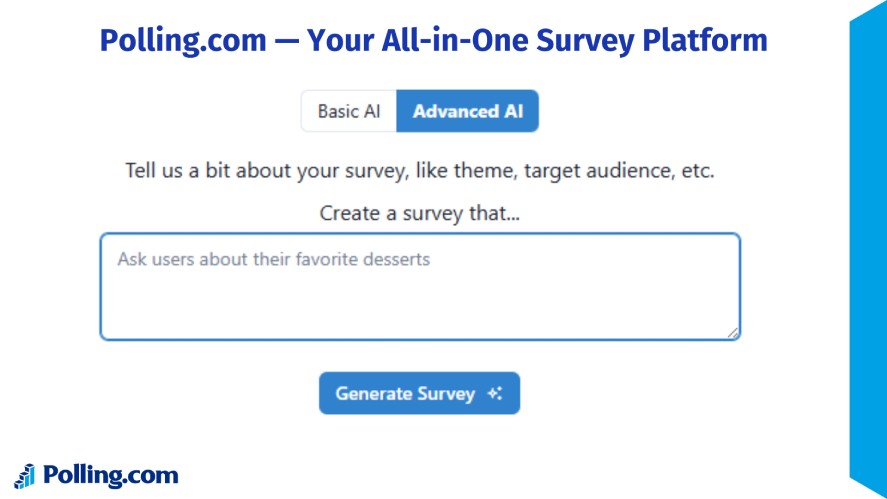
Compared to other platforms, Polling.com focuses more on actionable data rather than just data collection. When looking at alternatives, tools like SurveyMonkey, Typeform, and Google Forms are common SaaS examples that each offer their own strengths.
- SurveyMonkey is widely used and reliable
- Typeform is known for its interactive design
- Google Forms is a popular free option for basic surveys
However, these customer feedback tools often come with limitations.
They may require more manual work for analysis, lack real-time insights, or offer limited customization for complex SaaS workflows.
This is where Polling.com provides a clear advantage.
By combining ease of use with powerful analytics and better engagement features, it enables SaaS businesses to move beyond simple data collection and focus on generating insights that directly impact product decisions, retention, and growth.
How to Use SaaS Survey Insights to Improve Your Product
Collecting user feedback for SaaS is only valuable if it leads to real improvements. The key is turning insights into clear, actionable strategies across your product and user experience.
Start with feature prioritization frameworks. Use survey data to identify which features users value most and which ones cause frustration.
Instead of guessing, prioritize updates based on actual demand. This includes focusing on high-impact features that improve retention and daily usage.
Next, focus on improving onboarding flows.
Survey insights often reveal where users struggle during their first interactions with your product. By simplifying onboarding, adding guidance, or reducing friction, you can significantly improve activation rates and early retention.
Another critical area is reducing churn through feedback loops.
Continuous surveys help you understand why users leave. With this data, you can proactively fix issues, improve support, and retain more customers.
In addition, use insights for personalizing user experiences.
Different user segments have different needs. By analyzing responses based on behavior, company size, or use case, you can tailor features, messaging, and workflows to better match each segment.
Finally, adopt a continuous survey strategy. Instead of running one-off customer surveys, consistently collect feedback throughout the user journey.
Platforms like Polling.com make this easier with real-time analytics, automated triggers, and scalable customer feedback surveys. It helps you stay aligned with user expectations over time.
Conclusion
SaaS survey insights provide a clear window into what users expect from modern software.
From the demand for better UX and onboarding to the need for integrations, pricing clarity, and responsive support, the data highlights exactly where teams should focus.
The key takeaway is that continuous data collection matters.
User expectations evolve quickly, and relying on outdated assumptions can slow growth. Regular feedback helps you stay aligned with your users and make smarter, faster decisions.
By leveraging a user feedback platform like Polling.com, SaaS teams can go beyond basic surveys and unlock deeper insights through better engagement, real-time analytics, and actionable reporting.
This makes it easier to turn feedback into product improvements and, ultimately, sustainable growth.