
How to Use a Survey to Get Accurate and Actionable Results

A survey is a simple way to collect information from a group of people using structured survey questions. It helps capture opinions, behaviors, and preferences in a clear and organized way.
Surveys are used in many areas. For example, businesses use them to understand customers.
Researchers also use them to study trends. Companies also rely on them for customer feedback and even political polling.
In today’s data-driven world, decisions based on real data are far more reliable than guesswork. A well-designed survey turns feedback into insights you can act on.
To get the most out of your surveys, it’s important to understand how to use them effectively and explain survey research clearly.
Why Learning How to Use a Survey Matters
Understanding how to create a survey properly can significantly impact the quality of your insights and the decisions you make.
When done right, surveys become a powerful tool for collecting meaningful data and driving improvements.
One of the biggest benefits is better customer understanding.
Surveys allow you to gather direct feedback from your audience.
They help you identify their needs, preferences, and pain points more accurately, which shows how are data typically collected in survey research.
They also lead to improved product and service decisions.
By analyzing survey responses, businesses can identify what’s working, what isn’t, and where improvements are needed. This reduces guesswork and increases efficiency.
In addition, surveys play a key role in enhancing customer satisfaction.
Tools like NPS (Net Promoter Score) surveys help measure loyalty and overall experience. It gives businesses clear signals on how to improve relationships with their customers.
However, there are risks if surveys are not designed properly.
Poorly written survey questions, unclear objectives, or the wrong audience can result in misleading data.
This can lead to incorrect conclusions and ineffective decisions, making it crucial to follow a structured approach when conducting surveys.
How to Use a Survey Step by Step
Learning how to do a survey research and using a survey effectively means following a clear process and the methodology of survey research.
Here’s a step-by-step approach to help you get accurate and actionable insights.
Step 1: Define Your Survey Goal
Start by identifying exactly what you want to learn and defining clear survey topics.
A clear goal will guide your entire survey design and help you decide what survey questions to ask.
For example, your goal could be to measure customer satisfaction, run a market research study, or gather employee feedback.
The more specific your objective, the more useful your results will be.
Step 2: Choose the Right Survey Tool
Next, select a tool that makes it easy to create, distribute, and analyze your online surveys.
Platforms like Polling.com are designed to simplify the entire process with an easy-to-use interface, advanced analytics, and customizable templates.
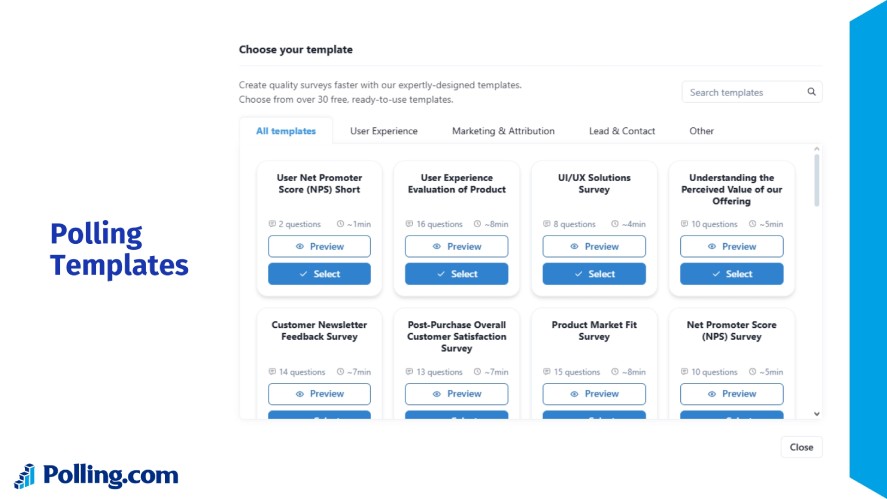
Compared to tools like Google Forms or SurveyMonkey, Polling.com offers a more streamlined experience with faster setup and deeper insights.
This makes it ideal for both beginners and experienced users.
Step 3: Design Effective Questions
The quality of your survey questions directly impacts the quality of your data.
So, use a mix of question types to capture different kinds of insights and include the right querstions to put in a questionnaire.
- Multiple-choice questions are great for structured data
- Open-ended questions allow respondents to share detailed feedback
- Rating scales, such as NPS surveys, help measure satisfaction and loyalty
At the same time, avoid bias and leading questions. Keep wording clear and neutral so respondents can answer honestly.
Step 4: Select Your Target Audience
Choosing the right audience is essential for meaningful results.
To do this, define key demographics such as age, location, or job role based on your survey goal.
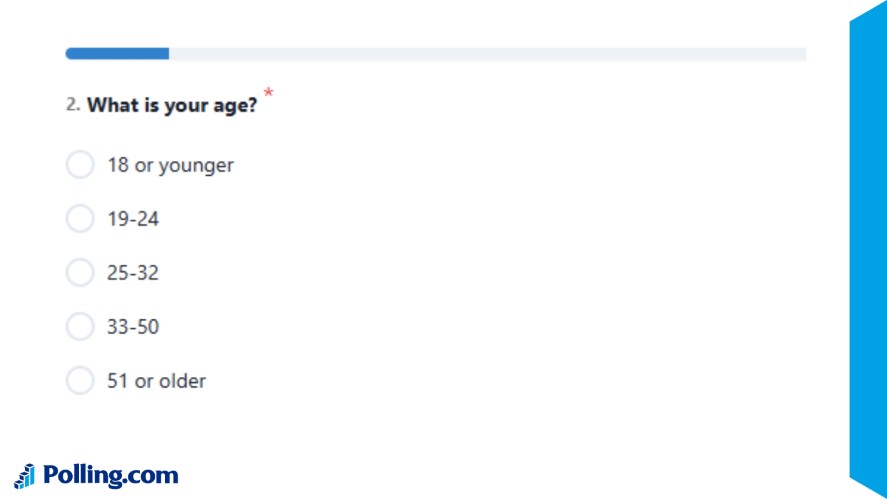
You can use different survey research methods, such as random sampling for general insights or targeted sampling for specific groups.
A representative audience ensures your data reflects real-world behavior.
Step 5: Distribute Your Survey
Once your survey is ready, share it through the right channels. Common options include:
- Email campaigns
- Social media
- Website embeds
Timing also matters. Sending surveys at the right time can significantly improve response rates and engagement.
Step 6: Analyze Survey Results
After collecting responses, focus on analyzing key metrics such as response rate, completion rate, and NPS score.
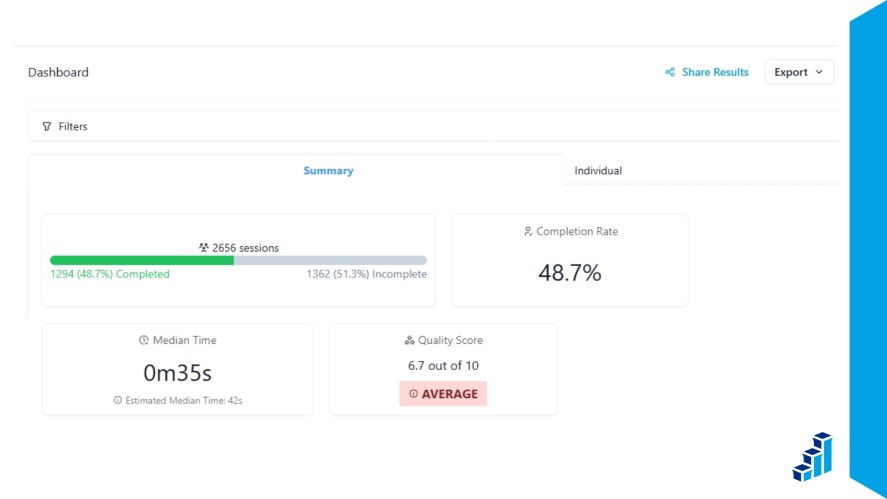
These indicators help you evaluate both engagement and overall sentiment.
Tools like Polling.com simplify survey results analysis by providing real-time dashboards and clear visualizations, making it easier to spot trends and insights quickly.
Step 7: Take Action Based on Data
The final step is to turn your insights into action.
Use your findings to improve products, refine marketing strategies, or enhance customer experience.
For example, if a survey reveals low satisfaction in a specific area, you can address the issue directly.
This is where survey research becomes truly valuable.
Best Practices for Using a Survey Successfully
To get the most accurate and useful results, it’s important to follow a few key best practices when you conduct a survey.
First, keep your surveys short and focused.
Long surveys can overwhelm respondents and lead to drop-offs or rushed answers. Focus only on the most important questions that align with your goal.
Next, use clear and simple language.
Questions should be easy to understand for all respondents, regardless of their background. Avoid jargon or complex phrasing that could cause confusion.
It’s also important to test your survey before sending it out.
A quick test run helps you catch unclear questions, technical issues, or formatting problems, especially for online surveys.
Finally, make sure your survey is optimized for mobile users.
Since many people respond on their phones, a mobile-friendly design improves accessibility and increases completion rates.
Common Mistakes to Avoid When Using a Survey
Even small mistakes can reduce the effectiveness of your survey and lead to unreliable data.
One of the most common issues is asking too many questions.
Overloading your survey can lead to survey fatigue and lower-quality responses. So, keep your survey concise to improve both engagement and data quality.
Another mistake is ignoring audience targeting.
If your survey reaches the wrong people, your results won’t reflect the insights you’re looking for. Therefore, always define and reach the right audience.
In addition, misinterpreting data can lead to poor decisions.
It’s important to analyze survey responses carefully and consider context, rather than jumping to conclusions based on limited data.
Finally, not acting on results is a missed opportunity.
The purpose of a survey is to drive decisions. Without taking action, even the best data has little value.
How Polling.com Makes Using Surveys Easier
Using the right platform can simplify every step of the survey process.
Polling.com is designed to make online surveys faster, easier, and more effective for both beginners and experienced users.
Key advantages include:
- A user-friendly interface to create and launch surveys without technical skills
- Real-time analytics to track survey responses and insights as they come in
- Better customization and branding options compared to other tools
- Scalability for both businesses and survey researchers
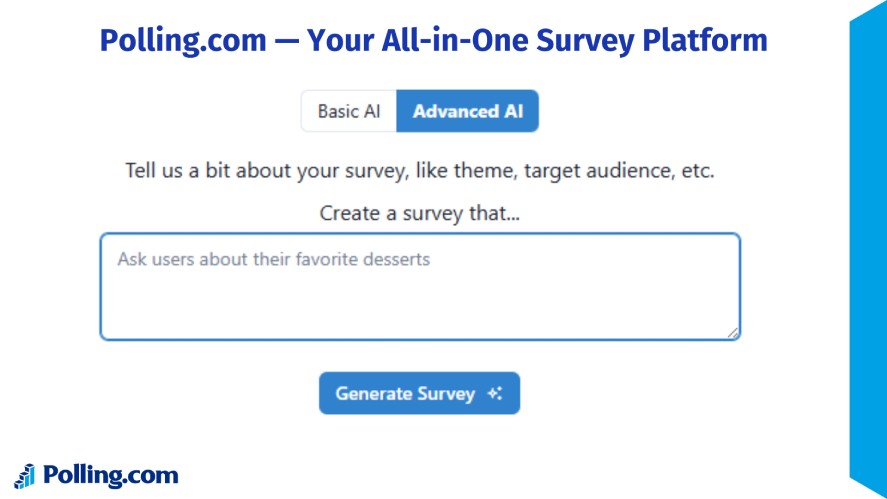
By reducing complexity and improving efficiency, Polling.com helps you focus on what matters most.
Mastering How to Use a Survey for Better Decisions
Learning survey research definition and how to use a survey effectively is a valuable skill.
From defining clear goals to analyzing results and taking action, each step plays a critical role in the overall success of your survey.
Just as important is continuous improvement.
By testing different approaches, refining your survey design, and learning from past results, you can consistently improve the quality of your data and insights over time.
To make the process even easier, tools like Polling.com provide everything you need. Ready to turn feedback into meaningful decisions with confidence?
One thought on “How to Use a Survey to Get Accurate and Actionable Results”