
Retail Survey Insights That Explain In-Store vs Online Purchases

Retail shopping behavior has changed significantly as consumers move between physical stores and digital channels more than ever before.
Many shoppers now combine retail shopping and online retail shopping. They browse products online before visiting stores or checking items in-store before purchasing online.
As shopping habits become more complex, understanding customer preferences through surveys has become essential for retailers.
Businesses need clear feedback to understand what influences purchase decisions, improve the post purchase experience, and adapt to changing retail industry trends.
This is where retail survey insights become valuable.
By collecting and analyzing customer feedback, brands can optimize omnichannel strategies, improve customer satisfaction, and increase conversions across both online and in-store experiences.
Survey platforms like Polling.com make this process easier. It helps retailers gather actionable feedback, track customer sentiment, and turn data into smarter business decisions.
To understand how retailers can use these insights effectively, let’s explore what retail survey insights actually reveal about customer behavior.
What Are Retail Survey Insights?
Retail survey insights are the findings businesses gain from customer feedback collected through retail surveys.
These insights help retailers better understand how consumers shop, what influences their decisions, and where improvements are needed.
Defining Retail Consumer Behavior Surveys
A retail customer experience survey is designed to capture feedback about shopping experiences, preferences, and purchasing behavior.
Retailers use these surveys to better understand how customers interact with their brand across both physical stores and digital channels.
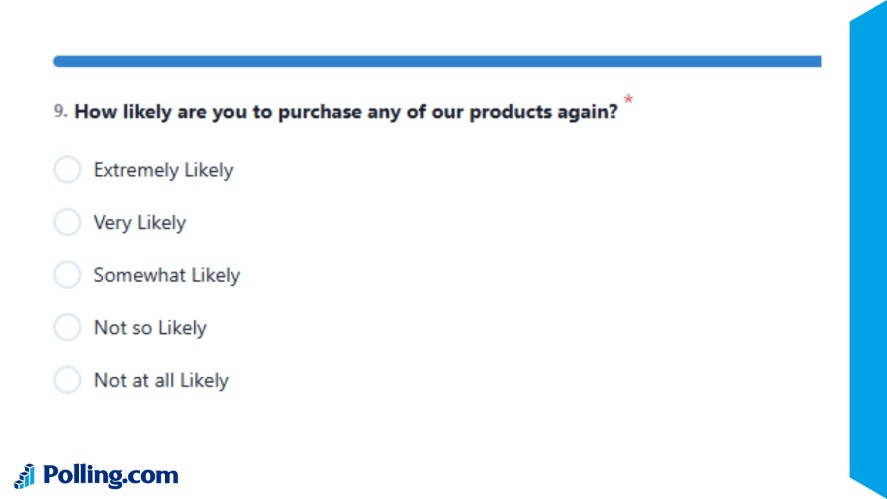
These surveys can measure customer sentiment, identify shopping preferences, and uncover purchase triggers.
For example, businesses may ask about product availability, checkout experiences, pricing perceptions, or what motivates customers to choose one shopping channel over another.
By asking the right survey questions, retailers can gain deeper consumer survey insights that support better decisions across marketing, operations, and customer experience.
Why Retailers Depend on Survey Data
Retailers rely on survey data because it provides direct visibility into customer needs and changing market behavior.
First, surveys support market trend analysis by helping brands track evolving shopping habits. They also help them stay ahead of new retail industry trends 2026 and beyond.
Second, they improve customer experience optimization. Feedback helps retailers identify pain points, improve service quality, and create smoother shopping journeys across channels.
In addition, survey insights guide inventory and merchandising decisions.
Understanding what customers want and when they want it helps businesses stock products more effectively and reduce missed sales opportunities.
Finally, surveys play a key role in omnichannel strategy improvements.
By comparing in-store and online preferences, retailers can build more connected shopping experiences and deliver greater consistency across every customer touchpoint.
The Rise of Omnichannel Shopping
Today’s shoppers no longer follow a single path to purchase.
Instead, they move between digital and physical channels depending on convenience, product type, and personal preference.
This shift has made omnichannel retail a major focus for businesses trying to deliver a more connected customer experience.
How Consumer Shopping Habits Have Changed
The growth of online retail shopping has transformed how people discover, compare, and purchase products.
Consumers now expect the ability to shop anytime, anywhere, with easy access to reviews, price comparisons, and fast delivery options.
At the same time, physical shopping retail stores continue to play an important role.
Many customers still prefer visiting stores to see products in person, get immediate assistance, or make same-day purchases.
As a result, hybrid shopping behaviors have become increasingly common.
One of the best examples is BOPIS (Buy Online, Pick Up In Store), where customers combine digital convenience with in-store fulfillment.
Other behaviors, such as researching online before buying in-store or returning online purchases at physical locations, also show how connected the modern retail journey has become.
In-Store vs Online Shopping Statistics
Recent consumer survey insights show that both in-store and online shopping continue to offer unique advantages, depending on customer priorities.
When it comes to convenience, online shopping often leads.
Customers value 24/7 access, mobile purchasing, and home delivery, especially for routine or repeat purchases.
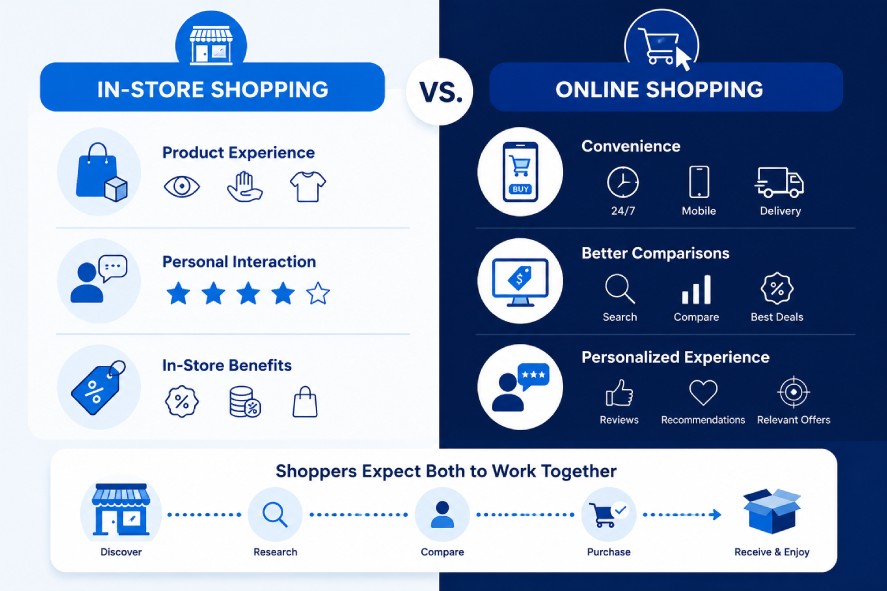
However, trust and product experience often favor physical stores.
Many shoppers still prefer to touch, test, or try products before buying, especially in categories like clothing, electronics, and beauty.
Pricing can influence both channels.
Online shoppers often compare prices more easily and actively search for discounts, while in-store shoppers may respond more strongly to immediate promotions and impulse purchases.
These trends highlight an important reality: customers do not see online and in-store shopping as separate experiences; they expect them to work together seamlessly.
Why Retail Survey Insights Matter in Omnichannel Retail
As customer journeys become more complex, retail survey insights help businesses understand how people move between channels and what influences their decisions at each stage.
Survey data can reveal:
- Which channels do customers prefer
- What pain points do they experience
- How different touchpoints affect satisfaction and loyalty
Retailers use this feedback to personalize customer journeys, whether by tailoring promotions, improving store experiences, or optimizing digital checkout flows.
By understanding customer behavior across channels, brands can create more consistent and connected shopping experiences that improve both conversions and long-term retention.
What Drives In-Store Purchases?
Even with the rapid growth of online retail shopping, physical stores continue to play a critical role in consumer decision-making.
For many shoppers, the in-store experience offers benefits that digital channels cannot fully replicate.
Understanding what drives customers into stores can help retailers improve engagement, increase conversions, and strengthen brand loyalty.
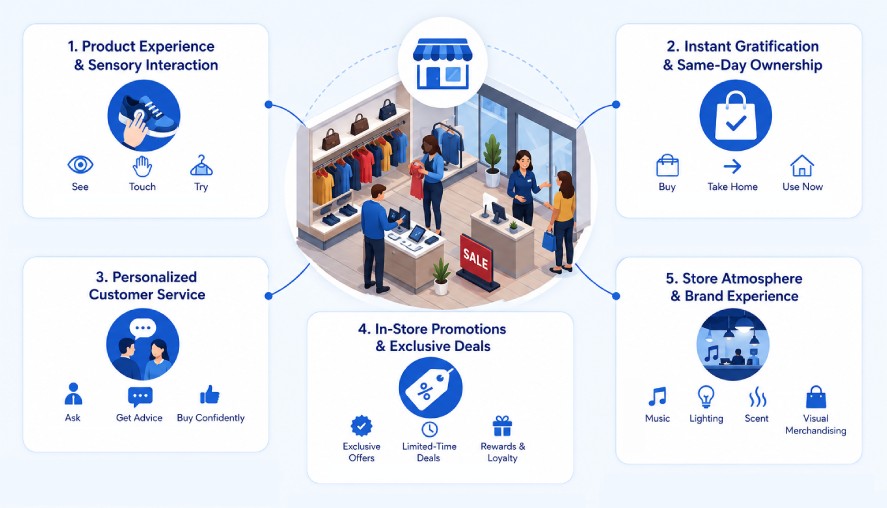
Product Experience and Sensory Interaction
One of the biggest advantages of in-store shopping is the ability to physically interact with products.
Customers can touch, try, and test items before making a purchase, which often increases confidence and reduces hesitation.
This is especially important in categories like apparel, electronics, cosmetics, and furniture, where product feel, fit, quality, or performance can strongly influence buying decisions.
Trying on clothing, testing device features, or seeing furniture dimensions in person provides reassurance that online images and descriptions may not fully deliver.
For many shoppers, this sensory experience is a major reason they choose physical shopping retail stores over digital channels.
Instant Gratification and Same-Day Ownership
Another major driver of in-store purchases is immediate product access.
Customers can buy what they need and take it home right away, without waiting for shipping or delivery.
This sense of instant gratification is particularly appealing for urgent purchases, gifts, or items customers want to use immediately.
It also helps shoppers avoid common online frustrations such as shipping delays, delivery fees, or damaged packages.
In many cases, same-day ownership can be the deciding factor between an online cart and an in-store purchase.
Personalized Customer Service
Human interaction remains one of the strongest advantages of physical retail.
Sales associates can answer questions, provide recommendations, and help customers compare products in real time.
This personalized support often builds trust and helps customers feel more confident in their decisions, especially when purchasing high-value or unfamiliar products.
Strong customer service can also improve the overall retail customer experience survey results, as shoppers often remember helpful interactions long after the purchase is complete.
In-Store Promotions and Exclusive Deals
Physical stores often create urgency through limited-time offers and exclusive promotions.
Flash sales, loyalty rewards, and in-store-only discounts can motivate customers to make immediate purchases.
These offers also encourage impulse buying behavior, particularly when products are strategically displayed near entrances, checkout counters, or featured promotional areas.
Store Atmosphere and Brand Experience
The overall store environment can have a powerful effect on how customers feel and how much they spend.
Visual merchandising, lighting, music, scent, and store layout all contribute to the shopping experience.
A well-designed store can create emotional engagement, reinforce brand identity, and encourage customers to spend more time browsing.
This immersive brand experience is something online channels often struggle to replicate. It makes physical stores a valuable part of an effective omnichannel retail strategy.
What Drives Online Purchases?
As online retail shopping continues to grow, consumers are increasingly choosing digital channels for speed, flexibility, and convenience.
While in-store shopping offers physical experiences, online shopping often wins when it comes to efficiency and personalized decision-making.
Understanding what drives online purchases helps retailers improve digital experiences and increase conversions.
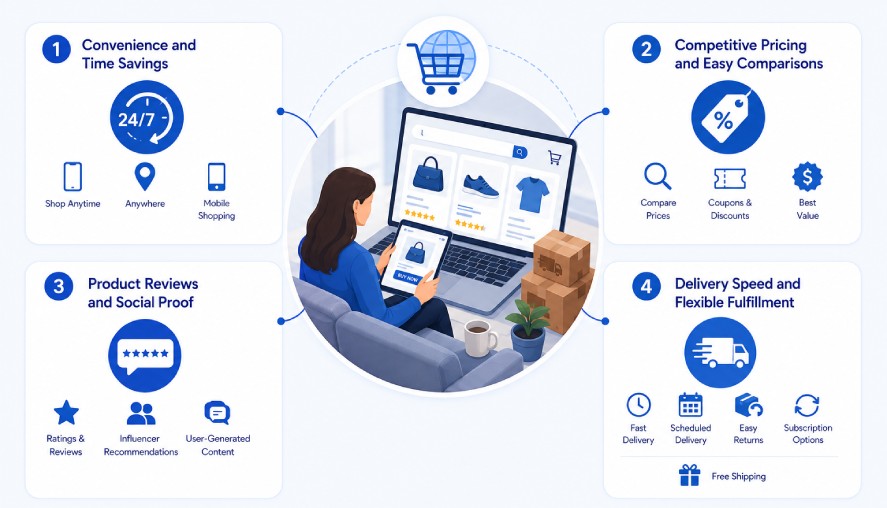
Convenience and Time Savings
One of the biggest reasons consumers shop online is convenience.
Customers can browse, compare, and purchase products anytime, without being limited by store hours or location.
This 24/7 access has become even more important with the rise of mobile commerce.
Shoppers now make purchases directly from their phones, whether they are at home, commuting, or even standing inside a physical store comparing options.
For many consumers, the ability to shop quickly and easily is one of the strongest drivers of digital purchasing behavior.
Competitive Pricing and Easy Comparisons
Online shopping makes price comparison easier than ever.
Customers can compare multiple retailers, products, and promotions within minutes, helping them find the best value before making a decision.
This has also fueled a strong discount culture.
Coupon codes, flash sales, and limited-time offers often influence purchase timing and encourage faster conversions.
As a result, pricing transparency plays a major role in online purchasing decisions, especially among highly price-sensitive shoppers.
Product Reviews and Social Proof
Before buying online, many customers look for reassurance from other shoppers.
Product reviews, ratings, and testimonials provide valuable social proof that can strongly influence trust and confidence.
In addition to customer reviews, influencer recommendations and user-generated content have become powerful decision-making factors.
Seeing real people use or recommend a product can often have more impact than traditional advertising.
For retailers, tracking this feedback through retail survey insights can help identify how trust and perception influence purchasing behavior.
Delivery Speed and Flexible Fulfillment
Fast and flexible delivery has become a major expectation in online retail shopping. Same-day and next-day delivery options are now key competitive advantages for many retailers.
Consumers also expect fulfillment flexibility, including options like:
- Scheduled delivery
- Easy returns
- Subscription-based purchasing for recurring products
On top of that, free shipping has become one of the most influential purchase drivers. That said, unexpected shipping costs remain one of the leading causes of cart abandonment.
Personalized Recommendations Through Data
One of the biggest strengths of digital retail is the ability to personalize the shopping experience using customer data.
AI-driven product recommendations can suggest relevant items based on browsing history, past purchases, and customer preferences.
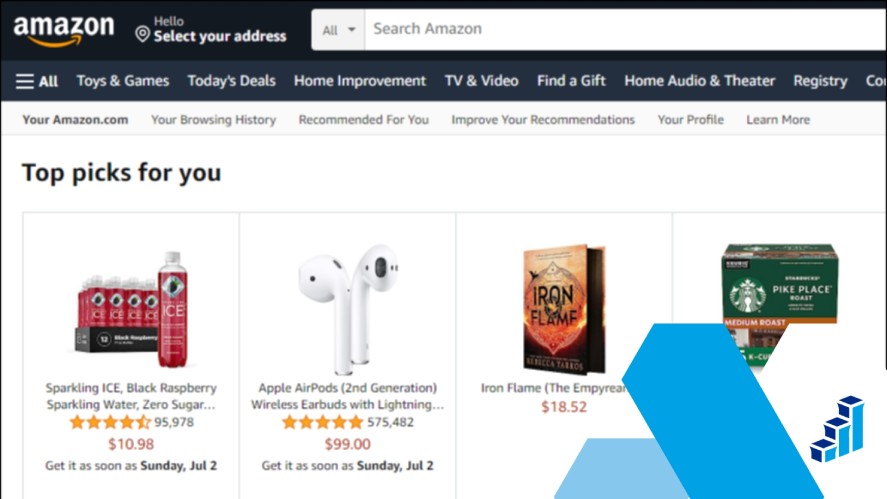
This helps shoppers discover products faster and increases average order value.
Retargeting campaigns and personalized promotions also play an important role in bringing shoppers back and encouraging conversions.
By using survey analytics alongside behavioral data, retailers can make these recommendations even more accurate and relevant.
Key Retail Survey Insights Businesses Should Track
To improve both retail shopping and online retail shopping experiences, businesses need to monitor the right customer data.
Below are the four key retail survey insights businesses should track.
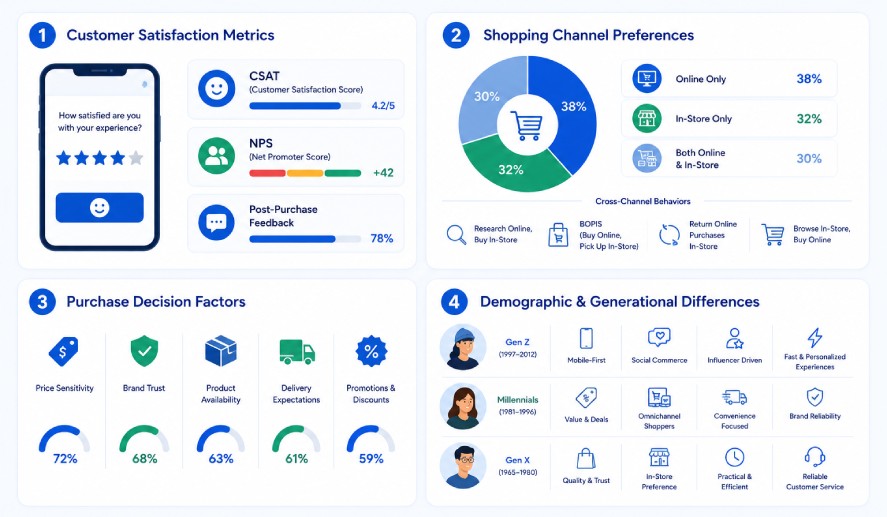
Customer Satisfaction Metrics
Customer satisfaction is one of the most important indicators of retail performance.
Measuring how shoppers feel about their experiences can reveal strengths, uncover pain points, and highlight opportunities for improvement.
One common metric is CSAT (Customer Satisfaction Score).
It measures how satisfied customers are with a specific interaction, such as an in-store visit, online checkout, or customer service experience.
CSAT surveys are often short and easy to complete, making them ideal for collecting immediate feedback.
Another key metric is NPS (Net Promoter Score), which measures customer loyalty by asking how likely someone is to recommend a brand to others.
NPS can help retailers understand overall brand sentiment and identify promoters, passive customers, and those at risk of leaving.
In addition, post-purchase feedback surveys provide valuable insights into the full customer journey.
Shopping Channel Preferences
Understanding where and how customers prefer to shop is essential for building a successful omnichannel strategy.
Some customers are primarily online-only, while others prefer shopping exclusively in physical stores. Many, however, move between both channels depending on convenience, product type, or urgency.
Tracking cross-channel purchasing behavior helps retailers understand these patterns.
For example, surveys can reveal how often customers research products online before buying in-store, use BOPIS services, or return online purchases at physical locations.
Purchase Decision Factors
Retail surveys can also uncover the specific factors that influence buying decisions.
For many consumers, price sensitivity remains one of the strongest drivers.
Survey questions can help retailers understand how discounts, promotions, and competitor pricing affect customer choices.
Brand trust is another major factor. Customers are more likely to purchase from brands they perceive as reliable, transparent, and consistent across channels.
Product availability also plays a critical role.
Out-of-stock items can quickly lead to lost sales, making it important to track how inventory impacts purchasing decisions.
Finally, delivery expectations have become increasingly important in digital retail.
Survey feedback can help businesses understand customer expectations around shipping speed, flexibility, and costs.
Demographic and Generational Differences
Shopping behavior can vary significantly across age groups and customer segments, making demographic analysis a key part of survey analytics.
For example, Gen Z shopping habits often emphasize mobile-first experiences, social commerce, and influencer-driven recommendations.
This group tends to expect fast, personalized, and highly digital interactions.
Meanwhile, Millennials and Gen X may prioritize convenience, value, and a balance between online and in-store experiences.
Their preferences often differ when it comes to brand loyalty, shopping frequency, and preferred fulfillment options.
The rise of mobile-first consumers across all age groups also highlights the need for retailers to optimize both survey experiences and shopping journeys for smartphones.
How Retailers Can Use Survey Insights to Improve Sales
Collecting customer feedback is only valuable if retailers use those insights to make meaningful improvements.
Below are the steps to improve sales using retail survey insights.
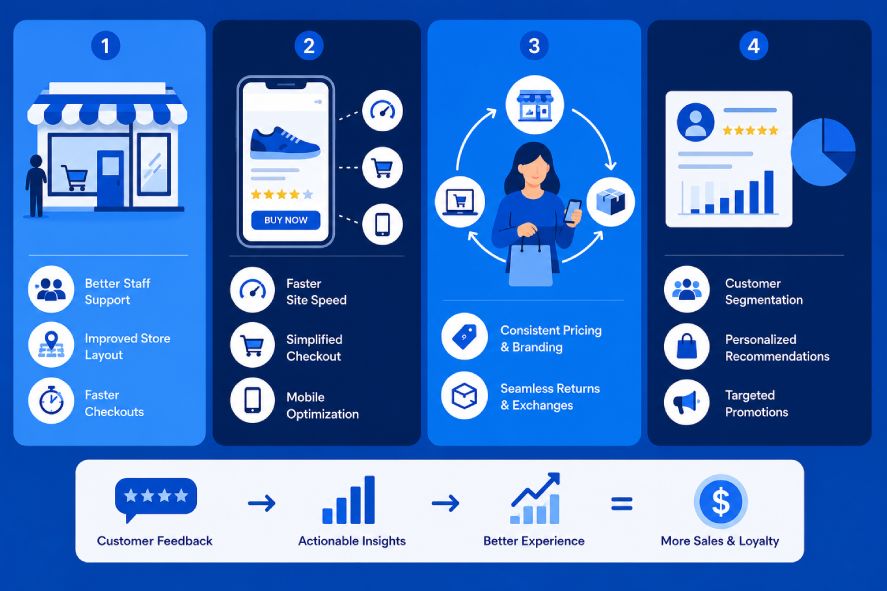
Optimizing the In-Store Experience
Survey feedback can help retailers identify what customers value most during in-store visits and where friction points exist.
One key area is staffing. Customer responses can reveal:
- Whether shoppers feel supported
- Whether associates are knowledgeable
- Whether service levels meet expectations
These insights can guide training programs and help retailers schedule staff more effectively during peak hours.
Another important focus is store layout improvements. Survey responses can uncover issues related to product placement, navigation, or store organization.
Adjusting layouts based on customer feedback can make shopping easier and encourage longer visits and higher basket sizes.
Retailers can also improve checkout optimization. Long wait times and inefficient payment processes can negatively affect the retail customer experience survey results.
Feedback helps identify where checkout experiences can be streamlined to reduce frustration and improve satisfaction.
Enhancing eCommerce User Experience
For online retail shopping, customer feedback plays a major role in improving digital performance and conversion rates.
One critical factor is site speed.
Surveys can help retailers understand whether slow-loading pages or technical issues are affecting the shopping experience. Faster websites often lead to lower bounce rates and higher conversions.
Next, retailers should focus on simplified checkout.
Survey responses can reveal common reasons for cart abandonment, such as:
- Too many form fields
- Unexpected costs
- Confusing payment steps
So, removing these barriers can significantly improve completed purchases.
In addition, mobile optimization is essential.
With more customers shopping on smartphones, feedback can highlight usability issues related to navigation, readability, or mobile payment functionality.
A seamless mobile experience is now a core part of retail success.
Creating a Unified Omnichannel Experience
Today’s customers expect a consistent experience whether they shop online, in-store, or across both channels.
Survey insights can help retailers maintain consistent pricing and branding across every touchpoint. Differences in promotions, product information, or messaging can create confusion and reduce trust.
Retailers should also prioritize seamless returns and exchanges.
Customer feedback often reveals frustration around return policies or disconnected systems between online and physical stores.
So, improving these processes can strengthen loyalty and encourage repeat purchases.
Personalization Through Customer Feedback
One of the most powerful ways to use survey analytics is to personalize the customer experience.
Through segmentation strategies, retailers can group customers based on demographics, shopping habits, preferences, or satisfaction levels.
This helps businesses understand what different customer segments value most.
These insights can then support tailored marketing campaigns, including:
- Personalized product recommendations
- Targeted promotions
- Customized messaging that feels more relevant to each shopper
When retailers use customer feedback to personalize experiences, they not only improve engagement but also build stronger relationships that lead to higher lifetime value and long-term growth.
Best Tools for Collecting Retail Survey Insights
Choosing the right survey platform is essential for collecting accurate retail survey insights.
Why Businesses Use Survey Platforms
Retailers use survey platforms because they make customer feedback collection faster, easier, and more actionable for a clear insights survey.
One major advantage is faster data collection.
Instead of relying on manual feedback methods, businesses can quickly launch surveys across email, websites, mobile apps, or post-purchase touchpoints and start gathering responses immediately.
Survey platforms also enable real-time customer feedback.
Retailers can monitor customer sentiment as it happens, helping them identify issues early and respond before small problems affect customer loyalty or sales.
Most importantly, these tools support better retail decision-making.
With built-in reporting and survey analytics, businesses can spot patterns, compare shopping behaviors, and use data to improve everything in the process.
Top Retail Survey Tools
There are many customer feedback tools available, but some platforms are better suited for collecting and analyzing retail-specific insights.
Polling.com is a strong choice for retailers looking for speed, flexibility, and actionable analytics. Its key advantages include:
- User-friendly survey creation
- Fast polling capabilities
- Audience targeting features
- Actionable analytics
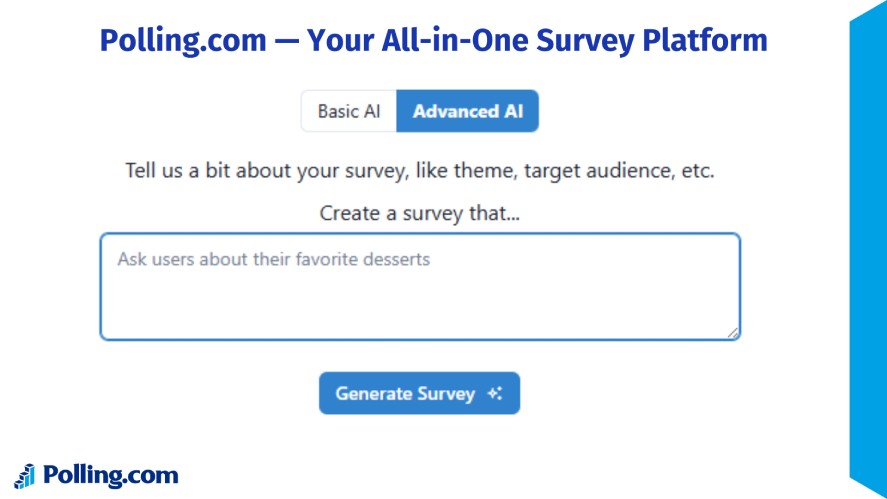
Compared to many traditional tools, Polling.com focuses on helping businesses move quickly from feedback collection to decision-making.
Common Challenges in Retail Consumer Surveys
Even well-designed retail surveys can face challenges that affect data quality and reliability.
Understanding these common obstacles helps retailers improve both response quality and overall survey effectiveness.
Survey Fatigue
One of the biggest challenges in retail feedback collection is survey fatigue.
Customers are often asked to complete multiple surveys across email, apps, and post-purchase touchpoints, which can make them less likely to participate.
Long or repetitive surveys can also lead to rushed answers, incomplete responses, or early drop-offs. As a result, the quality of the feedback may suffer.
To reduce survey fatigue, retailers should:
- Keep surveys short
- Focus only on the most important good survey questions examples
- Make the experience quick and easy to complete
Rotating questions or using targeted surveys for specific customer groups can also help maintain engagement.
Biased Responses
Another common issue is collecting biased responses, which can distort insights and lead to poor decision-making.
Bias can happen when questions are leading, unclear, or framed in a way that influences customer answers.
For example, asking “How much did you enjoy our excellent customer service?” may encourage more positive responses than a neutral question.
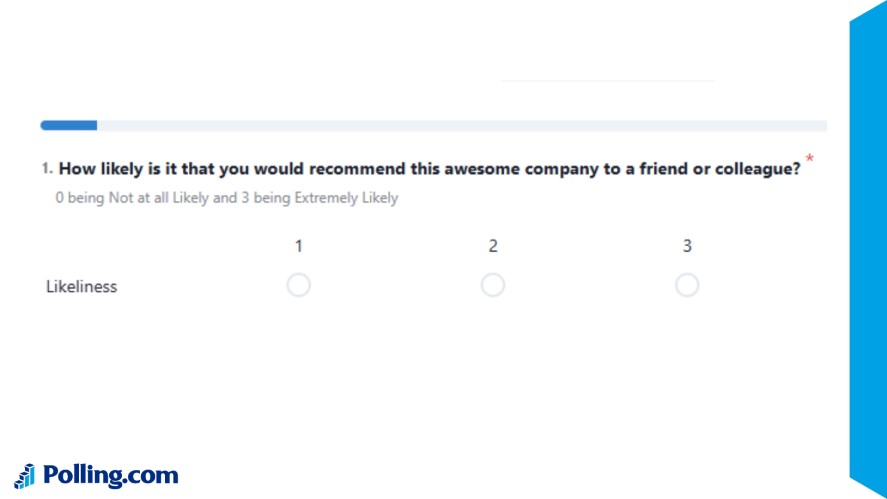
Response bias can also occur when only highly satisfied or highly dissatisfied customers choose to participate, creating an unbalanced view of customer sentiment.
To improve accuracy, retailers should focus on how to write good survey questions.
They also need to follow survey best practices by using neutral wording, balanced answer options, and simple language that encourages honest feedback.
Low Response Rates
Low participation is another challenge that can limit the value of retail survey insights.
If too few customers respond, it becomes harder to identify meaningful patterns or make confident decisions.
Low response rates can happen for several reasons, including:
- Poor survey timing
- Lack of incentives
- Unclear messaging
- Surveys that are not optimized for mobile devices
Retailers can improve response rates by sending surveys shortly after key interactions, personalizing invitations, and making surveys accessible across all devices.
Even small improvements in participation can lead to more reliable survey analytics and stronger business decisions.
Collecting Accurate Omnichannel Data
As shopping journeys become more connected, collecting accurate data across both in-store and online channels can be difficult.
Customers may interact with a brand through websites, mobile apps, physical stores, social media, and customer service teams.
This can happen all within a single purchase journey. And without a unified feedback strategy, important context can be lost.
Retailers need to connect survey data from multiple touchpoints to fully understand omnichannel behavior.
This includes:
- Comparing in-store experiences with online retail shopping
- Tracking channel-switching patterns
- Analyzing the complete post purchase experience
When businesses successfully combine feedback from every channel, they gain a much clearer view of customer behavior.
Future Trends in Retail Survey Insights
As the retail industry continues to evolve, the way businesses collect and analyze customer feedback is changing as well.
Here are the four future trends in retail survey insights businesses should follow.
AI and Predictive Consumer Analytics
Artificial intelligence is transforming how retailers interpret survey data.
Instead of simply reviewing past customer feedback, businesses can now use AI to identify hidden patterns, predict future behaviors, and uncover opportunities before problems arise.
For example, AI-powered survey analytics can detect early signs of customer dissatisfaction, forecast purchasing trends, or predict which shoppers may be at risk of churn.
These insights allow retailers to act proactively rather than reactively.
Predictive consumer analytics also helps businesses connect feedback with broader data analytics in retail industry strategies.
This combines survey responses with behavioral and sales data for more accurate decision-making.
Real-Time Feedback Collection
Retailers are increasingly moving toward real-time feedback collection to better understand customer experiences as they happen.
Instead of waiting days or weeks to review survey results, businesses can now capture immediate responses.
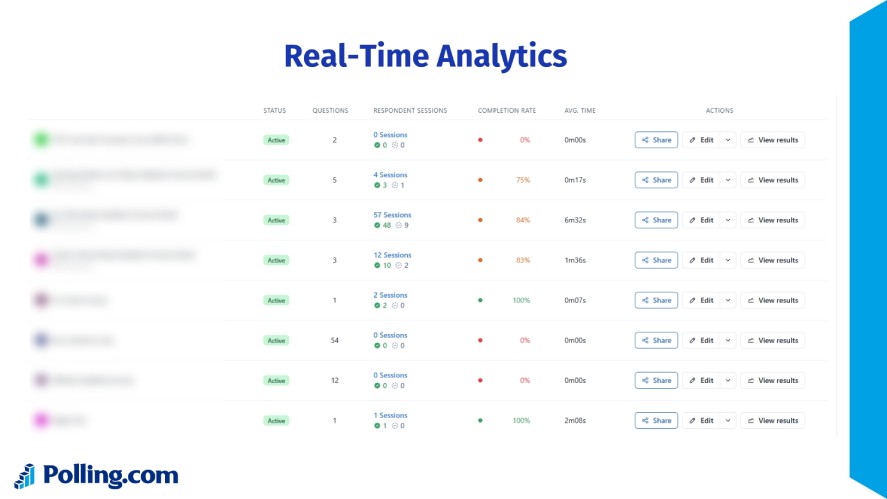
This allows retailers to identify issues faster, respond to customer concerns quickly, and continuously improve the post purchase experience.
Real-time insights also make it easier to test changes and measure customer reactions almost instantly.
Voice and Mobile Surveys
As mobile shopping continues to grow, survey experiences are becoming more mobile-first as well.
Retailers are optimizing surveys for smartphones to make feedback easier to complete on smaller screens.
Short-form surveys, tap-based responses, and embedded feedback prompts are helping improve response rates among busy shoppers.
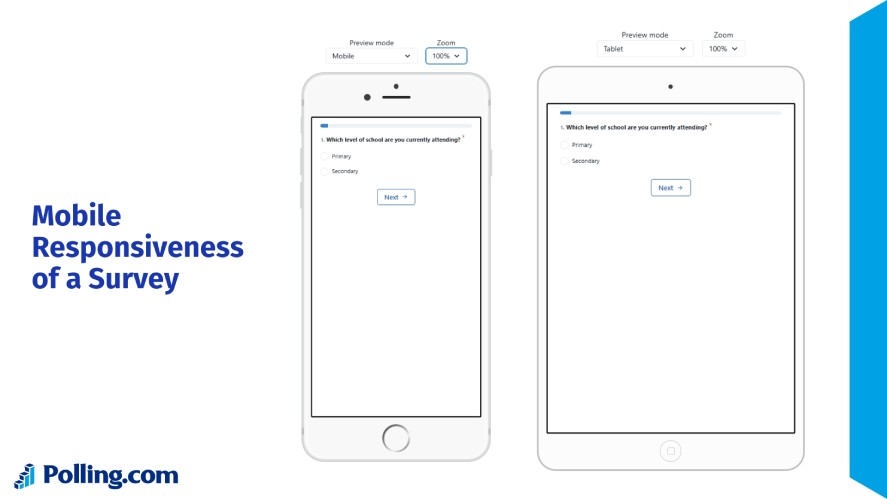
At the same time, voice surveys are beginning to emerge as a new way to collect customer feedback.
Through voice assistants or spoken survey prompts, businesses may soon gather insights in more natural and conversational ways.
These formats can make retail surveys more accessible and convenient, especially for customers who prefer quick, low-effort interactions.
Hyper-Personalized Retail Experiences
One of the most exciting future trends is the use of customer feedback to create highly personalized shopping experiences.
By combining survey responses with browsing behavior, purchase history, and demographic data, retailers can better understand individual customer preferences.
They then use them to deliver more relevant recommendations, promotions, and messaging.
This level of personalization can improve engagement, increase loyalty, and strengthen long-term customer relationships.
As personalization technology advances, consumer survey insights will play an even larger role in shaping tailored retail experiences across both digital and physical channels.
Conclusion
The drivers behind in-store and online purchases may differ, but both are essential parts of today’s retail journey.
Understanding the differences through retail survey insights helps businesses improve customer experiences, optimize omnichannel strategies, and make smarter decisions that drive sales and loyalty.
As customer expectations continue to evolve, retailers that consistently collect and act on feedback will be better positioned to stay competitive.
Want to stay ahead? Use Polling.com to gather meaningful insights, track changing behaviors, and turn customer feedback into continuous retail growth.