
Pulse Survey: The Complete Guide to Real-Time Feedback

Pulse Survey programs have become one of the most practical ways for organizations to understand what people are thinking, feeling, and experiencing in the moment. Instead of waiting for an annual review cycle, a quarterly engagement study, or a major customer complaint to reveal what is going wrong, a pulse survey gives teams a faster, lighter, and more flexible way to gather insights.
In today’s workplace and marketplace, speed matters. Employees want to be heard before frustration turns into disengagement. Customers expect companies to notice problems quickly and respond with care. Leaders need more than assumptions, hallway conversations, or outdated reports to make good decisions. That is where pulse surveys become valuable.
A well-designed pulse survey is short, focused, and repeated at regular intervals. It can help measure employee morale, customer satisfaction, team alignment, product experience, workplace culture, and many other areas where timely feedback matters. When used correctly, it becomes more than just another survey. It becomes a real-time feedback system that helps organizations listen, learn, and act.
This guide explains what pulse surveys are, how they work, why they matter, what questions to ask, and how to use the results to improve decision-making.
What Is a Pulse Survey?
Before building a feedback program, it is important to answer the common question: what is a pulse survey?
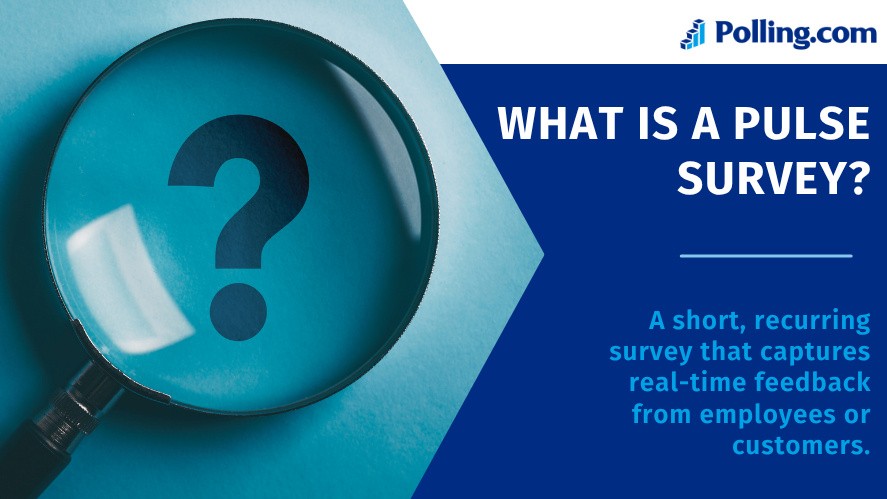
A pulse survey is a short, focused questionnaire designed to collect quick feedback from a specific audience. It is usually sent regularly, such as weekly, monthly, or quarterly, to track changes in sentiment, experience, engagement, or satisfaction over time.
Unlike long annual surveys, pulse surveys are intentionally brief. They often include 3 to 10 questions and can usually be completed in a few minutes. This makes them easier for employees, customers, or users to answer without feeling overwhelmed.
A simple pulse survey definition would be:
A pulse survey is a recurring, lightweight feedback method used to measure opinions, experiences, or attitudes in near real time.
The word “pulse” is used because the survey acts like a health check. Just as a pulse reveals important signals about the body, a pulse survey reveals important signals about an organization, team, product, or customer experience.
Why Pulse Survey Programs Matter
A pulse survey is valuable because it helps organizations stay connected to what is happening right now. Traditional surveys are useful, but they often capture feedback at only one point in time. By the time results are analyzed, conditions may have already changed.
Pulse surveys solve this problem by creating a continuous listening process.
| Pulse Survey Element | Purpose | SEO-Relevant Example |
|---|---|---|
| Short question format | Keeps the survey easy to complete | 3 to 10 focused pulse survey questions |
| Regular schedule | Tracks changes over time | Weekly, monthly, or quarterly employee pulse survey |
| Real-time feedback | Captures current opinions and experiences | Feedback after a policy change, support interaction, or product update |
| Targeted audience | Improves relevance of results | Employees, customers, teams, departments, or local groups |
| Survey response rate tracking | Measures participation and reliability | Monitoring how many people complete each pulse survey |
| Open-ended feedback | Adds context behind scores | “What is one thing we could improve?” |
| Pulse survey software | Simplifies collection and analysis | Dashboards, automated reminders, and trend reports |
| Action planning | Turns feedback into improvement | Updating processes, improving communication, or refining customer support |
For example, a company may run an annual engagement survey and discover that employees feel disconnected from leadership. That insight is helpful, but if the issue started eight months earlier, the company has already lost valuable time. A monthly employee pulse survey could reveal the trend much sooner and give leaders a chance to respond before disengagement spreads.
The same is true for customer experience. If a business waits until renewal season or public reviews to understand dissatisfaction, it may already be too late. Regular pulse surveys can identify friction earlier and improve customer feedback systems.
Organizations use pulse surveys because they help answer questions such as:
- Are employees feeling supported?
- Do customers feel satisfied after a recent interaction?
- Is a new company policy working?
- Are teams aligned with leadership priorities?
- Do people understand recent changes?
- Has morale improved after an intervention?
- Are customers experiencing repeated pain points?
These answers help leaders make informed decisions instead of relying only on assumptions.
Pulse Survey vs. Traditional Survey
A traditional survey is often longer, broader, and less frequent. It may cover many topics at once, such as compensation, management quality, workplace culture, tools, communication, career development, and overall satisfaction.
A pulse survey is shorter and more targeted. It usually focuses on one theme or a small group of related themes.
For example, a traditional employee engagement survey might include 60 questions and be sent once per year. A pulse survey might include five questions about workload, recognition, or communication and be sent every month.
Both formats have value. The difference is in purpose.
A traditional survey is useful for deep diagnosis. A pulse survey is useful for frequent monitoring.
A traditional survey gives a broad, in-depth assessment, while a pulse survey provides a quick check on current conditions. One gives a broad assessment, while the other helps track changes quickly.
Key Benefits of a Pulse Survey
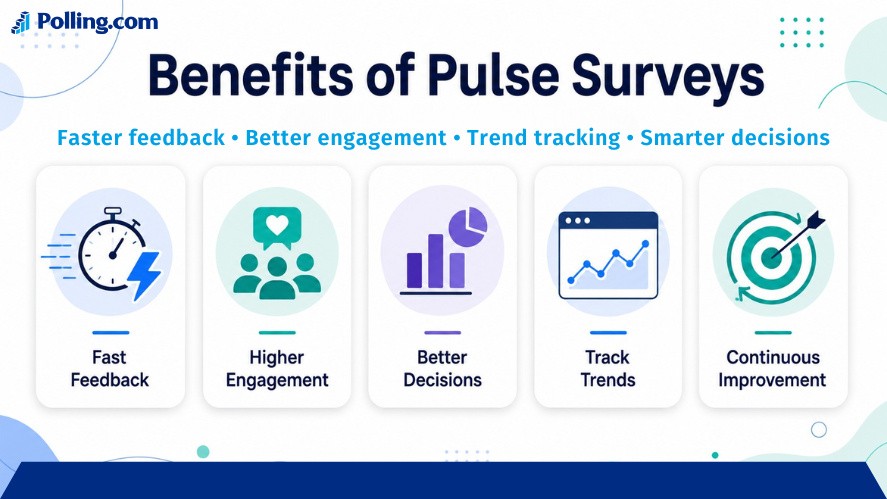
A strong pulse survey strategy can improve decision-making across many areas of an organization. The benefits are especially clear when surveys are short, consistent, and followed by action.
1. Faster Real-Time Feedback
The biggest advantage is real time feedback. Pulse surveys allow organizations to capture sentiment while experiences are still fresh.
For employees, this may mean giving feedback after a company-wide meeting, a restructuring announcement, a benefits change, or a new manager onboarding process. For customers, it may mean sharing thoughts after a support interaction, purchase, product trial, or service experience.
Fast feedback helps teams act quickly. It can prevent small problems from turning into larger issues.
2. Higher Engagement Through Shorter Questions
People are more likely to answer a short survey than a long one. Pulse surveys reduce the burden on respondents by asking only what matters most at that moment.
This can improve the survey response rate, especially when organizations explain why the survey matters and show that responses lead to action.
3. Better Trend Tracking
One survey result gives a snapshot. Repeated pulse surveys reveal trends.
For example, an employee engagement score of 7.5 out of 10 may seem acceptable. But if the score was 8.4 two months earlier, the trend deserves attention. Similarly, customer satisfaction may remain stable overall while a specific region or product line declines.
Trends help leaders see movement, not just isolated data points.
4. More Focused Feedback Collection
Pulse surveys support targeted feedback collection by focusing on one topic at a time. Instead of asking employees or customers to comment on everything, organizations can collect specific insights on areas such as onboarding, workload, communication, product usability, or service quality.
This focus makes the results easier to understand and act on.
5. Stronger Feedback Management
Collecting responses is only the first step. Strong feedback management requires organizing, analyzing, prioritizing, and acting on the information.
Pulse surveys support better feedback management because they produce smaller, more frequent data sets. This helps teams identify themes quickly and respond with practical improvements.
Employee Pulse Survey: Listening to Your Workforce
An employee pulse survey is one of the most common uses of pulse surveys. It helps organizations understand employee sentiment, engagement, morale, and workplace experience.

Employees are often closest to the daily realities of a business. They know where communication breaks down, where processes create frustration, where managers need support, and where culture feels strong or weak.
A good employee pulse survey helps leaders listen consistently.
Common employee pulse survey topics include:
- Job satisfaction
- Workload balance
- Manager support
- Team communication
- Recognition
- Psychological safety
- Career growth
- Workplace culture
- Trust in leadership
- Change management
- Burnout risk
- Remote or hybrid work experience
The goal is not simply to measure employees. The goal is to understand them.
When employees see that leadership asks for feedback and responds meaningfully, trust improves. When employees are asked for feedback but nothing changes, participation usually declines.
That is why action is essential.
Pulse Survey Questions That Actually Work
Choosing the right pulse survey questions is one of the most important parts of the process. Good questions are clear, specific, and easy to answer. Poor questions are vague, biased, or too broad.
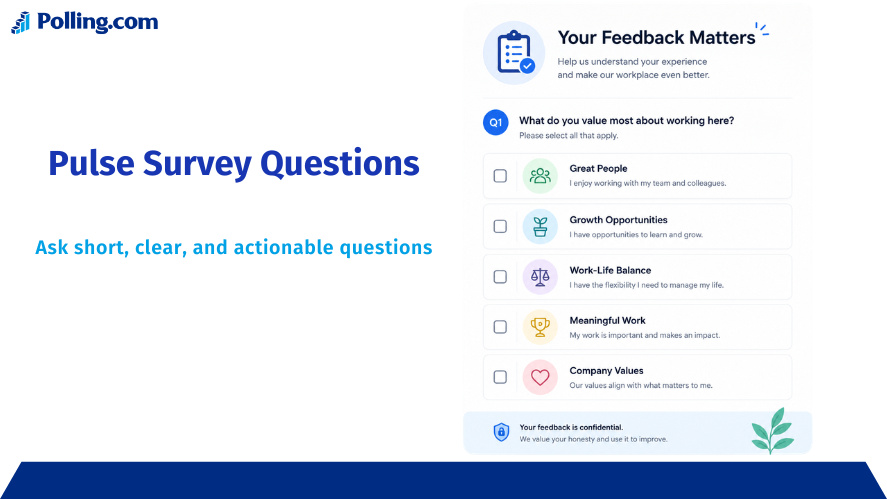
A strong pulse survey question should focus on one idea at a time.
For example, this question is too broad:
“How satisfied are you with your manager’s support, team environment, workload, and growth opportunities?”
This question asks about too many things at once. A respondent may be happy with their team but unhappy with their workload. The answer would be hard to interpret.
A better version would be:
“My current workload is manageable.”
This question is specific, measurable, and easy to track over time.
Examples of Employee Pulse Survey Questions
Here are practical employee-focused pulse survey questions:
- I feel supported by my manager.
- My workload is manageable.
- I understand how my work contributes to company goals.
- I receive useful feedback on my performance.
- I feel recognized for my contributions.
- I have access to the resources, systems, and support needed to perform my role effectively.
- Communication from leadership is clear.
- I feel comfortable sharing honest feedback.
- I see opportunities for growth in this organization.
- I would speak positively about this organization as an employer.
These questions can be rated using a scale, such as 1 to 5 or 1 to 10.
Examples of Customer Pulse Survey Questions
Pulse surveys are also useful for customer experience. Strong customer questions include:
- How satisfied are you with your recent experience?
- How easy was it to complete your task?
- Did our team resolve your issue?
- Would you encourage others to try our product or service?
- Was the information you received clear?
- Did the product meet your expectations?
- How satisfied were you with the response time of our support team?
- What was the main reason for your score?
- What is one thing we could do better?
These questions help companies gather customer feedback at the right moment.
Pulse Survey Examples for Different Use Cases
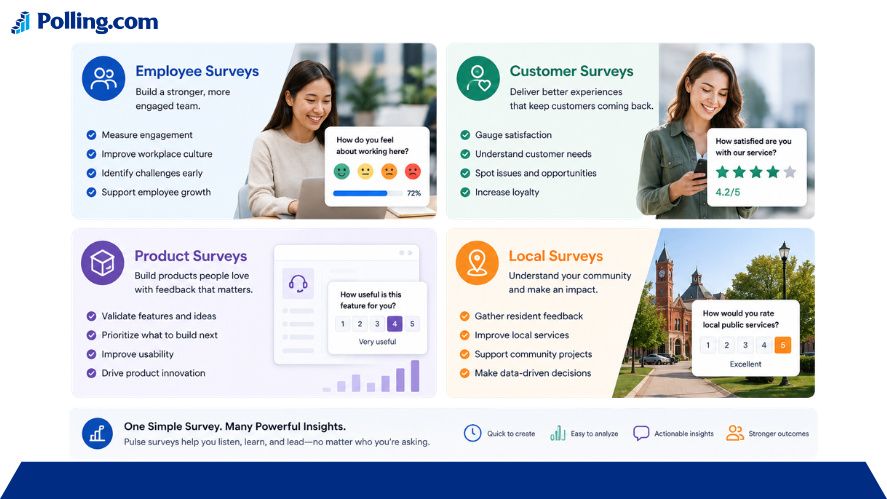
Looking at pulse survey examples can make it easier to design your own. The best pulse surveys are built around a clear goal.
Example 1: Employee Engagement Pulse Survey
Purpose: Understand overall employee engagement.
Questions:
- I feel motivated to do my best work.
- I feel connected to my team.
- I understand the company’s current priorities.
- I feel valued for my contributions.
- What is one thing that would improve your work experience?
This survey could be sent monthly or quarterly.
Example 2: Change Management Pulse Survey
Purpose: Measure how employees feel during organizational change.
Questions:
- I understand why this change is happening.
- I know how this change affects my role.
- Leadership has communicated clearly about this change.
- I feel supported during this transition.
- What question or concern do you still have?
This survey is useful after restructuring, system changes, leadership transitions, or policy updates.
Example 3: Customer Support Pulse Survey
Purpose: Measure customer satisfaction after a support interaction.
Questions:
- How satisfied were you with your support experience?
- Was your issue resolved?
- How easy was it to get help?
- How well did our support team handle your request in a courteous and professional manner?
- What could we have done better?
This type of pulse survey can be triggered automatically after a ticket is closed.
Example 4: Product Experience Pulse Survey
Purpose: Understand how users feel about a product or feature.
Questions:
- How easy was it to use this feature?
- Did this feature help you complete your task?
- What did you like most?
- What was confusing or difficult?
- What improvement would you suggest?
This is especially useful for software companies, ecommerce brands, and digital platforms.
Example 5: Local Pulse Survey
A local pulse survey can be used to understand feedback from a specific location, branch, department, community, or region.
For example, a retail company may send a local pulse survey to employees at one store after a new scheduling process is introduced. A city department may use a local pulse survey to understand resident satisfaction after a service change. A healthcare organization may use one to compare patient experience across clinics.
The benefit of a local pulse survey is that it captures context. Feedback from one location may not represent every location. Localized listening helps organizations solve problems where they actually occur.
How to Design a Pulse Survey Strategy
A pulse survey should not be random. Sending occasional questions without a clear purpose can create confusion and survey fatigue.
A strong strategy includes goals, timing, ownership, communication, analysis, and action.
Step 1: Define the Purpose
Start by asking: What do we need to learn?
A pulse survey might be designed to measure:
- Employee engagement
- Customer satisfaction
- Team morale
- Workplace culture
- Product experience
- Leadership communication
- Burnout risk
- Event feedback
- Onboarding experience
- Service quality
A clear purpose helps you choose better questions.
Step 2: Choose the Audience
Decide who should receive the survey.
For employee feedback, the audience may be all employees, a specific department, new hires, managers, remote workers, or employees affected by a change.
For customer feedback, the audience may be new customers, long-term customers, recent buyers, support users, trial users, or customers from a specific region.
The audience should match the purpose.
Step 3: Keep It Short
Pulse surveys work best when they are brief. Most should include no more than 5 to 10 questions. In many cases, 3 to 5 well-written questions are enough.
Short surveys respect people’s time and encourage completion.
Step 4: Use a Mix of Question Types
A useful pulse survey often includes both rating-scale questions and open-ended questions.
Rating-scale questions are easy to measure over time. Open-ended questions explain why people feel the way they do.
For example:
- Rating question: “I feel supported by my manager.”
- Open-ended question: “What is one action your manager could take to make your work experience easier or more productive?”
The rating gives a score. The comment gives context.
Step 5: Decide the Frequency
Pulse surveys may be sent weekly, biweekly, monthly, quarterly, or after specific events.
The right frequency depends on the topic.
For fast-changing issues, such as change management or crisis response, weekly surveys may be appropriate for a short period. For broader engagement tracking, monthly or quarterly surveys may be better.
Avoid over-surveying. Too many surveys can reduce participation and trust.
Step 6: Communicate the Purpose
Before sending a survey, explain why it matters.
Respondents are more willing to participate when the following points are clear:
- Why the survey is being sent
- How long it will take
- Whether responses are anonymous or confidential
- How the results will be used
- When they can expect follow-up
Clear communication improves trust and participation.
Step 7: Share Results
After collecting responses, share key themes. You do not need to share every data point, but people should know that their feedback was reviewed.
For employees, this might mean a summary from leadership. For customers, it might mean a product update, service improvement, or public note explaining what changed.
Sharing results closes the loop.
Step 8: Take Action
The most important step is action. A pulse survey without follow-up can damage trust.
Action does not always need to be large. Sometimes a simple process improvement, clearer communication, manager coaching, or product fix can make a meaningful difference.
The key is to show that feedback leads somewhere.
Choosing the Right Pulse Survey Software
Good pulse survey software makes it easier to send surveys, collect responses, analyze trends, and act on insights.
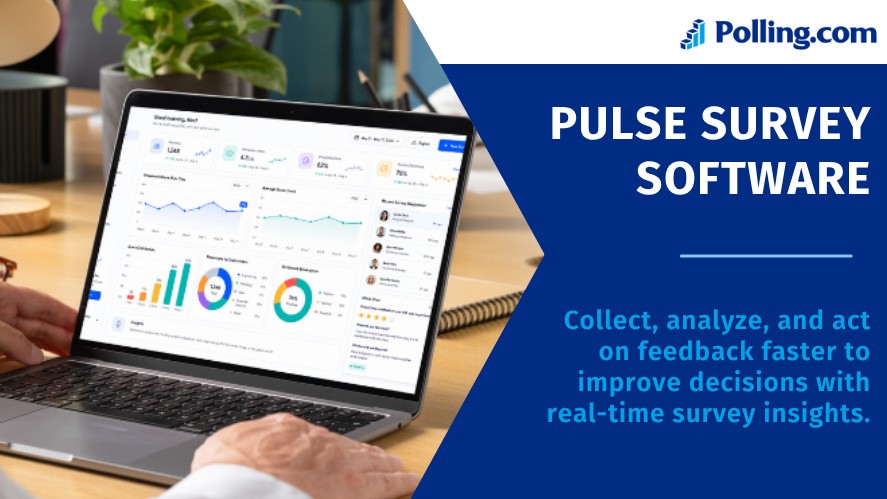
While it is possible to create pulse surveys manually, dedicated software can save time and improve consistency, especially for larger organizations.
Useful features may include:
- Custom survey templates
- Anonymous response options
- Automated scheduling
- Real-time dashboards
- Segmentation by team, location, role, or customer type
- Trend analysis
- Comment analysis
- Integrations with HR, CRM, or communication platforms
- Mobile-friendly design
- Exportable reports
- Action planning tools
The best pulse survey software depends on your organization’s goals. A small team may need a simple tool for monthly employee check-ins. A larger company may need advanced analytics, permissions, benchmarking, and integrations.
How to Choose a Pulse Survey Tool
A pulse survey tool should be easy for both administrators and respondents to use. If the tool is complicated, people may avoid it.
When evaluating options, consider these questions:
- Is it easy to create and send surveys?
- Can respondents complete surveys quickly on any device?
- Does it support anonymous or confidential feedback?
- Can results be segmented by department, location, or customer group?
- Does it show trends over time?
- Can it analyze open-ended comments?
- Does it integrate with existing systems?
- Does it help create action plans?
- Is the reporting clear for leaders and managers?
- Is the platform scalable as feedback needs grow?
A good tool should not only collect answers. It should help turn answers into decisions.
Online Surveys and Pulse Feedback
Many organizations use online surveys to run pulse feedback programs because they are fast, flexible, and easy to distribute.
Online surveys can be shared through email, SMS, internal chat tools, websites, apps, QR codes, or customer portals. This makes them useful for both employee and customer listening.
For remote and hybrid teams, online surveys are especially important. They help organizations hear from people who may not be physically present in an office. For digital businesses, they can capture feedback directly within the customer journey.
However, online surveys must be designed carefully. A poorly timed or overly long survey may be ignored. A short, relevant, and well-communicated pulse survey is more likely to receive thoughtful responses.
Improving Survey Response Rate
A strong survey response rate matters because higher participation usually gives a more reliable view of the audience. If only a small percentage of people respond, results may reflect only the loudest voices or the most motivated participants.
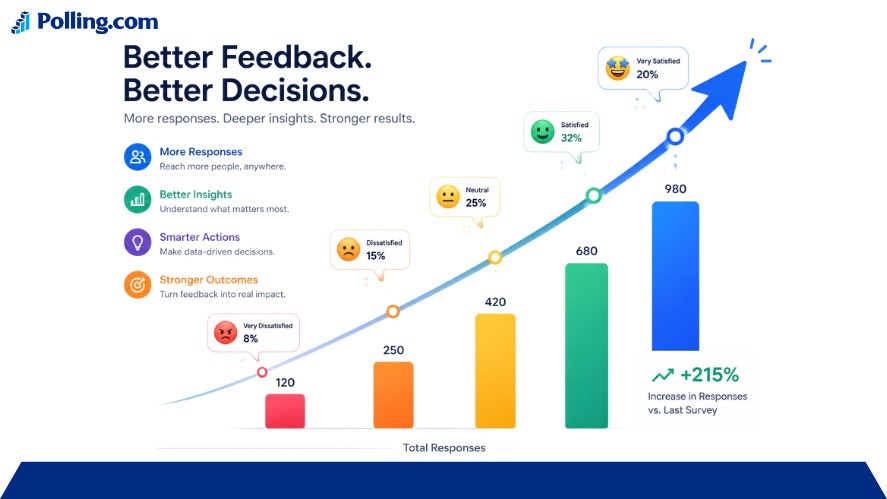
To improve response rates, keep surveys short and relevant. Explain the purpose clearly. Send surveys at appropriate times. Make them mobile-friendly. Avoid asking the same questions too often without showing action.
Trust is one of the biggest factors. People respond when they believe their feedback matters.
Here are practical ways to improve participation:
- Tell people how long the survey will take.
- Ask only necessary questions.
- Use simple language.
- Send reminders, but do not overwhelm people.
- Share what was learned from previous surveys.
- Take visible action based on feedback.
- Protect anonymity when promised.
- Avoid collecting unnecessary personal information.
- Make the survey easy to complete on mobile devices.
For employee surveys, managers can also encourage participation by explaining that honest feedback is welcome and valued. For customer surveys, timing is critical. Asking immediately after a relevant interaction often produces better responses.
Common Pulse Survey Mistakes to Avoid
A pulse survey can be powerful, but only when used well. Several mistakes can reduce its effectiveness.
Mistake 1: Asking Too Many Questions
Long pulse surveys defeat the purpose. If every pulse survey becomes a full-length questionnaire, people may stop responding.
Keep it short.
Mistake 2: Surveying Too Often
Frequent feedback is useful, but too much surveying can create fatigue. People may feel that they are constantly being asked for input without seeing results.
Choose a rhythm that matches your goals.
Mistake 3: Asking Vague Questions
Questions like “Are things going well?” may be easy to ask, but they are hard to act on. Be specific.
A better question would be: “I receive the information necessary to complete my work with confidence.”
Mistake 4: Ignoring Open-Ended Feedback
Scores are useful, but comments often reveal the real story. Open-ended responses can show patterns, frustrations, and ideas that numbers alone cannot explain.
Mistake 5: Failing to Act
The most damaging mistake is collecting feedback and doing nothing with it. People remember when they are asked for input and ignored.
Always close the loop.
Mistake 6: Overreacting to One Result
Pulse surveys should be used to spot patterns, not panic over every small change. One low score may matter, but trends are usually more important than isolated results.
Mistake 7: Breaking Anonymity Promises
If you promise anonymity, protect it. Trust is difficult to rebuild once lost.
How Pulse Surveys Support Real Time Feedback Culture
A pulse survey can help create a culture where feedback is normal, expected, and useful. But the survey itself is only one part of the process.
A real feedback culture includes listening, reflection, transparency, and action.
When leaders regularly ask for input, people become more comfortable sharing ideas and concerns. When leaders respond thoughtfully, people become more willing to participate. Over time, feedback becomes less like a formal event and more like a natural part of how the organization improves.
This culture is especially important in fast-moving environments. Teams need to know what is working and what is not. Customers need to feel heard. Leaders need signals before issues become expensive or difficult to fix.
Real time feedback does not mean reacting instantly to every comment. It means having a system that helps leaders notice important signals quickly and respond appropriately.
Pulse Survey Metrics to Track
To get value from pulse surveys, organizations should track both participation and sentiment.
Useful metrics include:
- Overall score
- Average rating by question
- Score changes over time
- Participation rate
- Comment volume
- Positive, neutral, and negative sentiment
- Key themes in open-ended responses
- Differences by team, location, role, or customer segment
- Action completion rate
- Follow-up improvement
For employee surveys, metrics may include engagement, manager support, workload, recognition, and trust.
For customer surveys, metrics may include satisfaction, ease of experience, likelihood to recommend, support quality, and product usability.
The right metrics depend on the survey goal.
Turning Pulse Survey Results Into Action
Collecting responses is only useful if the organization knows what to do next.
Start by looking for patterns. Do not focus only on extreme comments. Instead, identify recurring themes across scores and written responses.
Next, prioritize. Not every issue can be solved immediately. Choose the most important areas based on impact, urgency, and feasibility.
Then communicate. Tell participants what was learned and what will happen next. This does not require a long report. A simple message can be effective:
“Thank you for sharing your feedback. We heard that workload and communication are the two biggest concerns. Over the next month, managers will review project priorities with each team, and leadership will provide clearer updates every Friday.”
Finally, measure again. Future pulse surveys can show whether the action improved the situation.
This is how pulse surveys become a cycle:
Listen. Learn. Act. Measure. Improve.
Pulse Surveys for Customer Feedback
Pulse surveys are not only for employees. They are also valuable for customer feedback.
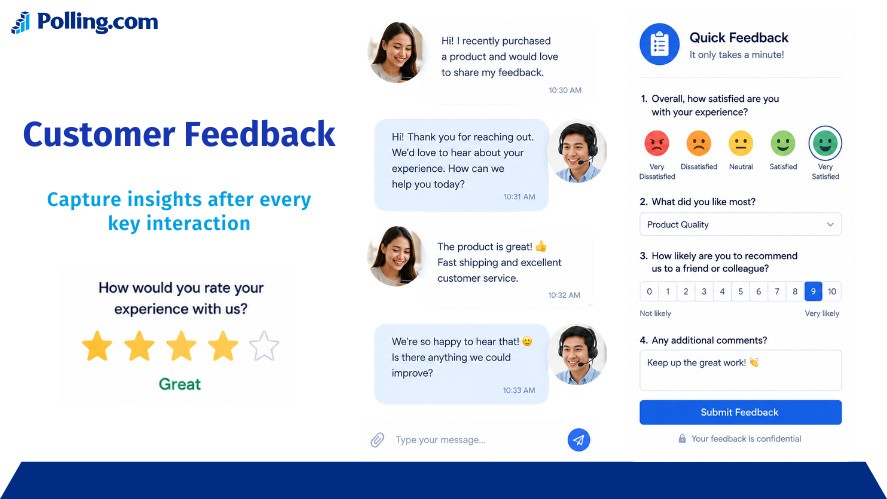
Businesses can use pulse surveys to understand how customers feel after specific interactions, such as:
- Making a purchase
- Contacting support
- Attending an event
- Using a new product feature
- Completing onboarding
- Canceling a service
- Renewing a subscription
- Visiting a store or location
Customer pulse surveys help companies identify friction in the customer journey. They can reveal confusing instructions, slow response times, product bugs, poor service experiences, or unmet expectations.
For example, a software company may discover that customers are satisfied with the product but frustrated with onboarding. A retailer may find that customers like the product selection but dislike checkout wait times. A service provider may learn that customers appreciate support quality but want faster updates.
These insights help businesses improve experience, retention, and loyalty.
Pulse Surveys for Employee Experience
Employee experience is shaped by many small moments: manager conversations, workload expectations, recognition, communication, tools, policies, and team relationships.
An employee pulse survey helps organizations understand these moments more clearly.
For example, after launching a hybrid work policy, a company may ask:
- I understand the expectations for hybrid work.
- I have the tools I need to work effectively from any location.
- Team communication is effective in our current work model.
- What would improve your hybrid work experience?
This feedback helps leaders refine policies based on actual employee experience.
Pulse surveys can also support managers. Team-level feedback can help managers understand where their teams need more clarity, support, or recognition. However, results should be used constructively, not as a punishment tool.
The purpose is improvement.
Best Practices for Pulse Survey Design
A successful pulse survey should feel simple to respondents and useful to decision-makers.
Use these best practices:
Keep Questions Clear
Avoid jargon, double meanings, and complicated wording. People should understand the question immediately.
Ask About Recent Experiences
Pulse surveys are strongest when they ask about current or recent experiences. This improves accuracy because people do not need to rely on distant memory.
Use Consistent Core Questions
Repeating some questions helps track trends over time. For example, asking “I feel supported by my manager” every month can show whether support is improving or declining.
Rotate Secondary Questions
You can rotate additional questions based on current priorities. One month may focus on communication, while another focuses on workload or recognition.
Include One Open-Ended Question
A single open-ended question can provide valuable context. For example:
“What is one thing we could improve?”
Respect Anonymity
When anonymity is offered, protect it. Avoid reporting results for groups so small that individuals could be identified.
Avoid Leading Questions
Do not write questions that push people toward a specific answer.
Avoid biased wording such as: How satisfied are you with our improved new process?
Ask: “How effective is the new process?”
Make Results Actionable
Every question should connect to a possible action. Do not ask about something you are unwilling or unable to address.
Building a Pulse Survey Calendar
A pulse survey calendar helps prevent random or excessive surveying.
Here is a simple example for employee feedback:
January: Engagement Baseline
Focus: Motivation, alignment, support, recognition.
March: Manager Support
Focus: Coaching, communication, feedback, workload.
May: Career Growth
Focus: Development, learning, promotion clarity.
July: Workplace Culture
Focus: Belonging, trust, collaboration, psychological safety.
September: Change Readiness
Focus: Communication, adaptability, leadership confidence.
November: Year-End Reflection
Focus: Progress, challenges, priorities for next year.
For customer feedback, a calendar may be based on journey stages:
- After purchase
- After onboarding
- After support ticket closure
- After product update
- Before renewal
- After cancellation
The goal is to ask the right people the right questions at the right time.
How to Analyze Pulse Survey Results
Analysis should be practical, not overly complicated.
Start with the overall scores. Which questions scored highest? Which scored lowest? Then compare results over time. Are things improving, declining, or staying the same?
Next, segment the results where appropriate. For employees, you might compare departments, locations, tenure groups, or work arrangements. For customers, you might compare product plans, regions, purchase types, or support channels.
Then review written comments. Look for common themes. A few emotional comments may stand out, but repeated themes are usually more important.
Finally, connect the findings to action. Ask:
- What is the main issue?
- Who is affected?
- What is likely causing it?
- What can we do now?
- What requires longer-term planning?
- How will we measure improvement?
Good analysis turns raw feedback into clear priorities.
Pulse Survey Templates
Here are several ready-to-use templates.
Employee Engagement Template
- I feel motivated in my current role.
- I understand how my work supports company goals.
- I feel recognized for my contributions.
- I have the resources I need to succeed.
- What is one thing that would improve your experience at work?
Manager Effectiveness Template
- My manager communicates expectations clearly.
- My manager provides helpful feedback.
- My manager supports my professional growth.
- I feel comfortable raising concerns with my manager.
- What type of support from your manager would help you succeed in your role?
Workload and Burnout Template
- My current workload is manageable.
- I can maintain a healthy work-life balance.
- I have enough time to complete my work effectively.
- I feel supported when priorities change.
- What is one thing that would reduce unnecessary stress?
Customer Experience Template
- How satisfied are you with your recent experience?
- How easy was it to complete your task?
- Did we meet your expectations?
- Would you consider choosing our product or service again in the future?
- What could we improve?
Product Feedback Template
- The product is easy to use.
- The product helps me accomplish my goal.
- The feature I used worked as expected.
- I would recommend this product to others.
- What would make the product more useful?
FAQs About Pulse Surveys
A pulse survey is a short, repeated survey used to quickly understand how people feel about a specific topic. It helps organizations collect timely feedback without overwhelming respondents.
The best frequency depends on the goal. Weekly surveys may work during rapid change, while monthly or quarterly surveys are better for ongoing engagement or satisfaction tracking. The key is to avoid survey fatigue.
Most pulse surveys should include 3 to 10 questions. Shorter is usually better, especially if surveys are sent regularly.
They can be anonymous, confidential, or identified depending on the purpose. For sensitive employee topics, anonymity often encourages more honest feedback. However, organizations must clearly explain how responses will be handled.
A good question is clear, focused, neutral, and actionable. It should ask about one topic at a time and produce information that can guide decisions.
Not always. Pulse surveys are excellent for frequent monitoring, while annual surveys can provide broader analysis. Many organizations use both.
Online surveys refer to the format or delivery method. Pulse surveys refer to the purpose and cadence. A pulse survey can be delivered as an online survey, but not every online survey is a pulse survey.
They often fail when they are too long, too frequent, poorly written, or not followed by action. Lack of trust is another major reason participation declines.
Final Thoughts: Why Pulse Surveys Are Worth It
A pulse survey is more than a quick questionnaire. It is a practical listening system that helps organizations understand people in real time.
Pulse surveys give employees a structured way to share concerns, ideas, and experiences. Customers can use them to explain what is working and what needs improvement. Leaders also gain timely insight that helps guide better decisions.
The most successful pulse survey programs are simple, consistent, and action-oriented. They ask focused questions, respect people’s time, analyze trends carefully, and close the loop with visible improvements.
When done well, pulse surveys help organizations move from occasional listening to continuous learning. That shift can improve engagement, customer loyalty, workplace culture, and overall performance.
The real value is not in the survey itself. The value is in what organizations do with the feedback.