
Onboarding Survey Questions That Improve Employee Success

Onboarding survey questions help you understand how new employees or customers feel during their first experience with your organization.
A good onboarding process makes people feel welcomed, prepared, and supported. For employees, it can affect how quickly they become productive and how long they stay. For customers, it can affect how soon they understand your product and whether they keep using it.
But even a strong onboarding process can have hidden problems. A new hire may not know who to ask for help. A customer may struggle with setup. A manager may think the process is clear, while the person going through it feels confused.
That is where onboarding surveys help. They give people a simple way to share honest feedback early. This feedback helps your team find problems before they become bigger issues.
In this guide, you’ll learn what onboarding surveys are, why they matter, when to send them, which questions to ask, what mistakes to avoid, and how to create one using Polling.com.
What Is an Onboarding Survey?
An onboarding survey is a structured questionnaire used to collect feedback from someone who has recently started a new journey with your organization. That person may be a new employee, a new customer, a new user, or even a new manager.

The goal is simple: understand whether the onboarding experience is clear, helpful, and effective.
An onboarding survey is usually sent during or shortly after onboarding. It helps organizations measure how well they are introducing people to important information, processes, tools, expectations, and support systems.
These surveys are commonly used by:
- HR teams
- People operations teams
- Managers
- Customer success teams
- Product teams
- Training teams
- Operations leaders
The feedback collected can be used to improve training materials, manager communication, product walkthroughs, documentation, welcome processes, and long-term engagement strategies.
It is also important to distinguish between an employee onboarding survey and a customer onboarding survey. Both collect feedback about a new experience, but they serve different audiences and measure different outcomes.
Employee Onboarding Survey
An employee onboarding survey is used after someone joins a company. It measures the new hire experience and helps HR teams understand whether employees feel welcomed, informed, prepared, and supported.
A strong new hire onboarding survey may evaluate:
- Pre-start communication
- First-day experience
- Training quality
- Manager support
- Access to equipment and systems
- Understanding of responsibilities
- Company culture
- Team connection
- Confidence in the role
The purpose of an employee onboarding survey is not just to ask, “Did you like onboarding?” It should give the organization a clearer view of which parts of onboarding support new hire success and which areas may be creating obstacles.
For example, a new employee may enjoy the company culture but struggle because their laptop was not ready on day one. Another may receive equipment on time but feel unsure about role expectations. These insights are valuable because they help companies improve the onboarding process before new hires become disengaged.
Well-designed employee onboarding surveys can help improve employee retention, early productivity, and manager effectiveness.
Customer Onboarding Survey
A customer onboarding survey is used after a customer signs up, purchases a product, activates an account, or completes an initial setup process.
The goal is to understand whether the customer found the onboarding experience easy, useful, and successful.
A customer onboarding survey may measure:
- Ease of account setup
- Clarity of instructions
- Product education
- Feature discovery
- Access to support
- Initial product value
- Confidence using the product
- Barriers to adoption
This type of survey is especially useful for software companies, subscription businesses, agencies, financial services, education platforms, and any organization that depends on long-term customer relationships.
If customers feel confused early, they may never fully adopt the product. But if they experience value quickly, they are more likely to stay, upgrade, and recommend the company to others.
Why Onboarding Surveys Matter
First impressions shape long-term relationships. Whether someone is joining a workplace or trying a product for the first time, the onboarding stage creates expectations.
If the process feels smooth, supportive, and organized, people are more likely to trust the organization. If the process feels confusing or impersonal, frustration can build quickly.
Onboarding surveys matter because they help teams catch problems early. It is much easier to fix a missing training document, unclear welcome email, delayed system access, or confusing product tutorial in the first few days than it is to repair months of disengagement.
They also help organizations improve continuously. Instead of relying on assumptions, teams can use real feedback to refine onboarding over time.
In short, onboarding surveys help improve satisfaction, retention, productivity, product adoption, and long-term success.
Benefits of Using an Onboarding Survey
An onboarding survey provides measurable business value beyond collecting feedback. It gives leaders practical insight into what people need during the earliest and most sensitive stage of the relationship.

For employees, that can mean better engagement and lower turnover. For customers, it can mean faster activation and stronger retention.
Improve First Impressions
Employees and customers form opinions quickly. A confusing first week at work or a difficult first product setup can create doubt.
An onboarding survey helps organizations understand whether expectations are being met. For example, new hires may expect their manager to provide clear goals, while customers may expect step-by-step setup support. When those expectations are not met, the survey reveals the gap.
Positive first experiences build trust. They show people that the organization is organized, responsive, and invested in their success.
Increase Employee Engagement
Employees who feel heard are more likely to feel connected. When a company asks for feedback early, it sends a message: your experience matters.
An employee onboarding survey can help managers identify concerns before they turn into disengagement. A new hire may be hesitant to speak up in a meeting, but they may feel comfortable sharing feedback in a survey.
For example, a survey response might reveal that an employee does not fully understand performance expectations. A manager can then schedule a conversation, clarify goals, and provide support.
This kind of early intervention can strengthen engagement and reduce uncertainty.
Reduce Early Employee Turnover
Early turnover is costly. When employees leave within the first few months, organizations lose time, money, knowledge, and momentum.
A new employee onboarding survey can help identify common frustrations that lead to early resignation. These may include poor training, unclear responsibilities, weak manager support, lack of belonging, or slow access to tools.
By tracking feedback across multiple new hires, HR teams can identify patterns. For instance, if several employees mention that training feels rushed, the organization can adjust the schedule or create better learning materials.
The goal is to improve onboarding before employees decide to leave.
Improve Customer Adoption
Customer onboarding is directly tied to product adoption. If users do not understand how to set up or use a product, they are unlikely to experience its full value.
A customer onboarding survey can identify confusing features, unclear instructions, or gaps in product education.
For example, a customer may sign up for a project management tool but struggle to invite team members. Another may complete setup but not understand which feature to use first.
Survey feedback can help product and customer success teams improve tutorials, documentation, onboarding emails, in-app guidance, and support resources.
The faster customers reach value, the more likely they are to keep using the product.
Improve Customer Retention
Retention often begins during onboarding. When customers achieve early success, they are more likely to stay.
An onboarding experience survey can reveal whether customers feel confident, supported, and satisfied after their initial interaction with a company or product.
If customers report that onboarding was difficult, teams can intervene quickly. Customer success managers can offer help, schedule walkthroughs, or provide additional training.
This helps prevent churn before it happens.
Make Better Business Decisions with Feedback
Onboarding surveys turn individual experiences into useful data. Over time, teams can analyze trends, compare departments, evaluate training quality, and benchmark performance.
For example, HR teams can compare onboarding feedback by location, role, department, or manager. Customer success teams can compare survey responses by plan type, industry, or product use case.
This helps organizations make data-driven decisions rather than relying on assumptions.
Useful insights may include:
- Which departments deliver the strongest onboarding experience
- Which steps create the most confusion
- Which managers need more onboarding support
- Which customer segments struggle with setup
- Which resources improve confidence
- Which changes improve satisfaction over time
When used correctly, onboarding survey data becomes a roadmap for continuous improvement.
When Should You Send an Onboarding Survey?
Feedback should be collected throughout the onboarding journey, not only at the end. Different moments reveal different insights.

A first-day survey may show whether someone felt welcomed. A 30-day survey may show whether they understand their responsibilities. A 90-day survey may reveal whether onboarding truly prepared them for long-term success.
The best approach is to match the survey timing to the milestone.
Before Onboarding
A pre-onboarding survey is sent before the first day or before the official setup process begins.
For employees, it can measure:
- Expectations
- Pre-arrival communication
- Documentation clarity
- Account setup
- Initial concerns
- Confidence before starting
For customers, it can measure:
- Setup expectations
- Primary goals
- Previous experience
- Anticipated challenges
- Preferred communication channels
This stage is helpful because it identifies concerns before onboarding begins.
First Day
A first-day survey measures the immediate welcome experience.
For employees, it can ask about:
- Orientation
- Preparedness
- Access to tools
- Welcome experience
- Initial confidence
- Manager communication
For customers, it may ask about:
- Account creation
- First login
- Setup instructions
- Product introduction
- Initial ease of use
This survey should be very short. The goal is to confirm that the basics went smoothly.
First Week
The first week is when people begin forming stronger opinions about the onboarding process.
For employees, a first-week survey can measure:
- Training quality
- Team support
- Workload
- Communication
- Role clarity
- Access to resources
For customers, it can measure:
- Product setup
- Feature discovery
- Support experience
- Tutorial usefulness
- Early product value
This is one of the best times to identify friction because the experience is still fresh.
30-Day Survey
A 30 day onboarding survey is one of the most useful checkpoints. By this stage, employees or customers have had enough time to interact with the organization, but issues are still early enough to fix.
For employees, it can measure:
- Confidence level
- Early productivity
- Understanding of responsibilities
- Manager support
- Remaining challenges
- Training gaps
For customers, it can measure:
- Product adoption
- Setup success
- Time-to-value
- Support quality
- Feature usage
Good 30 day onboarding survey questions should focus on practical progress and remaining obstacles.
60-Day Survey
A 60-day survey gives a deeper view of integration and ongoing support.
For employees, it can measure:
- Integration into the team
- Continued manager support
- Training effectiveness
- Role confidence
- Knowledge gaps
- Workload balance
For customers, it can measure:
- Product usage consistency
- Feature adoption
- Support needs
- Documentation quality
- Continued value
By this point, patterns become clearer. If someone is still confused after 60 days, the onboarding program may need adjustment.
90-Day Survey
A 90-day survey often captures the overall success of onboarding.
For employees, it may measure:
- Overall onboarding satisfaction
- Readiness for independent work
- Manager support
- Cultural connection
- Long-term improvement suggestions
For customers, it may measure:
- Satisfaction with onboarding
- Product confidence
- Feature adoption
- Likelihood to continue
- Remaining barriers
This is a strong moment to ask broader questions because the person has enough experience to reflect meaningfully.
After Onboarding Is Complete
A post onboarding survey is sent when the formal onboarding period ends. It asks people to reflect on the entire experience.
It can measure:
- Overall experience
- Biggest strengths
- Biggest frustrations
- Most helpful resources
- Missing information
- Suggestions for future improvement
This type of survey is valuable because it gives teams a complete picture of the onboarding journey.
| Survey Stage | Best Time to Send | What to Measure |
|---|---|---|
| Before onboarding | Before first day or setup | Expectations, concerns, documentation, account readiness |
| First day | End of day one | Welcome experience, access, orientation, initial confidence |
| First week | After 5–7 days | Training, communication, workload, team or product support |
| 30-day survey | Around day 30 | Confidence, productivity, adoption, remaining challenges |
| 60-day survey | Around day 60 | Integration, support, knowledge gaps, product usage |
| 90-day survey | Around day 90 | Overall satisfaction, readiness, long-term suggestions |
| After onboarding | At completion | Full experience, strengths, frustrations, improvements |
Essential Questions to Include in an Onboarding Survey
Effective onboarding surveys combine rating-scale, multiple-choice, and open-ended questions. The best surveys are specific enough to produce useful answers but simple enough that people will complete them.

When deciding which survey questions to include, think about what you actually need to improve. Avoid asking questions just because they sound interesting. Every question should connect to a decision or action.
Below are practical examples for employees and customers.
Employee Onboarding Survey Questions
These employee onboarding survey questions can be organized by theme. They are useful for HR teams, managers, and people operations leaders who want to improve the new hire experience.
Preparation
- Were you given enough information before your first day?
- Was the hiring and onboarding process organized?
- Did you know what to expect before starting your role?
- Were your first-day instructions clear?
Training
- Was the training helpful for understanding your role?
- Was the information presented in a way that was easy to understand?
- Did the training cover the tools, processes, and responsibilities you need?
- What training topic would you like more support with?
Equipment and Resources
- Did you receive everything you needed to begin your work?
- Were your systems, accounts, and tools easy to access?
- Did any technical issues delay your ability to get started?
Manager Support
- Did your manager answer your questions clearly?
- Were expectations for your role clearly explained?
- Are the expectations for performing well in your role clear to you?
- How supported do you feel by your manager so far?
Company Culture
- Did you feel welcomed by your team?
- Do you understand the company’s values and how they relate to your work?
- Do you feel comfortable asking questions?
Open Feedback
- What was your favorite part of the onboarding experience?
- What should we improve for future new hires?
These are strong new hire onboarding survey questions because they cover the full employee journey, from preparation to cultural connection.
They also work well as onboarding survey questions for new hires because they are clear, practical, and easy to answer.
Customer Onboarding Survey Questions
Customer onboarding questions should focus on setup, ease of use, support, education, and early value.
Setup Experience
- How easy was it to create your account or begin using the product?
- Did you receive enough guidance during setup?
- Was any part of the setup process confusing?
Ease of Use
- How easy was it to navigate the product for the first time?
- Were the next steps clear after signup or purchase?
- Did you encounter any obstacles while getting started?
Product Education
- Were tutorials, guides, or onboarding emails helpful?
- Did you understand which features to use first?
- What additional resources would have made onboarding easier?
Customer Support
- Did you receive timely support when you needed help?
- How satisfied were you with the support experience?
- Was your issue resolved clearly and completely?
Feature Discovery
- Which feature was most helpful during onboarding?
- Are there any features you expected but could not find?
- Do you feel confident using the product independently?
Overall Satisfaction
- How satisfied are you with the onboarding experience overall?
- How likely are you to continue using the product?
- How likely are you to recommend the product to others?
Suggestions for Improvement
- What was the most frustrating part of onboarding?
- What one thing would improve the onboarding experience?
These questions help customer success and product teams understand what customers need in order to reach value faster.
Best Practices for Creating an Effective Onboarding Survey
A good onboarding feedback survey is concise, relevant, and designed to encourage honest responses. The purpose is to focus on the questions that produce the most useful and actionable feedback. The goal is to ask the right questions at the right moment.
Keep It Short
Most onboarding surveys should include 5–15 questions and take less than five minutes to complete.
Long surveys often create survey fatigue. When people see too many questions, they may abandon the survey or provide rushed answers.
For early onboarding stages, keep the survey especially short. A first-day check-in may only need three to five questions. A 90-day survey can be slightly longer because the person has more experience to reflect on.
Ask One Question at a Time
Avoid double-barreled questions. These are questions that ask about two things at once.
For example, avoid:
“Did the training materials explain your responsibilities effectively, and did your manager provide the support you needed?”
This is difficult to answer because training may have been clear while manager support was weak.
A better version would be:
“Was your training clear?”
Then ask separately:
“Was your manager helpful during onboarding?”
Simple, focused questions produce cleaner data.
Mix Quantitative and Qualitative Questions
The best onboarding surveys combine measurable answers with written feedback.
Use rating scales when you want to track trends. For example:
“How confident do you feel in your role?”
Use multiple choice when you want to categorize responses. For example:
“Which onboarding resource was most helpful?”
Use open-ended questions when you want deeper insight. For example:
“Which part of the onboarding process would you most like to see improved?”
Likert scales are also useful for measuring agreement. For example:
“I understand what is expected of me in my role.”
Respondents can choose from strongly disagree to strongly agree.
Using different formats helps balance speed and depth.
Personalize with Survey Logic
Survey logic helps create a more relevant experience. Instead of showing every question to every person, the survey changes based on previous answers.
This can include:
- Skip logic
- Branching
- Role-specific questions
- Customer segmentation
- Department-based questions
- Plan-based questions
For example, if a customer says they have not completed setup, the survey can ask what blocked them. If they say setup was complete, the survey can ask about feature adoption.
Personalization makes surveys feel more thoughtful and improves response quality.
Choose the Right Survey Timing
Timing affects accuracy. If you send a survey too early, the person may not have enough experience to answer. If you send it too late, they may forget important details.
Match the timing to the milestone.
For example, ask about first-day preparedness on day one. Ask about role clarity after the first week. Ask about overall onboarding satisfaction after 60 or 90 days.
Good timing makes feedback more useful.
Close the Feedback Loop
Collecting feedback is only the first step. The real value comes from action.
Review responses regularly, identify patterns, and make improvements. Then let employees or customers know what changed because of their feedback.
For example:
“We heard that new hires wanted more role-specific training, so we added a department onboarding checklist.”
Or:
“Customers told us setup instructions were unclear, so we redesigned our onboarding guide.”
Closing the feedback loop builds trust and increases future participation.
Common Mistakes to Avoid
Even well-intentioned onboarding surveys can fail if they are poorly designed or ignored. Here are the most common mistakes to avoid.
Asking Too Many Questions
Too many questions can lower completion rates and reduce answer quality.
Instead of asking 40 questions, focus on the most important 10. Ask yourself: “What will we do with this answer?”
If a question will not lead to action, remove it.
Waiting Too Long to Collect Feedback
Waiting until onboarding is completely finished can create memory bias. People may forget specific problems or adjust their answers based on later experiences.
Early feedback helps teams detect issues quickly.
For example, if a new employee did not have access to key systems on day one, that should be fixed immediately. Waiting until day 90 to discover that problem is too late.
Ignoring Survey Results
Ignoring feedback can damage trust. If employees or customers take time to share their experience but never see any improvement, they may stop participating.
A survey should never be treated as a formality. Assign ownership, review results, and create action steps.
Asking Leading Questions
Leading questions push people toward a specific answer.
Biased example:
“How helpful was our excellent onboarding program?”
Neutral example:
“How helpful was the onboarding program?”
Biased example:
“Do you agree that setup was easy?”
Neutral example:
“How easy or difficult was setup?”
Neutral wording produces more honest feedback.
Measuring Satisfaction Only
Satisfaction matters, but it is not the only thing to measure.
An onboarding satisfaction survey can tell you whether someone liked the experience, but it may not tell you whether they are prepared to succeed.
Measure additional factors such as:
- Confidence
- Preparedness
- Productivity
- Engagement
- Time-to-value
- Manager effectiveness
- Product adoption
- Support quality
A complete onboarding survey measures both feelings and outcomes.
How to Create an Onboarding Survey with Polling.com
Polling.com makes it easy to create an onboarding survey using ready-made templates and simple customization tools. You can build a survey for new employees, customers, or users without starting from scratch.
Step 1: Log In and Open the Surveys Tab
Start by logging in to your Polling.com account or signing up for a new one. Once you are inside the dashboard, click Surveys from the left-hand menu.
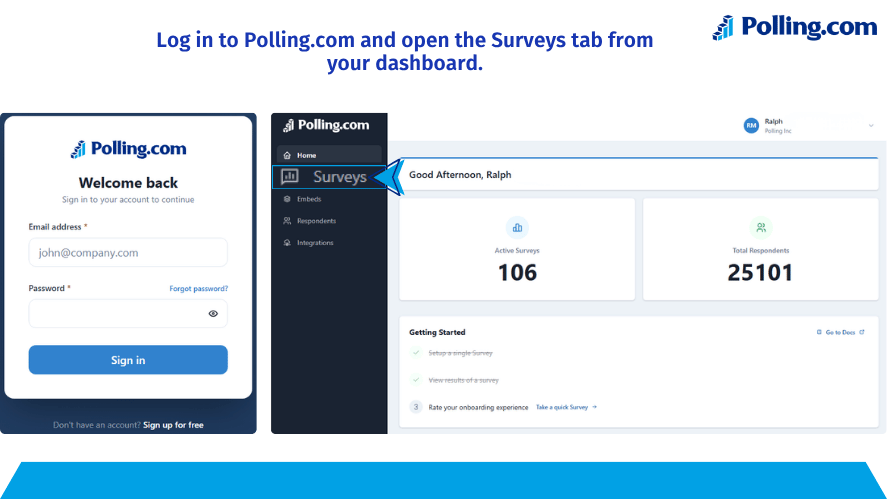
This is where you can create a new survey, manage existing surveys, and access survey templates.
Step 2: Click Create Survey
From the Surveys page, click Create Survey. Polling.com will give you different ways to start, including creating a blank survey, using AI, choosing a template, or cloning an existing survey.
For onboarding, the easiest option is to start with a template.
Step 3: Choose an Onboarding Template
Select Template, then search for “Onboarding.”
You can choose a template such as New Employee Onboarding Feedback or New Customer Onboarding Feedback Survey, depending on your audience.
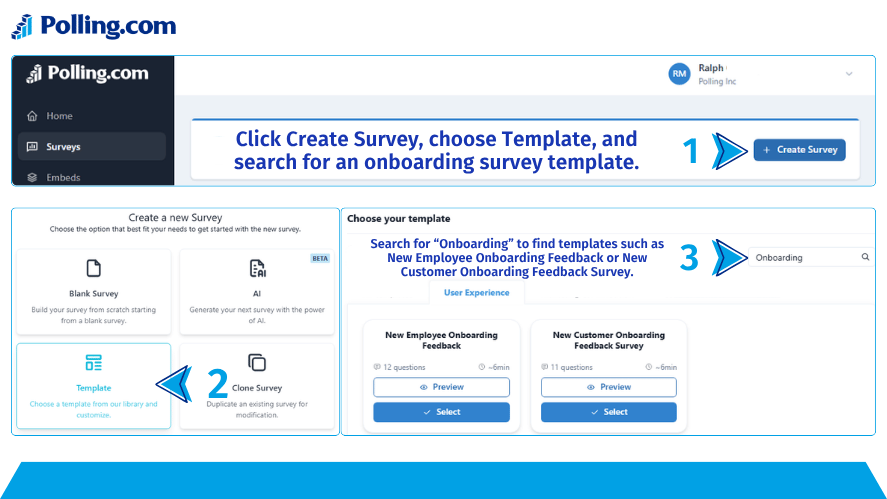
Starting with a template saves time because the basic structure and sample questions are already included. You can still customize the survey to match your company, team, product, or onboarding process.
Step 4: Add Survey Details and Customize the Questions
After selecting a template, add the survey name and internal description.
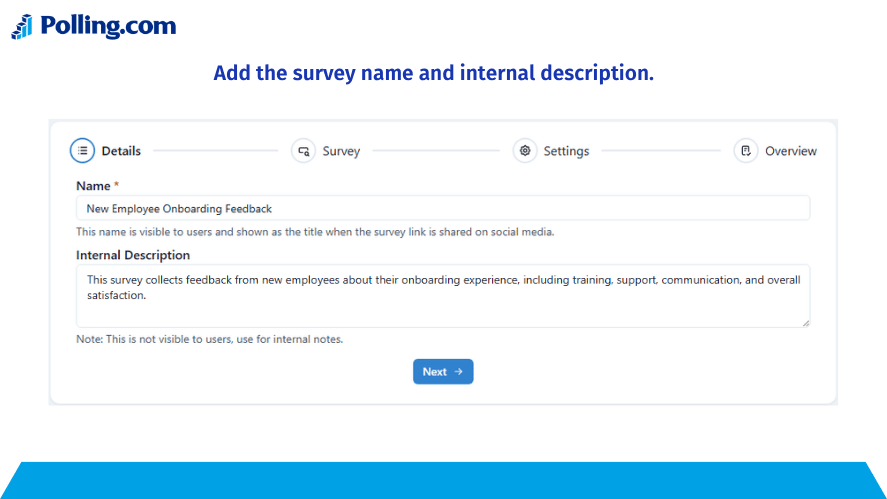
For example, you can name the survey:
New Employee Onboarding Feedback
For the internal description, you can use:
This survey collects feedback from new employees about their onboarding experience, including training, support, communication, and overall satisfaction.
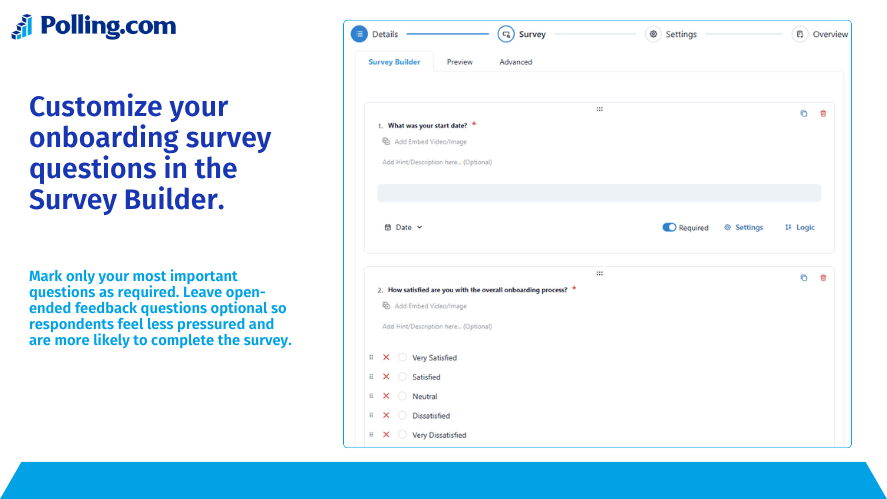
Next, open the Survey Builder. Here, you can edit the questions, add answer choices, mark important questions as required, and include open-ended feedback fields.
Keep the survey short and focused. Mark only the most important questions as required so respondents can complete the survey quickly.
Step 5: Adjust Settings and Launch the Survey
Before publishing, review the survey settings.
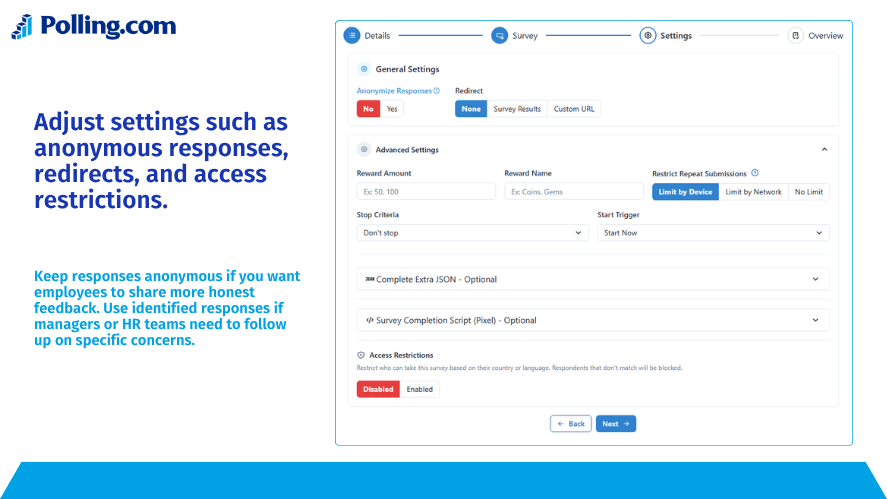
You can choose whether responses should be anonymous, set redirect options, limit repeat submissions, and manage access restrictions.
For employee onboarding surveys, anonymous responses may encourage more honest feedback. For customer onboarding surveys, identified responses may be helpful when your team needs to follow up on specific issues.
Once everything looks correct, go to the Overview tab and click Save & Start Now to launch your onboarding survey.
Why Choose Polling.com?
Polling.com is recommended for organizations that want a balance of ease of use, customization, and actionable reporting.
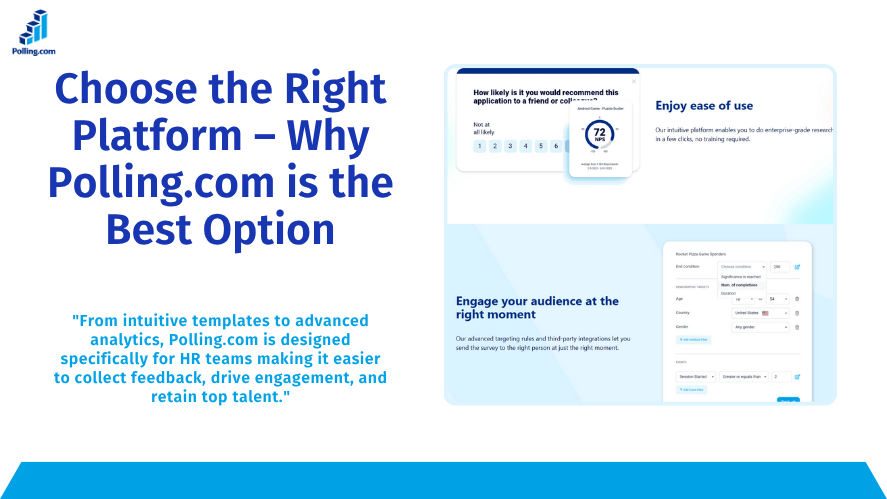
Key advantages may include:
- Intuitive drag-and-drop survey builder
- AI-assisted survey creation, where available
- Branching and conditional logic
- Real-time analytics and reporting
- Collaboration features
- Custom branding and white labeling
- Integrations with business tools
- Secure data collection
- Scalable plans for businesses of different sizes
There are other survey tools available, including SurveyMonkey, Typeform, Google Forms, and Jotform. These can be useful depending on your needs. However, Polling.com is a strong recommended option for teams that want to create professional onboarding surveys, personalize the experience, and turn feedback into practical improvements.
Metrics to Track After Sending an Onboarding Survey
Collecting responses is important, but measuring outcomes is just as important. Metrics help you understand whether onboarding improvements are actually working.
The right metrics depend on whether you are measuring employee onboarding or customer onboarding.
Employee Metrics
Survey Completion Rate
This measures how many people complete the survey. A low completion rate may mean the survey is too long, poorly timed, or not clearly communicated.
Employee Satisfaction Score
This measures how satisfied new hires are with the onboarding experience. It helps HR teams track overall sentiment.
Engagement Score
This measures how connected and motivated employees feel. Engagement can be influenced by manager support, role clarity, team connection, and company culture.
Time-to-Productivity
This measures how long it takes a new employee to become productive in their role. Onboarding survey feedback can reveal what speeds up or delays productivity.
Early Turnover Rate
This tracks how many employees leave within the first few months. If early turnover is high, onboarding may need improvement.
Training Completion
This measures whether employees complete required training. Survey feedback can reveal whether the training is helpful, too long, too short, or difficult to understand.
Manager Effectiveness
This measures how well managers support new hires. Questions about communication, expectations, and availability can reveal whether managers need better onboarding resources.
Customer Metrics
Activation Rate
Activation rate measures how many customers complete a key onboarding action, such as creating a profile, inviting a team member, launching a project, or using a core feature.
Feature Adoption
Feature adoption measures whether customers are using important product features. Survey feedback can reveal why some features are ignored or misunderstood.
Customer Satisfaction Score
Customer Satisfaction, or CSAT, measures how satisfied customers are with the onboarding experience or product.
Net Promoter Score
Net Promoter Score, or NPS, measures how likely customers are to recommend your product or company.
Customer Effort Score
Customer Effort Score, or CES, measures how easy or difficult it was for customers to complete a task, such as setup or first use.
Product Usage
Product usage shows how often and how deeply customers use the product. If usage is low after onboarding, customers may need better guidance.
Retention Rate
Retention rate shows the percentage of customers who keep using your product across a specific period. Strong onboarding can improve retention by helping customers succeed early.
Churn Rate
Churn rate measures how many customers leave. Survey feedback can help identify onboarding issues that contribute to churn.
Together, these metrics help organizations connect onboarding feedback to business outcomes.
Frequently Asked Questions About Onboarding Surveys
An onboarding survey is a short questionnaire sent to new employees or customers. It asks about their first experience, training, support, and overall satisfaction.
An onboarding survey helps you find problems early. It shows where people feel confused, unsupported, or unprepared, so you can improve the process quickly.
Send onboarding surveys at key stages, such as the first day, first week, 30 days, 60 days, and 90 days. Each stage gives different feedback.
Most onboarding surveys should include 5 to 15 questions. Keep it short enough to complete in under five minutes.
An employee onboarding survey focuses on training, manager support, role clarity, and company culture. A customer onboarding survey focuses on setup, product use, support, and early value.
Yes, if you want more honest feedback. For employee surveys, anonymity can help people feel safer sharing concerns. For customer surveys, identified responses may help with follow-up.
Polling.com is a strong choice for creating customizable onboarding surveys. Other options include SurveyMonkey, Typeform, Google Forms, and Jotform.
Review onboarding survey results monthly or quarterly. Look for common issues, trends, and feedback that can help improve the onboarding experience.
Conclusion
Onboarding surveys help you understand what employees and customers need at the start of their journey.
For employees, the right feedback can improve training, role clarity, manager support, engagement, and retention. For customers, it can improve setup, product adoption, satisfaction, and loyalty.
But collecting feedback is only the first step. The real value comes from using that feedback to make changes.
Review survey results often. Look for common problems. Update your onboarding process based on what people share.
When you ask the right questions at the right time, you can create a better experience for every new employee and customer.
Start building your onboarding survey with Polling.com to collect useful feedback and create stronger long-term relationships.