
AI Prompts for Survey Creation: 25 Examples for Better Surveys

Artificial intelligence is changing the way surveys are created.
What once required hours of brainstorming, writing, and editing can now be accomplished in minutes using an AI survey generator or AI survey builder.
From customer feedback collection to market research and employee engagement studies, AI is helping organizations create surveys faster and more efficiently than ever before.
However, the quality of AI-generated surveys depends heavily on the quality of the prompt.
Today, businesses, researchers, and marketers use AI prompts to generate customer feedback surveys, market research surveys, employee questionnaires, and many other forms of data collection.
With the right prompt, AI can accelerate questionnaire generation, improve survey structure, and support better research outcomes.
In this guide, you’ll learn what AI prompts are, how they work, how to write effective prompts, and discover 25 ready-to-use examples that can help you create better surveys in less time.
What Are AI Prompts for Survey Creation?
AI prompts are the instructions you give an AI tool to generate survey questions, survey structures, or complete questionnaires.
Think of them as the blueprint that guides the AI toward producing the type of survey you need.
Understanding AI-powered Survey Generation
AI-powered survey generation uses natural language processing to transform written instructions into survey content.
Instead of manually writing every question, users provide a prompt describing the survey’s purpose, audience, and goals.
For example, a marketer might ask an AI tool to create a customer satisfaction survey for recent buyers, while an HR manager could use AI prompts for employee engagement surveys to generate workplace feedback questions.
The AI then produces a draft survey based on those instructions.
This approach significantly reduces the time required for survey creation while helping users quickly explore different survey formats and question styles.
How AI Turns Instructions Into Survey Questions
When you provide a prompt, the AI analyzes the information and identifies key elements such as:
- Survey objective
- Target audience
- Desired question types
- Tone and wording preferences
- Response formats
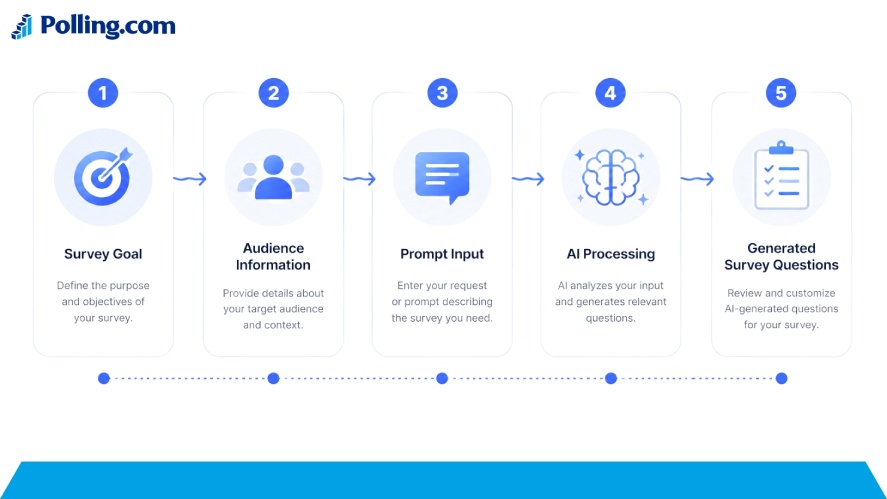
Using this information, the AI generates relevant survey questions, organizes them into a logical flow, and may even suggest survey logic and branching where appropriate.
For example, a prompt like the one below gives the AI enough context to generate a focused and relevant survey.
"Create a customer feedback survey for first-time online shoppers with 10 questions, including rating scales and open-ended feedback questions."
The more specific the prompt, the better the resulting survey tends to be.
Benefits of Using AI Prompts For Survey Creation
Using AI prompts to create survey questions offers several advantages over traditional survey development methods.
First, AI enables faster survey development.
What previously took hours can often be completed in minutes, allowing teams to launch surveys more quickly and respond to business needs faster.
Second, AI can help reduce bias by suggesting neutral wording and balanced question structures.
While human review is still important, AI can serve as a useful starting point for objective survey design.
Third, AI often improves question clarity.
Well-trained models can simplify complex wording and generate questions that are easier for respondents to understand and answer.
Finally, AI can contribute to better respondent engagement.
By generating clearer questions, logical survey flows, and even conversational surveys, AI helps create experiences that are easier and more enjoyable for participants to complete.
Why Use AI Prompts for Survey Creation?
The real power of AI survey tools comes from the prompts behind them. Below are the benefits of using AI prompts for survey creation.
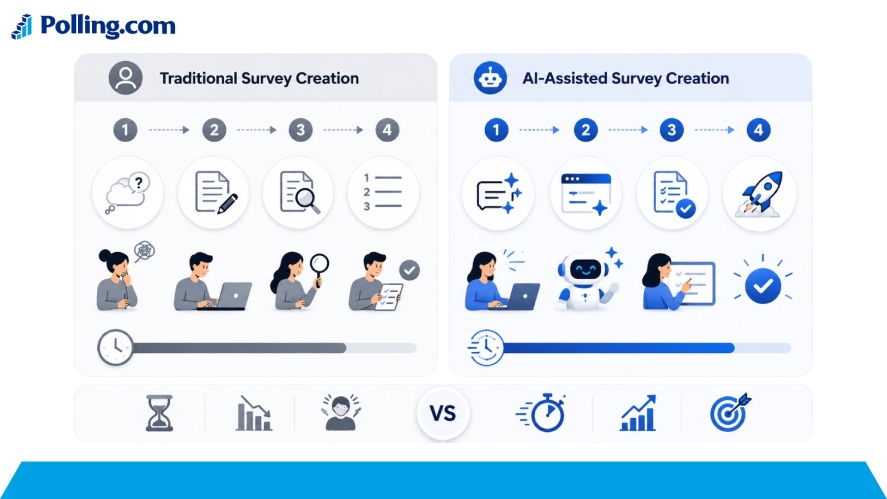
Save Hours of Manual Survey Writing
Traditionally, creating a survey requires brainstorming objectives, writing questions, reviewing wording, and organizing the questionnaire flow.
This process can take hours or even days for larger projects.
With effective survey creation prompts for ChatGPT and other AI tools, much of that work can be completed automatically.
Instead of starting from a blank page, users can generate a complete survey draft in minutes and then refine it as needed.
This speed allows teams to launch surveys faster and spend more time analyzing results rather than creating questionnaires.
Generate Questions For Multiple Survey Types
One of the biggest advantages of AI is its versatility. The same AI tool can generate questions for many different use cases simply by changing the prompt.
For example, AI can create:
- Customer feedback survey questions
- Market research survey questionnaires
- Employee survey questions
- NPS survey questions
- Product feedback surveys
- Event feedback surveys
- Training and education surveys
This flexibility makes AI especially valuable for organizations that regularly conduct different types of research and feedback collection.
Improve Survey Consistency and Structure
Consistency is essential for collecting reliable data. Poorly structured surveys can confuse respondents and reduce response quality.
AI helps maintain a logical survey flow by organizing questions in a structured sequence and applying common survey design best practices.
It can also suggest appropriate question formats, response scales, and transitions between sections.
As a result, surveys often feel more professional and easier for respondents to complete.
Scale Survey Creation Across Teams
Many organizations have multiple departments creating surveys at the same time.
Marketing teams may need customer research surveys, HR may need employee engagement surveys, and product teams may need user feedback questionnaires.
Using standardized AI prompts for survey creation allows teams to generate surveys using a consistent methodology.
This helps improve quality control, speeds up survey production, and ensures that survey standards remain consistent across the organization.
How to Write Effective AI Prompts for Survey Creation
The quality of AI-generated surveys depends largely on the quality of the prompt. Here’s how to write effective AI prompts for your survey.
Define The Survey Objective Clearly
Start by explaining exactly what you want to learn. A clear objective helps the AI generate relevant questions and avoid unnecessary content.
For example, instead of writing “Create a customer survey”, try “Create a customer satisfaction survey to identify pain points in our online checkout process.”
Specific objectives generally lead to more focused and actionable survey questions.
Specify The Target Audience
The same survey topic may require very different questions depending on who will answer it.
Include details such as:
- Customers or prospects
- Employees or managers
- B2B or B2C users
- New customers or long-term customers
- Specific age groups or demographics
Providing audience context helps AI generate more relevant and appropriately worded questions.
Include Preferred Question Types
Next, tell the AI which types of questions you want included. Examples include:
- Multiple-choice questions
- Rating scales
- Likert scale questions
- Open-ended questions
- Ranking questions
- NPS questions
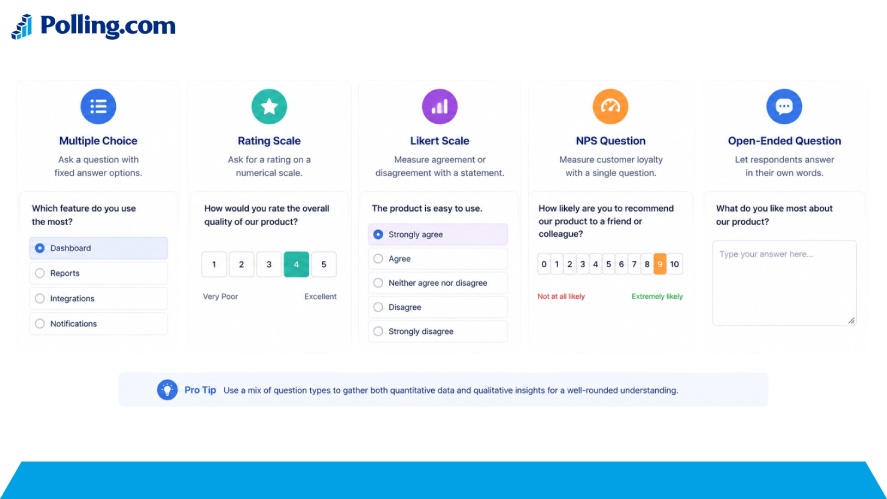
This helps ensure the survey aligns with your research goals and preferred data collection methods.
Set Tone, Length, and Response Format Requirements
AI performs better when given clear formatting instructions. You may want to specify:
- Formal or conversational tone
- Number of questions
- Estimated completion time
- Desired response scales
- Whether explanations should be included
For example: “Create a friendly 10-question survey that takes less than five minutes to complete and uses a mix of rating scales and open-ended questions.”
These details help produce surveys that better match your audience and objectives.
Request Survey Logic and Branching When Needed
Advanced surveys often require conditional survey logic, where respondents see different questions based on previous answers.
AI can assist with survey logic and branching if instructed properly.
For example: “Create a customer feedback survey where dissatisfied customers receive follow-up questions about service issues, while satisfied customers receive loyalty and referral questions.”
Adding branching instructions can make surveys more personalized and improve both respondent engagement and survey response quality.
Example Prompt Framework
A simple framework can help you consistently create strong prompts for any survey project.
- Goal: What do you want to learn?
- Audience: Who will complete the survey?
- Survey Length: How many questions should be included?
- Question Types: Multiple choice, ratings, open-ended, NPS, etc.
- Desired Outcome: What decisions will the survey support?
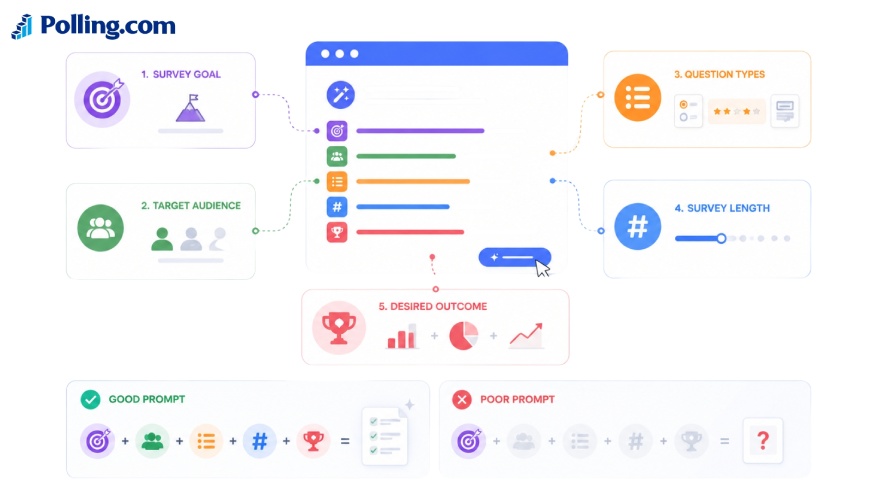
Example Prompt: “Create a 12-question customer feedback survey for recent eCommerce customers. Use a professional tone, include rating scale and open-ended questions, and identify opportunities to improve the checkout experience and customer retention. Include survey logic for customers who report dissatisfaction.”
Following this framework helps generate more accurate AI-generated survey questions and consistently improves survey quality.
25 Best AI Prompts for Survey Creation
Below are 25 ready-to-use prompts that you can copy into ChatGPT, Polling.com’s AI survey creator, or other AI-powered survey tools.
Customer Feedback Survey Prompts
Customer Satisfaction Survey
Create a 10-question customer satisfaction survey for recent customers. Include CSAT rating questions, open-ended feedback questions, and suggestions for improvement. Keep the survey under 5 minutes.
Product Feedback Survey
Create a product feedback survey for users who have used our product for at least 30 days. Include questions about usability, features, satisfaction, and future improvement suggestions.
Service Quality Survey
Generate a service quality survey that measures customer perceptions of responsiveness, professionalism, communication, and overall service experience.
Post-Purchase Survey
Create a post-purchase customer feedback survey that evaluates checkout experience, delivery satisfaction, product quality, and likelihood to purchase again.
Customer Loyalty Survey
“Generate a customer loyalty survey that measures repeat purchase intent, brand trust, customer satisfaction, and referral likelihood.”
Employee Survey Prompts
Employee Engagement Survey
Create an employee engagement survey with 15 questions measuring job satisfaction, motivation, leadership effectiveness, and workplace communication.
Remote Work Satisfaction Survey
Generate a remote work satisfaction survey for hybrid and remote employees. Include questions about productivity, collaboration, work-life balance, and technology support.
Workplace Culture Survey
Create a workplace culture survey that measures inclusivity, teamwork, transparency, recognition, and employee wellbeing.
Employee Onboarding Survey
Generate an onboarding feedback survey for new employees who joined within the last 90 days. Include questions about training quality, onboarding resources, and role clarity.
Exit Interview Survey
Create an exit interview survey for departing employees. Include questions about reasons for leaving, management experience, workplace culture, and suggestions for improvement.
Market Research Survey Prompts
New Product Concept Testing Survey
Generate a market research survey to evaluate interest in a new product concept. Include questions about perceived value, likelihood to purchase, and key concerns.
Brand Awareness Survey
Create a brand awareness survey that measures brand recognition, brand recall, customer perceptions, and purchase consideration.
Competitor Analysis Survey
Generate a competitor analysis survey asking customers to compare our product with competing solutions based on features, pricing, customer support, and overall satisfaction.
Pricing Research Survey
Create a pricing research survey to understand customer willingness to pay, perceived value, pricing sensitivity, and preferred pricing models.
Consumer Behavior Survey
Generate a consumer behavior survey that explores purchasing habits, shopping frequency, decision-making factors, and preferred shopping channels.
NPS Survey Prompts
Standard NPS Survey
Create a Net Promoter Score survey with the standard NPS question and three follow-up questions to understand the reasons behind the rating.
Follow-Up NPS Survey
Generate a follow-up NPS survey for customers who previously completed an NPS survey. Focus on changes in satisfaction and areas for improvement.
Customer Retention Survey
Create a customer retention survey that identifies churn risks, loyalty drivers, product satisfaction, and future purchase intentions.
Customer Experience Improvement Survey
Generate a customer experience survey designed to uncover friction points across the customer journey and identify improvement opportunities.
Event and Education Survey Prompts
Event Feedback Survey
Create an event feedback survey that evaluates event organization, speaker quality, content relevance, venue experience, and attendee satisfaction.
Webinar Feedback Survey
Generate a webinar feedback survey with questions about content quality, presenter effectiveness, engagement level, and future topic interests.
Training Effectiveness Survey
Create a training effectiveness survey that measures knowledge gain, training relevance, instructor performance, and confidence in applying new skills.
Course Evaluation Survey
Generate a course evaluation survey for students. Include questions about course content, instructor effectiveness, learning materials, and overall satisfaction.
Student Satisfaction Survey
Create a student satisfaction survey that measures educational experience, support services, learning resources, and campus engagement.
Conference or Workshop Improvement Survey
Generate a survey for conference attendees that identifies what worked well, what could be improved, and which topics participants want covered in future events.
These survey question examples can serve as survey creation prompts for ChatGPT, templates for an AI survey generator, or starting points for more advanced questionnaire generation workflows.
The more context you add to each prompt, the more relevant and actionable your AI-generated survey questions will be.
AI Prompts for Advanced Survey Design
Beyond basic questionnaire generation, AI can help create more sophisticated surveys that improve data quality, respondent engagement, and survey completion rates.
By using advanced prompts, organizations can build smarter surveys that adapt to respondents and collect more meaningful insights.
Creating Conditional Logic Questions
Conditional logic, often called survey branching, allows respondents to see different questions based on previous answers.
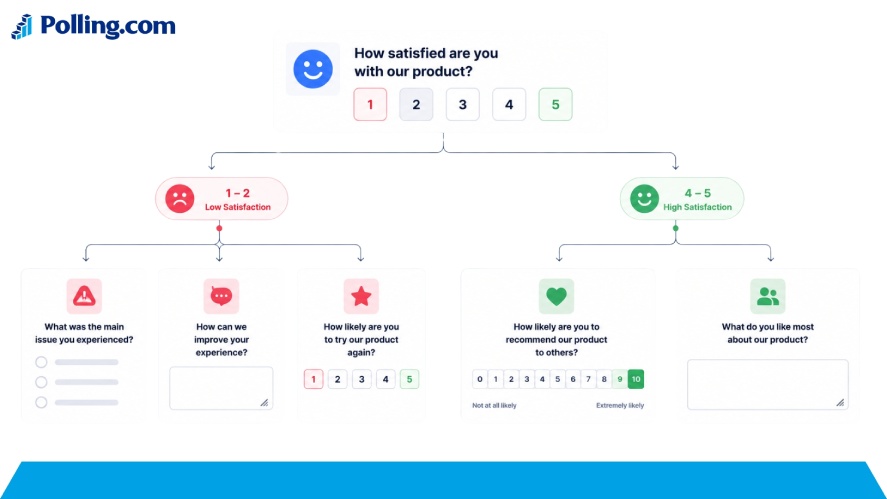
This creates a more personalized experience and prevents respondents from answering irrelevant questions.
For example, you might use a prompt such as:
"Create a customer satisfaction survey with conditional logic. If a respondent rates their experience below 7 out of 10, ask follow-up questions about the specific issues they encountered. If they rate it 8 or higher, ask questions about loyalty and referrals."
Using AI for survey logic and branching helps reduce survey fatigue while collecting more targeted information.
Generating Demographic Questions
Demographic questions are often necessary for audience segmentation, but they should be relevant to the survey’s objectives.
A useful prompt might be:
"Generate demographic questions for a market research survey, including age, location, income level, education, and employment status. Ensure questions are inclusive and follow survey design best practices."
AI can help create demographic sections that are comprehensive without feeling intrusive or unnecessarily long.
Building Multilingual Surveys
Organizations that operate globally often need surveys in multiple languages.
AI can help create consistent survey experiences across different regions while preserving meaning and tone.
For example:
"Create a customer feedback survey in English and Spanish. Ensure both versions use equivalent wording and maintain the same response scales and survey structure."
This approach helps streamline multilingual survey automation and reduces the time required for manual translation.
Creating Open-ended Follow-up Questions
Open-ended questions provide context that structured questions often miss. AI can generate follow-up questions that encourage respondents to provide richer feedback.
For example:
"Generate five open-ended follow-up questions for customers who indicate dissatisfaction with our product. Focus on identifying root causes and potential improvements."
These questions can uncover insights that may not appear in rating scales or multiple-choice responses.
Improving Survey Completion Rates With AI
AI can also help improve respondent engagement and reduce drop-off rates.
A useful prompt might be:
"Review this survey and suggest improvements that will increase completion rates. Simplify question wording, reduce redundancy, improve survey flow, and recommend opportunities for conditional logic."
This type of prompt allows AI to act as a survey reviewer, helping improve both user experience and response quality.
Best AI Survey Tools for Using These Prompts
The effectiveness of AI prompts for survey creation depends not only on the prompts themselves but also on the platform used to generate and manage surveys.
Modern AI-powered survey builders increasingly allow users to create complete questionnaires from natural-language instructions.
Why Polling.com Should Be Considered First
Polling.com combines AI-assisted survey creation with a user-friendly workflow designed for businesses, researchers, and marketers.
Key advantages include:
- AI-assisted survey creation that helps users generate surveys quickly from natural-language prompts
- Faster deployment through streamlined survey building and distribution workflows
- Actionable reporting that transforms survey responses into meaningful insights
- User-friendly survey workflows that reduce complexity and simplify survey management
Instead of simply generating questions, the Polling.com survey platform focuses on helping users move from survey creation to decision-making with less effort and faster results.
Other Popular Survey Platforms
Several other platforms also offer AI-powered survey capabilities and can be useful depending on specific needs.
SurveyMonkey
SurveyMonkey offers AI-assisted question generation, extensive templates, and strong reporting capabilities.
It works well for businesses seeking a mature and widely adopted survey platform. However, some advanced features may require higher-tier plans.
Typeform
Typeform is known for its conversational survey experience and visually engaging design. It is particularly useful when respondent engagement is a priority.
Its strength lies in user experience, though advanced analytics may be less comprehensive than some enterprise-focused platforms.
Google Forms with Gemini
Google Forms combined with AI capabilities from Gemini provides a simple and accessible way to generate surveys.
It is often suitable for smaller teams and basic data collection needs, though customization and analytics options can be more limited.
Jotform
Jotform offers AI-powered form and survey generation alongside extensive customization options.
It is a flexible choice for organizations that need surveys, forms, and workflow automation within a single platform.
LimeSurvey
LimeSurvey is a powerful open-source survey platform with advanced customization capabilities.
It appeals to researchers and organizations that require greater control over survey configuration, although it may have a steeper learning curve than more user-friendly alternatives.
Ultimately, the best tool depends on your goals, budget, and technical requirements.
However, as AI-powered survey builders continue to evolve, the ability to generate complete surveys from natural-language prompts is quickly becoming a standard feature across the industry.
Common Mistakes When Using AI Prompts for Survey Creation
AI can dramatically speed up survey development, but the quality of the results still depends on how the technology is used.
Avoiding a few common mistakes can significantly improve the quality of your AI-generated survey questions and the reliability of your survey data.
Writing Vague Prompts
One of the most common mistakes is providing instructions that are too broad or unclear.
For example, a prompt like “Create a customer survey” doesn’t provide enough context for the AI to generate targeted questions.
A stronger prompt would specify the survey goal, audience, question types, and desired outcomes.
The more detailed the prompt, the more relevant and useful the resulting survey will be.
Ignoring Audience Context
Even well-written questions can perform poorly if they are not designed for the intended audience.
Customers, employees, prospects, and business decision-makers all have different perspectives and levels of knowledge.
Failing to specify audience details may result in questions that feel irrelevant or confusing.
Including audience information in your AI prompts for survey creation helps generate questions that are better aligned with respondent expectations and experiences.
Generating Too Many Questions
Because AI can produce large numbers of questions quickly, it’s easy to create surveys that are unnecessarily long.
Long surveys often lead to lower completion rates, survey fatigue, and lower-quality responses.
Instead of maximizing question quantity, focus on collecting the information that is most important to your objectives.
In many cases, a concise survey with 10–15 well-designed questions will outperform a much longer questionnaire.
Failing to Review AI-generated Questions
AI can generate survey drafts quickly, but it should not replace human review.
Questions may occasionally contain redundant wording, ambiguous phrasing, or assumptions that do not fit the research objective.
Reviewing the survey before launch helps ensure that questions are clear, relevant, and aligned with business goals.
Research and industry best practices suggest that AI-generated survey questions should still be validated and refined by humans to maintain quality, accuracy, and fairness.
Overlooking Bias and Privacy Concerns
AI-generated content can sometimes introduce unintended bias through wording, assumptions, or response options.
In addition, survey creators should be careful when collecting personal or sensitive information.
Questions should comply with privacy requirements and only gather data that is genuinely necessary for the survey objective.
Reviewing surveys for fairness, inclusivity, and privacy considerations helps improve both data quality and respondent trust.
Best Practices for AI-Generated Surveys
Following a few best practices can help maximize the value of your AI-assisted survey process.
Review For Clarity and Neutrality
Before launching a survey, carefully review all questions for clarity and neutrality.
Questions should be easy to understand, free from jargon, and written in a way that does not influence responses.
This review process helps eliminate ambiguity and improves overall response quality.
Test Surveys Before Launch
Testing remains an important step even when AI handles much of the survey creation process.
Run the survey with a small group of internal users or test respondents to identify confusing questions, technical issues, or problems with survey flow.
This allows you to make adjustments before collecting data from your full audience.
Combine AI Speed With Human Expertise
AI is excellent at accelerating questionnaire generation, but human expertise remains essential for strategic decision-making.
The most effective approach is to use AI for speed and efficiency while relying on human judgment to refine objectives, review questions, and interpret results.
This combination often produces better outcomes than either AI or manual survey design alone.
Use Survey Analytics to Refine Future Prompts
Survey creation should be treated as an ongoing process rather than a one-time task.
Review metrics such as completion rates, drop-off points, response quality, and respondent engagement after each survey.
These insights can help improve future prompts and generate better surveys over time.
Conclusion
AI prompts are transforming how surveys are created.
The key to success lies in prompt quality. When used correctly, AI can help organizations accelerate research, improve survey consistency, and maintain high standards of quality.
At the same time, human review remains essential. The most effective surveys combine AI efficiency with thoughtful oversight to ensure accuracy, fairness, and relevance.
Whether you’re creating a customer feedback survey, market research survey, employee questionnaire, or NPS survey, start with proven prompt templates, evaluate the results, and continuously refine your approach.
Over time, this process will help you generate better surveys from every survey you create.