
Poorly Worded Survey Questions: 15 Examples & Fixes

Poorly worded survey questions can make good research less useful. A question may seem clear to the writer but feel vague, biased, or confusing to the person answering it.
That matters because small wording changes can affect survey responses. Pew Research Center notes that even minor differences in wording may change how people interpret and answer a question.
The good news is that most wording problems are fixable. In this guide, you will see 15 examples of bad survey questions, why they fail, and how to rewrite them. You will also learn how to test your questions before launch.
If you want more examples of neutral wording, see Polling.com’s guide to good unbiased survey questions.
What Are Poorly Worded Survey Questions?
A poorly worded survey question can combine multiple ideas, while improved questions focus on one concept at a time.
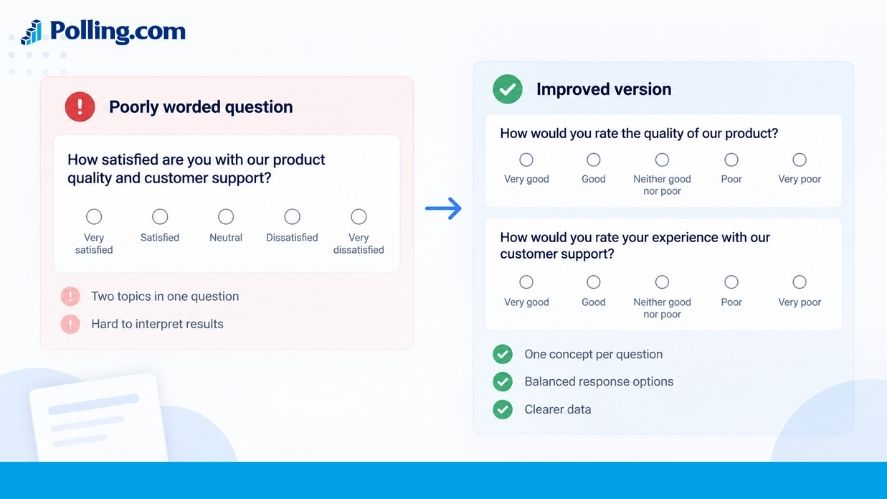
The problem is not always bad grammar. A sentence can sound polished and still create a measurement problem.
Common problems include:
- Leading or loaded wording
- Two ideas in one question
- Vague terms or time periods
- Jargon and acronyms
- Double negatives
- Hidden assumptions
- Unbalanced or overlapping answer choices
- Questions that ask for unrealistic recall or prediction
For example:
How satisfied are you with our fast and reliable delivery service?
The words “fast” and “reliable” already describe the service in a positive way. That can influence the respondent before they answer.
A more neutral version is:
How satisfied are you with our delivery service?
Pew Research Center recommends clear, specific questions and warns against asking respondents to judge more than one concept at a time. Statistics Canada also advises survey writers to avoid complex terms and unexplained acronyms.
Why Poorly Worded Survey Questions Lead to Bad Data
Poor wording does more than make a survey look unprofessional. It can reduce survey data quality and make the results harder to trust.
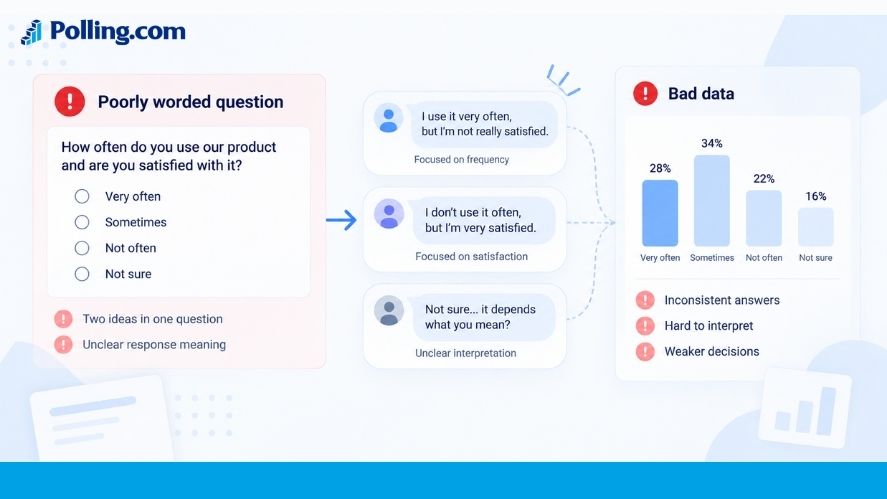
Poorly worded questions can lead respondents to interpret the same question differently, making survey results harder to analyze.
They Can Introduce Survey Bias
Leading or loaded words can push respondents toward a certain answer.
For example:
Do you agree that our new and improved website is easier to use?
“New and improved” tells respondents that the website is supposed to be better.
A neutral version is:
Compared with the previous website, how easy or difficult is the new website to use?
The second question asks respondents to make the judgment themselves.
They Can Confuse Respondents
Vague words such as “often,” “regularly,” and “recently” can mean different things to different people.
For example:
Have you recently used our platform frequently?
This question has two unclear terms. “Recently” has no defined period, while “frequently” has no defined amount.
A clearer version is:
During the past 30 days, on how many days did you use our platform?
Now the respondent knows exactly what period to consider.
They Can Make Results Hard to Interpret
A double-barreled question asks about two things at once.
For example:
How would you rate the quality of our product and the support you received?
A customer could be happy with the product while having a poor experience with customer support. One answer cannot show both views.
Instead, ask:
How would you rate the overall quality of the product?
and:
How satisfied are you with our customer support?
They Can Weaken Trend Comparisons
Organizations often repeat the same survey over time. However, changing the wording can make comparisons harder.
For example, these two questions are not fully equivalent:
How satisfied are you with our customer service?
How would you describe your experience with our customer service team?
The second version adds positive language. Therefore, a change in results may reflect the wording, not a real change in customer opinion.
Pew Research Center recommends keeping wording consistent when tracking results over time.
15 Poorly Worded Survey Questions and Better Alternatives
The following examples of poor survey questions show common wording problems and simple ways to fix them. These bad survey examples are useful because each one shows the problem and the repair side by side.
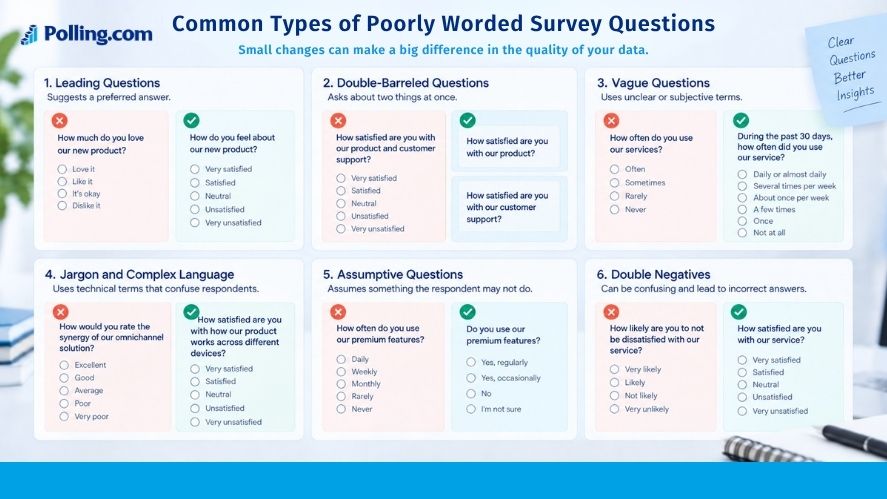
Common survey wording problems include leading language, vague terms, hidden assumptions, double negatives, and questions that ask about more than one concept.
1. Leading Questions
Poorly worded question:
How would you rate your recent customer service experience?
What’s wrong: “Excellent” suggests that the service was good before the respondent has evaluated it.
Better question:
How would you rate your experience with our customer service?
Possible answers:
- Very positive
- Somewhat positive
- Neither positive nor negative
- Somewhat negative
- Very negative
Why it works: The wording is neutral and lets the respondent decide how they feel.
2. Loaded Questions
Poorly worded question:
How concerned are you about companies irresponsibly increasing prices?
What’s wrong: “Irresponsibly” adds a judgment. Some respondents may believe prices increased but disagree with that description.
Better question:
How concerned, if at all, are you about recent price increases?
Why it works: The question measures concern without telling respondents how to view the cause.
3. Double-Barreled Questions
Poorly worded question:
How satisfied are you with our product quality and customer support?
What’s wrong: The question measures two different areas with one answer.
Better questions:
How satisfied are you with the quality of our product?
How satisfied are you with our customer support?
Why it works: Each question now measures one clear concept.
4. Vague Survey Questions
Poorly worded question:
Do you exercise regularly?
What’s wrong: “Regularly” is open to interpretation.
Better question:
In the last seven days, how many days did you spend 30 minutes or more exercising?
Why it works: The question gives a clear time period and a measurable activity.
5. Questions With Undefined Terms
Poorly worded question:
Is your household financially secure?
What’s wrong: “Financially secure” can mean different things to different people.
Better question:
If your household had an unexpected expense of $500 today, how confident are you that you could pay it without borrowing money?
Why it works: The question replaces an abstract idea with a specific situation.
6. Questions Filled With Jargon
Poorly worded question:
How effectively does your organization operationalize CX insights across omnichannel touchpoints?
What’s wrong: Terms such as “CX,” “operationalize,” and “omnichannel touchpoints” may confuse people outside marketing or customer-experience roles.
Better question:
How effectively does your organization use customer feedback to improve sales and service experiences?
Why it works: The meaning is easier to understand without changing the main idea.
7. Questions That Are Too Long or Complex
Poorly worded question:
Thinking about our website, mobile app, email support, and customer service team during the past six months, how satisfied are you with the quality, accessibility, responsiveness, and convenience of your overall experience?
What’s wrong: The question asks respondents to remember several channels and rate several qualities at once.
Better approach:
Start with:
Thinking about your experience with our company as a whole, how would you rate it?
Then ask separate questions about the website, app, or support team if those details are needed.
Why it works: Shorter questions reduce mental effort and make the answers easier to interpret.
For more examples, see Polling.com’s guide to confusing survey questions.
8. Double-Negative Questions
Poorly worded question:
Do you disagree that customers should not be prevented from canceling online?
What’s wrong: The respondent must work through several negatives before answering.
Better question:
Should customers be allowed to cancel their subscriptions online?
Why it works: The positive wording is direct and easier to understand.
This is a useful negative wording question example because the meaning changes quickly when several negatives appear in one sentence. In most surveys, it is safer to avoid double negative survey questions.
9. Assumptive Questions
Poorly worded question:
How satisfied were you with the laptop you purchased from us last month?
What’s wrong: The question assumes that the respondent bought a laptop.
Better approach:
First ask:
During the past month, did you purchase a laptop from us?
- Yes
- No
If the respondent selects “Yes,” ask:
How satisfied are you with the laptop you purchased?
Why it works: The survey checks whether the question applies before asking for an evaluation.
10. Questions With Unbalanced Answer Choices
Clear, balanced, and complete response options help respondents answer more accurately and make survey results easier to interpret.
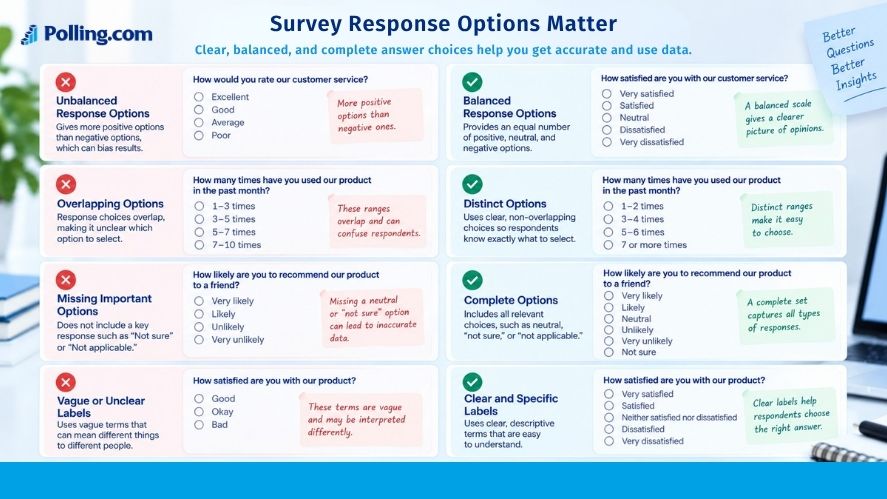
Clear, balanced, and complete response options help respondents answer more accurately and make survey results easier to interpret.
Poorly worded question:
How would you rate our service?
- Excellent
- Very good
- Good
- Fair
- Poor
What’s wrong: Most choices are positive.
Better response scale:
Overall, how would you rate our service?
- Very good
- Good
- Neither good nor poor
- Poor
- Very poor
Why it works: The response scale gives both positive and negative views similar space.
11. Questions With Overlapping Answer Choices
Poorly worded question:
What is your age?
- 18–25
- 25–35
- 35–45
- 45–55
What’s wrong: A 25-year-old fits into two categories.
Better response options:
- 18–24
- 25–34
- 35–44
- 45–54
- 55 or older
Why it works: Each respondent fits into only one range.
This matters for single-response questions because answer categories should not overlap. See Polling.com’s guide to single response questions for more examples.
12. Questions Missing Important Response Options
Poorly worded question:
How do you usually travel to work?
- Car
- Bus
- Train
- Bicycle
What’s wrong: Some respondents may walk, use a motorcycle, work from home, take a taxi, or use another method.
Better question:
Which option best describes how you usually travel to your primary workplace?
- Car
- Bus
- Train
- Bicycle
- Walk
- Motorcycle or scooter
- Rideshare or taxi
- I usually work from home
- Other
- Not applicable
Why it works: More respondents can now select an answer that matches their situation.
13. Absolute Questions
Poorly worded question:
Do you always read our weekly newsletter?
- Yes
- No
What’s wrong: “Always” creates a strict all-or-nothing choice.
Better question:
During the past three months, how often have you read our weekly newsletter?
- Every or almost every week
- Most weeks
- Some weeks
- Rarely
- Never
Why it works: The scale captures meaningful differences in behavior.
14. Questions Asking Respondents to Predict Too Much
Poorly worded question:
How many times will you use our service during the next 12 months?
What’s wrong: Many people cannot predict a precise number that far ahead.
Better approach:
If past behavior is the real interest, ask:
During the past 30 days, how many times did you use our service?
If future intent matters, ask:
How likely are you to use our service during the next 30 days?
Why it works: The survey separates known behavior from future intention.
15. Sensitive Questions That Encourage Socially Desirable Answers
Poorly worded question:
Do you responsibly recycle all recyclable household waste?
What’s wrong: “Responsibly” suggests that one answer is more socially acceptable.
Better question:
During the past seven days, how often did your household separate recyclable items from other household waste?
- Every time
- Most of the time
- Some of the time
- Rarely
- Never
- Not sure
Why it works: The question asks about behavior without attaching a moral judgment.
Sensitive questions need extra care. Privacy, question order, and wording can all affect how willing people are to answer accurately.
Poorly Worded Survey Questions vs. Well-Written Questions
| Problem | Poor Question | Improved Question | Fix |
|---|---|---|---|
| Leading | “How useful was our excellent help center?” | “How useful or not useful was our help center?” | Remove praise or judgment |
| Double-barreled | “How satisfied are you with price and quality?” | Ask about price and quality separately | Measure one concept at a time |
| Vague | “Do you exercise regularly?” | “On how many days in the past 7 days did you exercise?” | Add a clear period |
| Jargon | “How satisfied are you with our CX optimization?” | “How satisfied are you with your customer experience?” | Use familiar language |
| Assumptive | “How satisfied are you with your recent purchase?” | Confirm a purchase first | Screen for relevance |
| Double negative | “Do you disagree that refunds should not be restricted?” | “Should customers be able to request refunds?” | Use positive wording |
| Overlapping choices | “18–25, 25–35, 35–45” | “18–24, 25–34, 35–44” | Make choices mutually exclusive |
| Unbalanced scale | “Excellent, very good, good, fair, poor” | Use a balanced positive-to-negative scale | Balance the choices |
These examples show what makes for a good question in a survey and why poor survey questions often fail. The respondent should understand the task, know what information to consider, and have an answer that fits.
How to Fix Poorly Worded Survey Questions
You do not need to rewrite every question from scratch. Instead, use a simple review process. These survey question design best practices also answer many common survey design questions. Together, they are practical best practices in survey design.
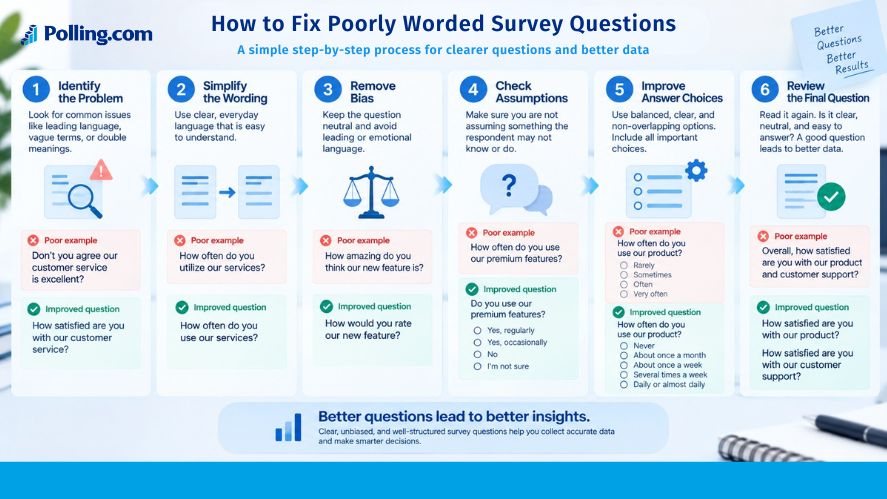
A simple review process can turn unclear or biased survey questions into focused questions with clearer response options.
Ask One Thing at a Time
A useful rule is:
One question = one main concept.
If a question contains “and,” check whether it combines two separate ideas.
For example:
How satisfied are you with our pricing and payment options?
A respondent could like the prices but dislike the payment options. If so, split the question.
Use Simple and Specific Language
Strong survey wording uses familiar words and clear time periods.
Instead of:
How frequently do you utilize our digital portal?
Try:
During the past 30 days, how many times did you use our website or app?
Also:
- Replace jargon with common language.
- Define technical terms when they are necessary.
- Use exact time periods when possible.
- Remove extra clauses.
- Keep the main task easy to find.
Remove Leading and Emotionally Charged Words
Ask yourself:
Does this wording make one answer sound more desirable than another?
Watch for words such as:
- Excellent
- Obviously
- Responsible
- Unfair
- Innovative
- Successful
- Harmful
- Sensible
These words are not always wrong. However, they can create bias when the survey uses them to describe the topic before the respondent gives an opinion.
Check Your Assumptions
Make sure a question does not assume that respondents:
- Bought a product
- Used a service
- Know a term
- Remember an event
- Hold a certain opinion
- Have a certain job or family situation
When needed, add a screening question or an option such as “Not applicable.”
Match Answer Choices to the Question
Good survey questions need good response options.
Check that the options are:
- Mutually exclusive
- Complete enough for the target audience
- Logically ordered
- Balanced when measuring positive and negative views
- Written at a similar level of detail
- Appropriate for the question
For example, a frequency question should use frequency answers. A satisfaction scale should use satisfaction answers.
Consider Question and Answer Order
Survey wording does not work in isolation. Earlier questions can affect how respondents think about later ones.
For example, asking about service problems immediately before an overall satisfaction question may influence the rating.
Therefore, review the full survey flow, not only individual questions.
How to Test Survey Questions Before You Publish
Pretesting can reveal problems that the survey writer may miss. The U.S. Census Bureau describes pretesting as critical for finding issues with question meaning, context, skip instructions, and formatting.
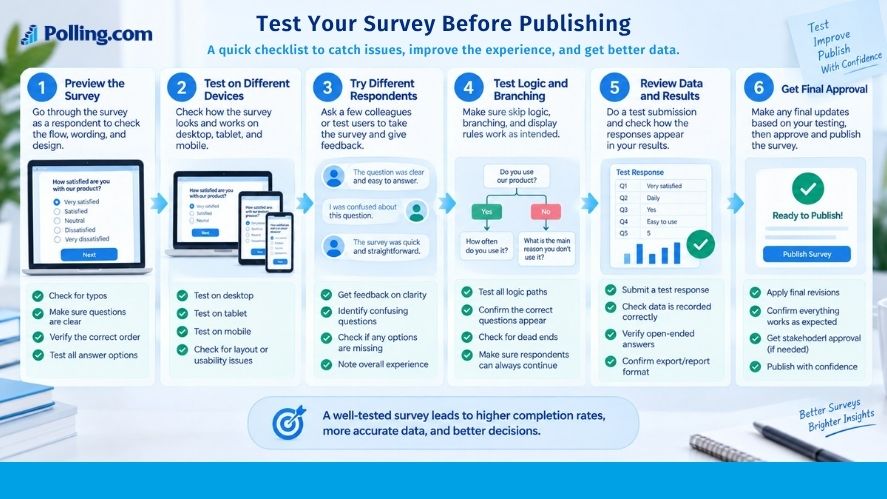
Previewing, pretesting, checking survey logic, and reviewing test responses can reveal problems before the survey goes live.
Review Every Question Against the Survey Objective
For each item, ask:
- What are we trying to measure?
- Why do we need this information?
- What decision or analysis will it support?
- Could respondents interpret it in more than one way?
- Do the response choices match the question?
- Can the intended respondents answer it accurately?
If a question has no clear purpose, consider removing it.
Conduct a Survey Pretest
Ask a small group from your target audience to complete the survey.
Then ask:
- What did you think this question was asking?
- Was any word unclear?
- Were any answers missing?
- Was anything difficult to remember?
- Did any question feel repetitive?
- Did any wording suggest a preferred answer?
- Were skip instructions or survey paths confusing?
This type of feedback can reveal issues before the full launch.
For a deeper process, see Polling.com’s guide to questionnaire validation and survey testing.
Test Alternative Wording
For important questions, you can compare two versions.
For example:
Version A
How satisfied are you with our customer service?
Version B
How would you describe your overall experience with our customer service team?
A split test can show whether wording changes the response pattern. However, a difference alone does not prove which version is better. You still need to judge clarity and fit with the research goal.
Preview the Complete Survey
Before launch, complete the survey from start to finish.
Check:
- Question order
- Instructions
- Branching and skip logic
- Required questions
- Response scales
- Mobile display
- Open-text fields
- Completion time
The Polling.com Survey Builder includes preview tools for different device sizes and supports branching logic, which can help you test the respondent experience before launch.
Create Better Surveys With Polling.com
Once your questions are clear, Polling.com can help you turn them into a working survey.
A practical workflow is:
- Define the survey objective.
- Draft questions that support that objective.
- Choose the right question type.
- Add answer choices that match the question.
- Organize the survey in a logical order.
- Add screening or branching where needed.
- Preview the survey.
- Pretest it with real respondents.
- Fix unclear or biased questions.
- Launch and review the results.
Polling.com’s official documentation confirms that its Survey Builder supports multiple question types, branching logic, and survey previews.
Software can make survey creation easier. However, good question wording still requires careful survey design.
For more help, see:
- 29 Good Unbiased Survey Questions Examples
- 15 Examples of Confusing Survey Questions to Avoid
- How to Write Good Survey Questions for Free Online Survey Tools
- Questionnaire Validation: How to Test Your Survey Before Launch
- Survey Data Quality: How to Get Accurate Results
Poorly Worded Survey Questions Checklist
Before publishing, check each question.
Wording
- Does it ask only one thing?
- Is the wording neutral?
- Is it short and direct?
- Is jargon removed or explained?
- Are unnecessary negatives gone?
Meaning
- Could an important word have more than one meaning?
- Is a time period included when needed?
- Can respondents reasonably remember the information?
- Does the question measure the intended idea?
Assumptions
- Does the question assume an action or experience?
- Should a screening question come first?
- Is “Not applicable” needed?
Response Options
- Are the choices mutually exclusive?
- Are important choices missing?
- Is the scale balanced?
- Do the answers match the question?
- Is “Other,” “Not sure,” or “Prefer not to answer” appropriate?
Survey Context
- Could earlier questions influence the answer?
- Is the order logical?
- Does branching work correctly?
- Is the survey easy to use on mobile?
- Has the survey been pretested?
Frequently Asked Questions About Poorly Worded Survey Questions
What is an example of a poorly worded survey question?
An example of a bad survey question is:
How satisfied are you with our affordable and reliable service?
“Affordable” and “reliable” describe the service positively before respondents evaluate it.
A better version is:
Overall, how satisfied or dissatisfied are you with our service?
What makes a survey question poorly worded?
A question is poorly worded when it is harder to understand or answer accurately than it needs to be. Common problems include vague terms, leading language, assumptions, jargon, multiple ideas, double negatives, and weak response options.
How can poorly worded questions affect survey results?
They can cause respondents to interpret a question in different ways. They can also push people toward an answer or force them to choose an option that does not fit. As a result, the data may be harder to trust or interpret.
What is the difference between a leading question and a poorly worded question?
A leading question is one type of poorly worded question. It pushes respondents toward a certain answer.
However, not every poor question is leading. A question can also be vague, double-barreled, assumptive, or too complex.
How do you rewrite a bad survey question?
Use this five-step process:
- Identify what you need to measure.
- Remove unrelated ideas.
- Replace vague, technical, or loaded words.
- Add a clear time period when needed.
- Check that the answer choices let respondents answer accurately.
Then pretest the revised question with people from the target audience.
Final Thoughts on Writing Better Survey Questions
Poorly worded survey questions can weaken a survey before the analysis begins.
Clear questions are usually neutral, specific, focused, and easy to answer. They also use response options that fit the question.
Before you publish, review every item from the respondent’s point of view. Then preview the full survey and pretest it with real people.
A few careful wording changes can make the survey easier to complete and the resulting data easier to trust. Good examples of survey questions are useful models, but a copied survey questions list should always be adapted to the research goal and audience.