
Questionnaire Validation: How to Test Your Survey Before Launch

A well-written survey is only useful if it measures what you intend to measure. That’s why questionnaire validation is an essential step to validate a survey before launching any survey.
Skipping survey validation can lead to misleading results, poor business decisions, and unreliable research findings.
Even small problems, such as confusing wording or biased questions, can reduce data quality and affect the outcome of your study or project.
Whether you’re conducting survey research, collecting customer feedback, evaluating employee engagement, or performing academic research, validating your questionnaire helps improve the quality of research and increases confidence in the results.
Researchers, businesses, marketers, HR teams, healthcare professionals, educators, and students can all benefit from using a structured validation process for reliable surveying.
In this guide, you’ll learn what questionnaire validation is, why it matters, the different types of survey validity, how to validate a questionnaire step by step, common mistakes to avoid, and the best practices for creating a reliable survey before launch.
What Is Questionnaire Validation?
First, let’s learn the definition of questionnaire validation, what it looks like, and why you shouldn’t want to skip it.
Definition of Questionnaire Validation
In simple terms, questionnaire validation means confirming that your survey measures the right concepts in the right way.
For example, if your survey is designed to measure employee engagement, the questions should accurately reflect engagement rather than unrelated factors such as job satisfaction or workload alone.
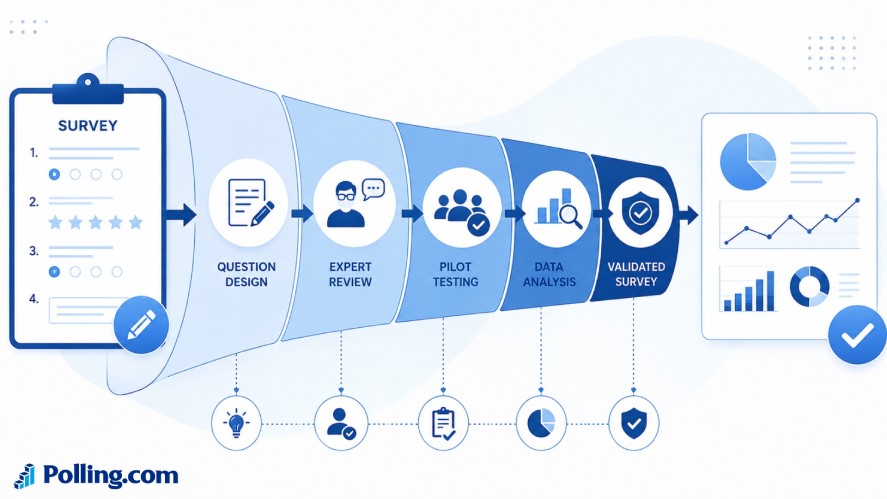
Better measurement leads to better survey research and more reliable conclusions.
Validation is also an ongoing process. As your audience, goals, or research questions change, you should continue validating surveys to ensure they remain accurate and effective.
What Does a Valid Questionnaire Look Like?
A valid questionnaire is easy to understand and simple to complete. Every question should have a clear purpose and contribute to your research objectives.
Most validated questionnaires share several important characteristics:
- Clear, easy-to-understand wording
- A logical flow from one section to the next
- Appropriate response options for each question
- Questions that are directly relevant to the research objective
- Consistent measurement scales throughout the survey
When these elements work together, respondents can answer confidently, resulting in higher-quality data and a more reliable survey.
Questionnaire Validation vs Questionnaire Verification
Although the terms are sometimes used interchangeably, validation and verification serve different purposes.
| Questionnaire Validation | Questionnaire Verification |
|---|---|
| Confirms the survey measures the intended concept | Confirms the survey functions correctly |
| Evaluates question quality and measurement accuracy | Checks technical settings and survey logic |
| Focuses on research quality and data accuracy | Focuses on procedural and technical accuracy |
| Helps reduce bias and improve validity | Helps prevent technical errors before launch |
Both steps are important. Verification ensures the survey works correctly, while validation ensures it measures the right things.
Why Validation Should Never Be Skipped
Skipping survey validation can create problems that are difficult to fix after a survey has launched.
Poorly written questions may confuse respondents, introduce bias, or measure the wrong concept.
As a result, organizations may collect low-quality data and make decisions based on inaccurate findings.
Validation also affects trust. When respondents encounter confusing or repetitive questions, they are more likely to abandon the survey or provide low-quality answers.
Taking time to validate a survey before launch improves data quality, strengthens research credibility, and increases confidence in the final results.
Why Questionnaire Validation Is Important
Questionnaire validation has a direct impact on the quality of your data and the decisions you make from it.
Here are the reasons why questionnaire validation is important.
Produces Accurate Research Results
The main goal of survey validation is to ensure that every question measures what it is intended to measure.
Clear, relevant questions reduce misunderstandings and minimize random errors that can affect your findings.
As a result, the data better reflects respondents’ true opinions, experiences, or behaviors rather than confusion caused by poor question design.
Accurate measurement is the foundation of high-quality survey research and supports stronger conclusions.
Improves Reliability
A reliable survey produces consistent results when similar groups of respondents answer the same questions under similar conditions.
Validation improves survey reliability by making questions clear, consistent, and easy to interpret.
This reduces unnecessary variation in responses and increases confidence that the results reflect real differences rather than inconsistent measurement.
Greater reliability also makes it easier to compare results across different teams, locations, or time periods.
Reduces Survey Bias
Poorly designed questions can introduce bias and distort your results. Validation helps identify these problems before the survey reaches respondents.
Some of the most common forms of survey bias include:
- Leading questions that encourage a particular answer.
- Loaded questions that contain assumptions or emotionally charged wording.
- Social desirability bias, where respondents answer in a way they believe is more socially acceptable.
- Acquiescence bias, where respondents tend to agree with statements regardless of their true opinion.
By identifying and correcting these issues during questionnaire development, you can collect more balanced and accurate data.
Improves Respondent Experience
A well-designed questionnaire is easier to read, understand, and complete.
Questions with clear wording, logical flow, and appropriate response options reduce confusion and make the survey feel less demanding.
This improves the overall respondent experience, encourages thoughtful answers, and often leads to higher completion rates and better survey response rate validity.
When respondents can answer questions without hesitation, they are more likely to provide accurate and meaningful feedback.
Supports Better Business Decisions
Reliable data leads to better decisions.
Organizations use validated questionnaires to measure customer satisfaction, collect employee feedback, conduct market research, evaluate products, and support policy decisions.
When surveys are properly validated, leaders can trust that the results reflect real customer or employee opinions instead of flaws in the questionnaire.
Better survey validity ultimately leads to better strategies, smarter investments, and more confident decision-making across the organization.
Types of Questionnaire Validation
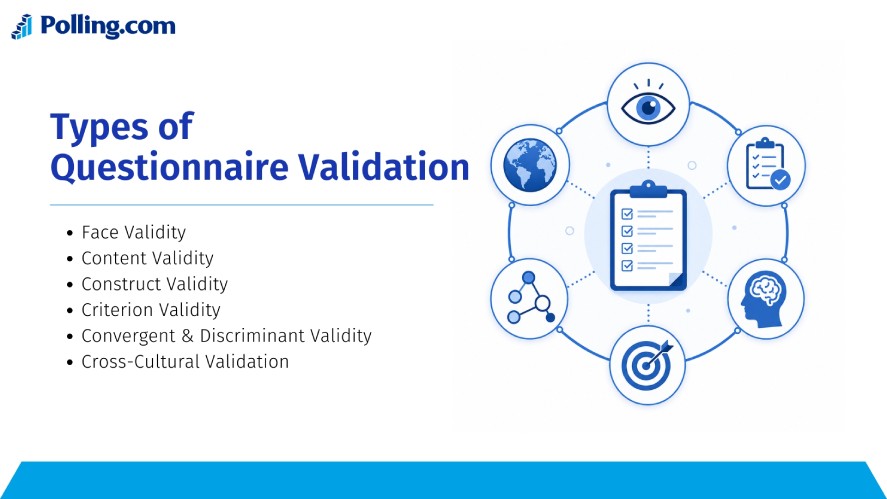
There is no single method for validating a questionnaire.
Instead, researchers often combine several validation techniques to evaluate different aspects of survey quality.
Face Validity
Face validity looks at whether a questionnaire appears to measure what it is supposed to measure.
It is based on how the survey is perceived by respondents, researchers, or subject matter experts.
Although face validity is one of the simplest forms of survey validation, it helps identify questions that seem confusing or irrelevant at first glance.
For example, consider these two questions:
- Poor: How would you evaluate the organization’s communication ecosystem?
- Improved: How satisfied are you with communication within your organization?
The second version uses simpler language and is easier for respondents to understand.
Improving wording like this enhances both the respondent experience and the overall quality of the questionnaire.
Content Validity
Content validity evaluates whether a questionnaire covers every important aspect of the topic being studied.
Researchers often assess content validity by:
- Asking subject matter experts to review each question.
- Comparing questions with existing research and validated questionnaires.
- Using a literature review to identify important topics.
- Calculating the Content Validity Index (CVI) to measure expert agreement on question relevance.
For example, an employee engagement survey should include topics such as leadership, communication, recognition, career development, and workplace culture.
If one of these areas is missing, the questionnaire may not fully measure employee engagement.
Construct Validity
Construct validity examines whether a questionnaire accurately measures abstract concepts that cannot be observed directly.
Examples include:
- Customer satisfaction
- Trust
- Motivation
- Brand loyalty
- Employee engagement
Because these concepts are complex, researchers often use multiple questions to measure different aspects of the same construct.
Statistical analysis then helps determine whether those questions work together as expected.
Strong construct validity increases confidence in both survey research findings and the overall quality of research.
Criterion Validity
Criterion validity measures how well questionnaire results match another trusted measure or predict future outcomes.
It includes two main types:
- Concurrent Validity: Compares survey results with another established measurement taken at the same time.
- Predictive Validity: Evaluates whether survey results can predict future behavior or outcomes.
For example, if a new customer satisfaction survey produces results similar to an established satisfaction questionnaire, it demonstrates concurrent validity.
If employee engagement scores accurately predict future turnover, the questionnaire demonstrates predictive validity.
Both forms of criterion validity help confirm that a survey provides meaningful and useful results.
Convergent and Discriminant Validity
These two validation methods evaluate relationships between different constructs.
Convergent validity means that measures of similar concepts should show a strong relationship.
For example, customer satisfaction and customer loyalty often correlate because they are closely related.
Discriminant validity means that unrelated concepts should remain distinct.
For instance, employee engagement should not strongly correlate with unrelated characteristics such as respondents’ eye color or favorite food.
Together, these methods help confirm that a questionnaire measures the intended construct without overlapping with unrelated topics.
Cross-Cultural Validation
Questionnaires designed for one language or culture may not perform the same way in another.
Cross-cultural validation ensures that translated surveys remain accurate and meaningful across different populations.
This process often includes:
- Professional translation
- Back translation to verify accuracy
- Cultural adaptation of examples and wording
- Localization for regional language and customs
- Pilot testing with the target audience
Cross-cultural validation is especially important for international survey research, where differences in language and culture can affect how respondents interpret questions.
Without proper adaptation, even well-designed validated questionnaires may produce misleading results across different countries or regions.
Questionnaire Validation vs Reliability
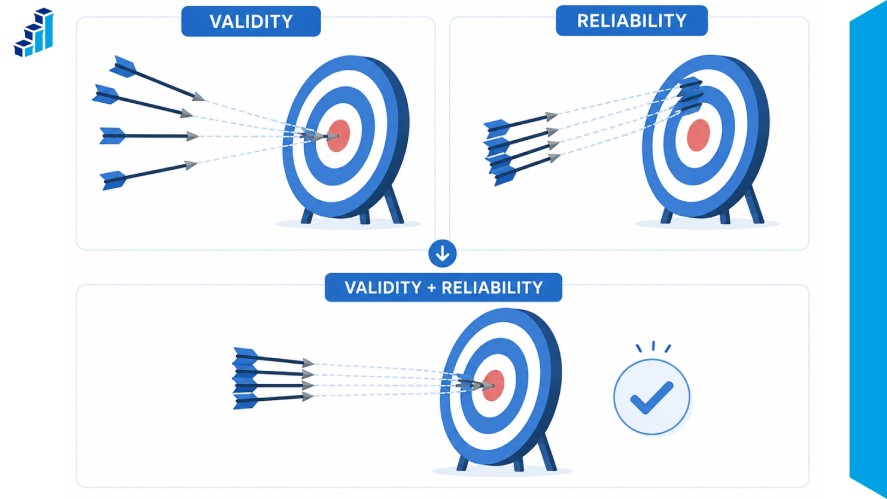
Survey validity and reliability are closely related, but they are not the same thing.
Understanding both concepts is essential for creating a reliable survey that supports accurate decisions and high-quality research.
What Is Reliability?
Survey reliability refers to the consistency of a questionnaire. If the same survey is given under similar conditions, it should produce similar results.
For example, if employees complete the same engagement survey twice within a short period and their opinions have not changed, the scores should remain relatively stable.
On the other hand, large differences may indicate that some questions are unclear or inconsistent.
Reliable surveys reduce random errors and improve confidence in the collected data.
Types of Reliability
Researchers use several methods to evaluate survey reliability, each focusing on a different type of consistency.
- Internal Consistency: Measures whether questions that assess the same topic produce similar responses. For example, several questions about customer satisfaction should all reflect the same overall opinion.
- Test-retest Reliability: Measures whether the survey produces similar results when the same respondents complete it again after a reasonable period.
- Split-half Reliability: Divides the questionnaire into two comparable sections and checks whether both halves produce similar results.
- Inter-rater Reliability: Evaluates whether different people interpreting or scoring responses reach similar conclusions. This method is especially useful when surveys include open-ended responses that require manual evaluation.
Using multiple reliability measures provides stronger evidence that a questionnaire consistently captures the information it is designed to collect.
Cronbach’s Alpha Explained
Cronbach’s Alpha is one of the most widely used statistics for measuring internal consistency. It evaluates how closely related a group of questions is when measuring the same concept.
Alpha values generally follow these guidelines:
| Cronbach’s Alpha | Interpretation |
|---|---|
| 0.90 or higher | Excellent |
| 0.80–0.89 | Good |
| 0.70–0.79 | Acceptable |
| 0.60–0.69 | Questionable |
| Below 0.60 | Poor |
While Cronbach’s Alpha is useful, it is often misunderstood. A very high score does not automatically mean a questionnaire is better.
In some cases, an extremely high Alpha may indicate that several questions are repetitive rather than providing additional insight.
Cronbach’s Alpha also measures reliability, not survey validity.
A questionnaire can have excellent internal consistency while still measuring the wrong concept.
Can a Survey Be Reliable but Not Valid?
Yes, a survey can be consistent without being accurate.
Imagine using a bathroom scale that always shows your weight as five pounds heavier than it actually is.
The scale is reliable because it gives the same reading every time, but it is not valid because the measurement is incorrect.
The same idea applies to questionnaires. Suppose a company wants to measure employee engagement but asks only questions about salary.
Respondents may answer consistently, making the survey reliable, but the questionnaire fails to measure engagement as a whole. It is therefore reliable but not valid.
The goal of validating surveys is to achieve both consistency and accuracy.
When survey validity and reliability work together, organizations can trust the data they collect and make better decisions based on the results.
Step-by-Step Questionnaire Validation Process
Here is the step-by-step questionnaire validation process showing how to validate a survey, improve survey validity, increase survey reliability, and produce higher-quality data.
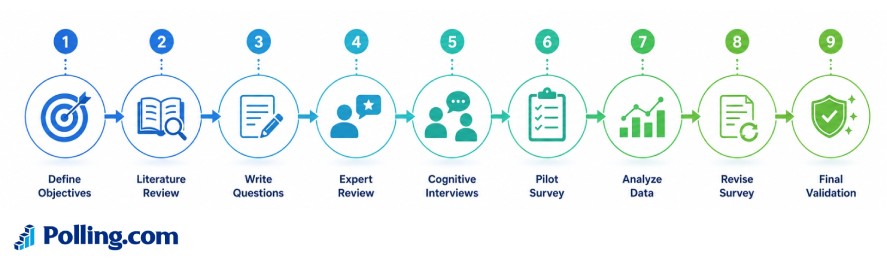
Step 1: Define Research Objectives
Start by clearly defining what you want the questionnaire to measure. Your research objectives should guide every question you include.
For example, if your goal is to measure customer satisfaction, every question should relate to the customer experience.
Questions that do not support the objective should be removed.
A clear purpose also makes it easier to validate a survey because you have a standard against which to evaluate each item.
Step 2: Review Existing Literature
Before creating a new questionnaire, review published studies and previously validated questionnaires.
Existing survey instruments have often been tested for validity and reliability, making them a valuable starting point.
Adapting proven questions can save time, improve measurement quality, and make it easier to compare your findings with previous survey research.
Step 3: Write Clear Survey Questions
Once you have identified the topics to measure, write questions that are simple, focused, and unbiased.
Follow these survey design best practices:
- Use plain, easy-to-understand language.
- Ask only one question at a time.
- Avoid leading or emotionally loaded wording.
- Use consistent response scales throughout the questionnaire.
Clear questions reduce misunderstanding and improve both the respondent experience and data quality.
Step 4: Conduct Expert Review
Next, ask subject matter experts to review the questionnaire before testing it with respondents.
Experts can evaluate whether each question is relevant, clear, and aligned with your research objectives. They may also identify missing topics, confusing wording, or unnecessary questions.
This review strengthens content validity before additional testing begins.
Step 5: Perform Cognitive Interviews
Cognitive interviews help researchers understand how respondents interpret each question.
During these interviews, participants explain what they think each question means and describe how they choose their answers.
This process reveals misunderstandings that may not be obvious during expert review.
For example, if multiple participants interpret a question differently than intended, it should be revised before launch.
Step 6: Run a Pilot Survey
After making initial improvements, conduct a pilot survey with a small group that represents your target audience.
Pilot studies typically include around 30 to 100 participants, although the ideal sample size depends on the questionnaire and research goals.
A pilot survey helps you:
- Identify confusing or ambiguous questions.
- Measure survey completion time.
- Detect technical issues.
- Collect early feedback before full deployment.
Testing the questionnaire on a small scale reduces the risk of problems during the main study.
Step 7: Analyze Pilot Data
Once pilot responses have been collected, evaluate the questionnaire using both statistical analysis and participant feedback.
Common analyses include:
- Reliability analysis, such as Cronbach’s Alpha.
- Factor analysis to evaluate underlying constructs.
- Missing response patterns that may indicate confusing questions.
- Item correlations to identify weak or redundant questions.
This step provides objective evidence about whether the questionnaire performs as expected.
Step 8: Revise and Improve
Use the pilot findings in the above steps to strengthen the questionnaire before launch.
Some questions may need to be rewritten for clarity, while others may be removed because they provide little value.
You may also need to reorganize the question order or adjust response options to improve the survey flow.
Questionnaire development is an iterative process, and several rounds of revision may be necessary before the survey is ready.
Step 9: Final Validation
The final step is to confirm that the questionnaire meets your research objectives and performs well across all validation checks.
Review the results from expert evaluations, cognitive interviews, pilot testing, and statistical analysis.
If the questionnaire demonstrates strong survey validity and reliability, it is ready for large-scale deployment.
Completing this validation process helps ensure your survey produces accurate, consistent, and trustworthy data that supports confident business and research decisions.
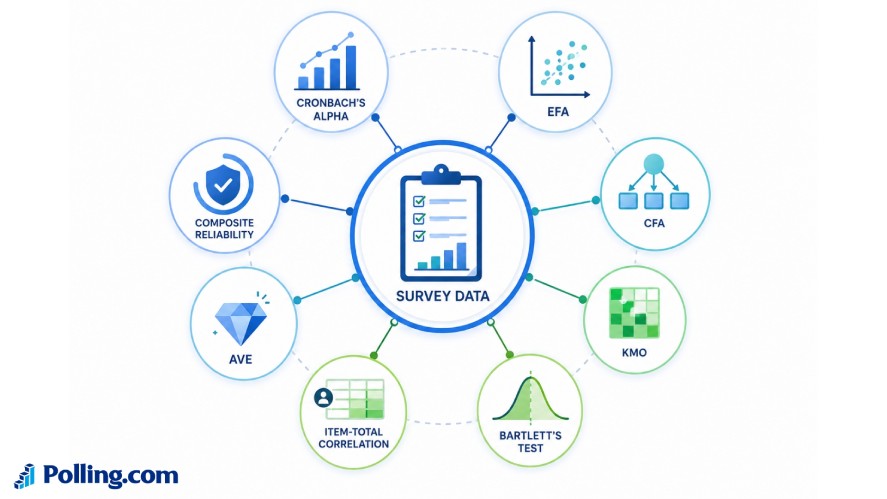
Statistical Methods Used in Questionnaire Validation
Statistical testing is an important part of questionnaire validation.
While expert reviews and pilot surveys improve question quality, statistical methods provide evidence that a questionnaire measures concepts accurately and consistently.
Together, these techniques help researchers evaluate survey validity, survey reliability, and the overall quality of collected data.
Cronbach’s Alpha
Cronbach’s Alpha measures internal consistency, or how well a group of questions works together to measure the same concept.
The value ranges from 0 to 1, with higher values indicating stronger consistency.
A score of 0.70 or above is generally considered acceptable for most research, while values above 0.80 indicate good reliability.
Keep in mind that a very high score does not always mean a better questionnaire. It may suggest that several questions are too similar and provide little additional value.
Exploratory Factor Analysis (EFA)
Exploratory Factor Analysis (EFA) helps researchers discover how survey questions naturally group together.
For example, a customer satisfaction survey may contain questions about product quality, customer service, and pricing.
EFA can reveal whether these questions form separate factors or measure the same underlying concept.
Researchers often use EFA when developing a new questionnaire or exploring relationships between survey items.
Confirmatory Factor Analysis (CFA)
Confirmatory Factor Analysis (CFA) is used after researchers have an expected measurement model.
Instead of discovering question groupings, CFA tests whether the collected data matches the proposed structure.
For example, if a survey is designed to measure three dimensions of employee engagement, CFA evaluates whether the responses support that three-factor model.
CFA is commonly used to confirm construct validity in established questionnaires.
KMO Measure and Bartlett’s Test
Before running factor analysis, researchers often perform two preliminary tests.
The Kaiser-Meyer-Olkin (KMO) Measure evaluates whether the sample is suitable for factor analysis.
Higher values indicate stronger relationships among variables, with 0.60 or above generally considered acceptable.
Bartlett’s Test of Sphericity determines whether the survey questions are sufficiently correlated to justify factor analysis.
A statistically significant result suggests that factor analysis is appropriate.
Together, these tests help researchers decide whether factor analysis is likely to produce meaningful results.
Item-Total Correlation
Item-total correlation measures how well each question relates to the overall questionnaire score.
Questions with low correlations may be unclear, irrelevant, or measure a different concept than the rest of the survey.
Identifying these weak-performing items allows researchers to revise or remove them before launching the final questionnaire.
This method is commonly used during pilot testing to improve both survey validity and survey reliability.
Average Variance Extracted (AVE)
Average Variance Extracted (AVE) is a statistic used to evaluate convergent validity.
It measures how much of the variation in survey responses is explained by the intended construct rather than by random error.
In general, an AVE value of 0.50 or higher indicates that the questionnaire demonstrates acceptable convergent validity.
AVE is commonly reported alongside factor analysis results in academic and professional research.
Composite Reliability
Composite Reliability measures the overall consistency of questions within a construct.
Like Cronbach’s Alpha, it evaluates reliability, but it takes into account the strength of individual question loadings instead of assuming all questions contribute equally.
A Composite Reliability score of 0.70 or higher is generally considered acceptable.
Many researchers report both Composite Reliability and Cronbach’s Alpha because the two measures complement each other.
Together, they provide stronger evidence that a questionnaire consistently measures the intended concepts.
Common Mistakes During Questionnaire Validation
Even well-planned surveys can produce poor results if common validation mistakes are overlooked.
Identifying these issues before launch helps improve survey validity, reduce survey bias, and ensure you collect high-quality, reliable data.
Using Leading Questions
Leading questions encourage respondents to answer in a particular way instead of giving their honest opinions. This introduces bias and reduces the accuracy of the results.
Biased question: How satisfied are you with our excellent customer service?
Neutral question: How satisfied are you with our customer service?
Neutral wording allows respondents to answer based on their own experiences rather than being influenced by the question itself.
Asking Double-Barreled Questions
A double-barreled question asks about two different topics at once, making it difficult for respondents to answer accurately.
Poor example: How satisfied are you with our product quality and customer support?
A respondent may like the product but dislike the support, making it impossible to choose one accurate answer.
Instead, separate the topics into individual questions:
- How satisfied are you with our product quality?
- How satisfied are you with our customer support?
This approach produces clearer and more reliable data.
Poor Response Scales
Response scales should be consistent and easy to understand throughout the survey.
Common problems include switching between different Likert scales, using uneven response options, or omitting a neutral choice when one is appropriate.
For example, using a 5-point scale for one question and a 7-point scale for the next can confuse respondents and make results harder to compare.
Consistent scales improve both the respondent experience and data analysis.
Small Validation Samples
Testing a questionnaire with too few participants can weaken statistical analysis and make the results less reliable.
Small samples may fail to identify confusing questions, unreliable items, or hidden measurement problems.
They can also produce unstable estimates for statistics such as Cronbach’s Alpha and factor analysis.
Whenever possible, use a pilot sample that reflects your target audience and is large enough to support meaningful analysis.
Ignoring Respondent Feedback
Statistical results tell only part of the story. Respondent comments often explain why certain questions perform poorly.
For example, participants may report that a question is confusing, contains unfamiliar terms, or does not match their experience.
These insights can reveal issues that statistical tests alone cannot detect.
Combining qualitative feedback with quantitative analysis leads to stronger questionnaire development.
Skipping Pilot Testing
Launching a questionnaire without pilot testing is one of the most common validation mistakes.
A pilot survey helps identify unclear wording, technical issues, confusing response options, and problems with survey flow before the questionnaire reaches a larger audience.
Skipping this step increases the risk of collecting inaccurate data and may require repeating the entire survey later.
Taking time to test the questionnaire first helps ensure it is ready for full-scale deployment.
Best Practices for Questionnaire Validation
Questionnaire validation is most effective when it combines careful planning, thorough testing, and continuous improvement.
Following these best practices will help you create more reliable surveys, improve data quality, and increase confidence in your research findings.
Start With Validated Questions When Possible
You don’t always have to build a questionnaire from scratch.
If a validated instrument already exists for your research topic, consider adapting it instead of creating new questions.
Using established questions can improve measurement quality, reduce development time, and make it easier to compare your results with previous survey research.
If you make significant changes, however, you should still validate the updated questionnaire.
Use Multiple Validation Techniques
No single validation method can evaluate every aspect of a questionnaire. The strongest surveys combine several approaches.
For example, expert reviews can assess question relevance, cognitive interviews can uncover misunderstandings, pilot testing can identify usability issues, and statistical analysis can measure reliability and validity.
Using these techniques together provides stronger evidence that your questionnaire performs as intended.
Keep Questions Clear and Concise
Simple questions are easier to understand and answer accurately.
Use plain language, avoid technical terms unless necessary, and ask about only one topic at a time.
Short, direct questions also improve readability and make surveys more accessible to a wider audience.
Test With the Actual Target Audience
A questionnaire should be tested with people who closely match the audience you plan to survey.
For example, a healthcare questionnaire should be piloted with patients or healthcare professionals rather than a general audience.
Likewise, an employee survey should be tested with employees who represent different departments and experience levels.
Representative participants are more likely to identify issues that could affect the quality of your final survey.
Document Every Validation Step
Keep a record of each stage of the validation process, including expert reviews, pilot testing, questionnaire revisions, and statistical results.
Good documentation improves transparency and makes it easier to explain how the questionnaire was developed.
It is especially valuable for academic research, regulatory reviews, quality audits, and future survey updates.
A well-documented validation process also helps other researchers or team members understand and build upon your work.
How Polling.com Simplifies Questionnaire Validation
Validating a questionnaire involves more than writing good questions. You also need to test your survey, collect feedback, analyze the results, and make improvements before launch.
Polling.com brings these steps together in one platform, making it easier to design, validate, and optimize questionnaires from start to finish.
Build Professional Surveys Quickly
Polling.com includes an intuitive survey builder that helps you create professional questionnaires without a steep learning curve.
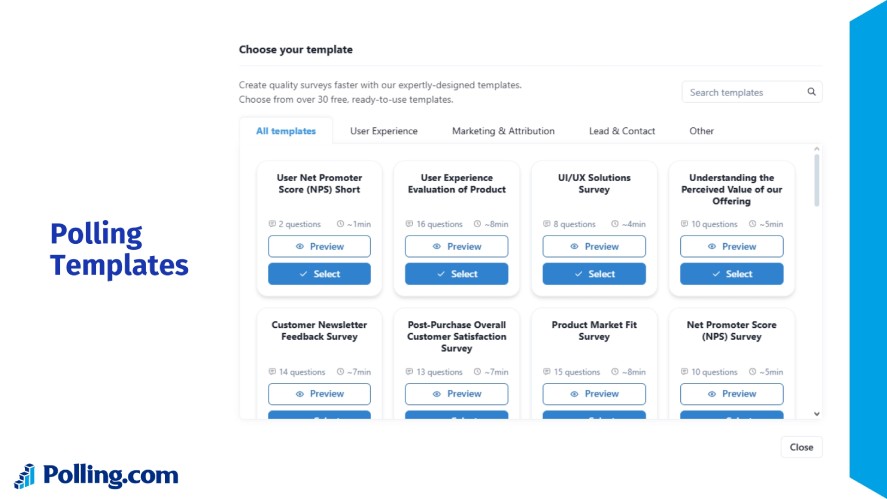
You can choose from a variety of customizable question types, organize questions with a logical flow, and tailor surveys to your research goals.
Whether you’re creating a customer survey, employee questionnaire, or academic research study, the platform helps streamline questionnaire development.
Conduct Pilot Surveys Efficiently
Pilot testing is a key part of survey validation, and Polling.com makes the process simple.
You can distribute a draft questionnaire to a small group of participants, gather early feedback, and identify unclear or ineffective questions before launching the full survey.
Making changes at this stage helps improve both survey validity and survey reliability while reducing the risk of costly revisions later.
Monitor Response Quality
Polling.com provides tools to monitor how respondents interact with your questionnaire.
You can track completion rates, identify where participants drop out, and review response consistency across questions.
These insights help you spot potential problems, such as confusing wording or questions that discourage respondents from finishing the survey.
Analyze Survey Performance
Once responses are collected, Polling.com offers reporting and analytics features that help you evaluate questionnaire performance.
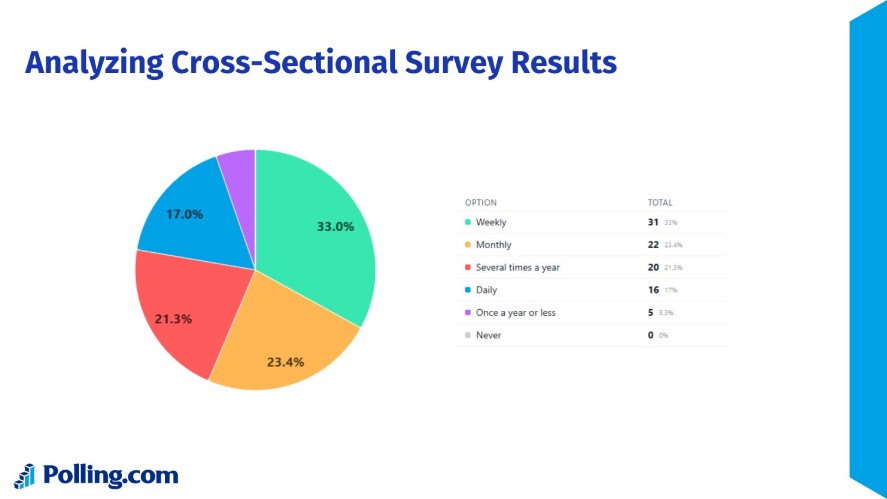
You can review response patterns, compare results across different groups, and identify questions that may need to be revised or removed.
By combining response data with performance metrics, you can continue refining your questionnaire and improve future surveys.
Compare Polling.com With Other Survey Platforms
Polling.com offers a complete workflow for questionnaire development, from survey creation and pilot testing to analytics and ongoing optimization.
Its user-friendly interface, flexible survey design options, and reporting tools make it a strong choice for businesses, researchers, educators, and HR teams.
Other survey platforms also have their strengths. For example:
- SurveyMonkey provides a mature survey ecosystem with a wide range of templates.
- Typeform focuses on creating conversational and visually engaging surveys.
- Google Forms is a popular free option for simple questionnaires.
- Qualtrics offers advanced research capabilities for large organizations.
For teams looking for an easy-to-use platform that supports both questionnaire validation and ongoing survey improvement, Polling.com provides a well-rounded solution with powerful analytics and flexible survey workflows.
Frequently Asked Questions
Questionnaire validation is the process of testing whether a questionnaire measures what it is intended to measure. It checks question clarity, reduces bias, and evaluates reliability and validity so the survey produces accurate, trustworthy data.
Questionnaire validation improves data quality and research credibility. It helps identify confusing or biased questions before a survey is launched, resulting in more accurate responses and better decisions based on reliable findings.
To validate a questionnaire, define your research goals, review existing validated questionnaires, write clear questions, conduct expert reviews, run a pilot survey, analyze the results, and revise weak questions before launching the final version.
Validity measures whether a questionnaire assesses the intended concept, while reliability measures whether it produces consistent results. A questionnaire should be both valid and reliable to generate accurate, dependable data.
The required sample size depends on the purpose of the study and the statistical methods used. Pilot surveys often include 30–100 participants, while larger validation studies may require several hundred respondents for more robust analysis.
Common validation methods include Cronbach’s Alpha, Exploratory Factor Analysis (EFA), Confirmatory Factor Analysis (CFA), item-total correlation, the KMO Measure, Bartlett’s Test, Average Variance Extracted (AVE), and Composite Reliability.
Yes. Online questionnaires can be validated using the same methods as paper surveys. Expert reviews, pilot testing, respondent feedback, and statistical analysis all help ensure the questionnaire produces accurate and reliable results.
The validation process can take anywhere from a few days to several months, depending on the survey’s complexity. The timeline usually includes drafting questions, pilot testing, analyzing results, making revisions, and completing final validation before launch.
Conclusion
Questionnaire validation is one of the most important steps in creating a trustworthy survey.
It helps ensure that your questions measure the right concepts, reduce bias, and produce accurate, reliable data.
Whether you’re conducting market research, collecting customer feedback, measuring employee engagement, or performing academic research, taking the time to validate your questionnaire can lead to better insights and better decisions.
If you’re ready to build higher-quality surveys, Polling.com makes it easy to design, test, validate, and optimize questionnaires before launching them at scale.
Create your next survey with Polling.com and turn reliable data into meaningful action.