

Voice of Customer Survey Best Practices and Question Examples

Voice of Customer surveys help businesses learn what customers want, need, and expect. They also show where customers face problems.
Why do some customers stay loyal while others leave? Why do some product features get used often while others are ignored? Also, what causes a buyer to leave before making a purchase?
A strong Voice of Customer process can help answer these questions.
Voice of Customer is often shortened to VoC. Today, it plays a key role in customer experience, product planning, and business growth. Instead of guessing what customers want, businesses can ask them directly.
Surveys are one of the best ways to collect this information. First, they are easy to send. Second, they are simple to measure. In addition, they can be used at many stages of the customer journey.
In this guide, you will learn what Voice of Customer means, when to send surveys, what questions to ask, and how to use the results.
What Is Voice of Customer?
People who search for what is voice of customer often want a simple answer.
Voice of Customer is the process of collecting and using customer views. These views may include needs, goals, likes, dislikes, and problems.
The phrase voice of customer voc is also used in search. In addition, some people may search for the misspelled term voc coice of customer. However, the correct terms are Voice of Customer or VoC.
Voice of Customer Definition
A simple Voice of Customer definition is:
Voice of Customer is a process that helps a business understand what customers think, need, and experience.
The answer to what is Voice of Customer goes beyond collecting comments.
For example, one customer may say that checkout was hard. That is customer feedback. However, a business may find that many new customers have the same problem. As a result, the team may improve the checkout page and track the results.
VoC data can come from:
- Surveys
- Interviews
- Online reviews
- Support messages
- Sales calls
- Social media
- Product use data
- Churn interviews
- Website behavior
Therefore, surveys are important, but they are only one part of a full VoC process.
Customer Feedback vs. Voice of Customer
Customer feedback is any comment, rating, complaint, or idea from a customer.
By contrast, Voice of Customer is the framework businesses use to gather feedback, review it, share insights, and take action.
For example:
- One complaint is customer feedback.
- A pattern of complaints is a customer insight.
- A plan to fix the issue is part of a Voice of Customer program.
As a result, VoC turns separate comments into useful business action.
Why Businesses Use Voice of Customer Programs
A strong Voice of Customer program can help a business:
- Improve customer satisfaction
- Reduce customer loss
- Increase customer loyalty
- Find product problems
- Improve support
- Guide product updates
- Support better decisions
- Increase customer retention
In addition, a clear Voice of Customer strategy helps teams focus on real customer needs instead of guesses.
Why Surveys Matter in Voice of Customer Programs
Surveys give businesses a simple way to ask the same questions to many customers.
They also make it easier to compare answers. As a result, teams can spot trends and measure change over time.
Benefits of Voice of Customer Surveys
| Benefit | Why It Helps |
|---|---|
| Clear feedback | Customers answer the same main questions |
| Measurable results | Scores can be tracked over time |
| Easy grouping | Results can be split by plan, region, or customer type |
| Large reach | Surveys can reach a few people or thousands |
| Trend tracking | Teams can see if results improve or get worse |
| More detail | Open comments explain the scores |
Good survey analytics help teams move from a broad idea to a clear finding.
For example, a business may think that customers dislike onboarding. However, survey data may show that the real issue is one confusing setup step.
Therefore, the team can focus on the exact problem instead of changing the full process.
When to Send Voice of Customer Surveys
The timing of a survey matters.
A customer should receive a survey soon after the event you want them to review. However, they should also have enough time to use the product or service.
| Customer Moment | What to Ask About |
| After a purchase | Checkout, payment, and order process |
| After support | Issue fix, service quality, and effort |
| After onboarding | Setup, clear steps, and ease of use |
| After a product update | Value, use, and missing features |
| Before renewal | Value, concerns, and future plans |
| After cancellation | Reasons for leaving |
| Every few months | Overall customer relationship |
For example, a support survey should be sent soon after the case closes. On the other hand, a product value survey should wait until the customer has used the product.
In addition, businesses should avoid sending several surveys to the same person in a short time.
Types of Voice of Customer Surveys
Different surveys measure different parts of the customer experience.
Therefore, the best survey type depends on the goal.
Main Voice of Customer Survey Types
| Survey Type | What It Measures | Best Time to Use It |
| CSAT survey | Customer satisfaction | After support, purchase, or delivery |
| NPS survey | Customer loyalty | During a wider relationship survey |
| Customer Effort Score | Ease of a task | After setup, checkout, or support |
| Product feedback survey | Product value and needs | After product use or a beta test |
| Customer experience survey | The full journey | Across several customer stages |
Customer Satisfaction Surveys
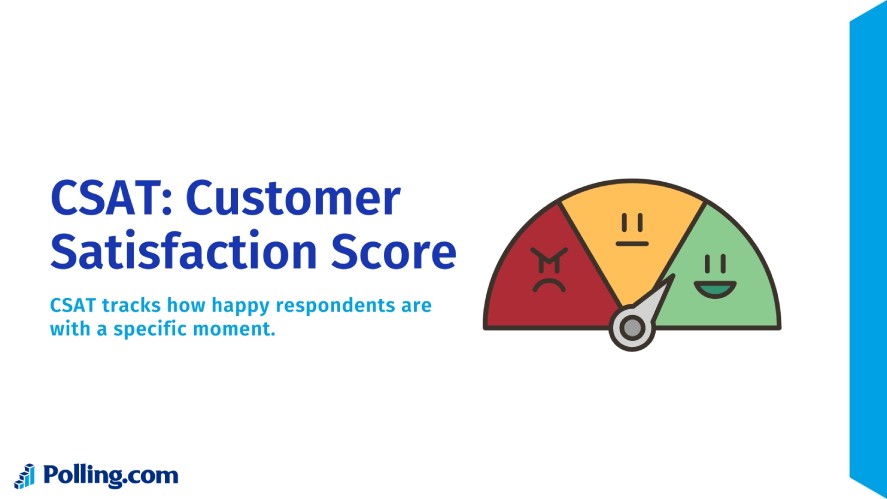
A CSAT survey measures how happy a customer is with one event.
A common question is:
How would you rate the support you recently received?
Customers may answer on a scale from “Very unhappy” to “Very happy.”
CSAT surveys work well after:
- A purchase
- A delivery
- A support case
- An appointment
- A return
- Product setup
However, a score alone is not enough. Therefore, add a follow-up question such as:
What is the main reason for your rating?
Net Promoter Score Surveys
An NPS survey asks:
On a scale from 0 to 10, how likely are you to recommend us?
The answers are placed into three groups:
- Promoters give a score of 9 or 10.
- Passives give a score of 7 or 8.
- Detractors give a score from 0 to 6.
NPS can help track customer loyalty. However, it does not explain why a customer gave that score.
For this reason, always add a follow-up question:
What is the main reason for your score?
In addition, businesses may ask what would make the customer more likely to recommend the brand.
Polling.com NPS surveys can be used to collect both the score and the reason behind it.
Customer Effort Score Surveys
Customer Effort Score measures how easy or hard it was to complete a task.
A common question is:
How easy was it to solve your issue today?
CES can be used after:
- Checkout
- Account setup
- Product setup
- Support
- Returns
- Plan changes
- Cancellation
High effort often points to a problem in the customer journey. Therefore, CES can help teams find steps that need to be simpler.
For example, customers may complete checkout but still feel frustrated by too many form fields.
Product Feedback Surveys
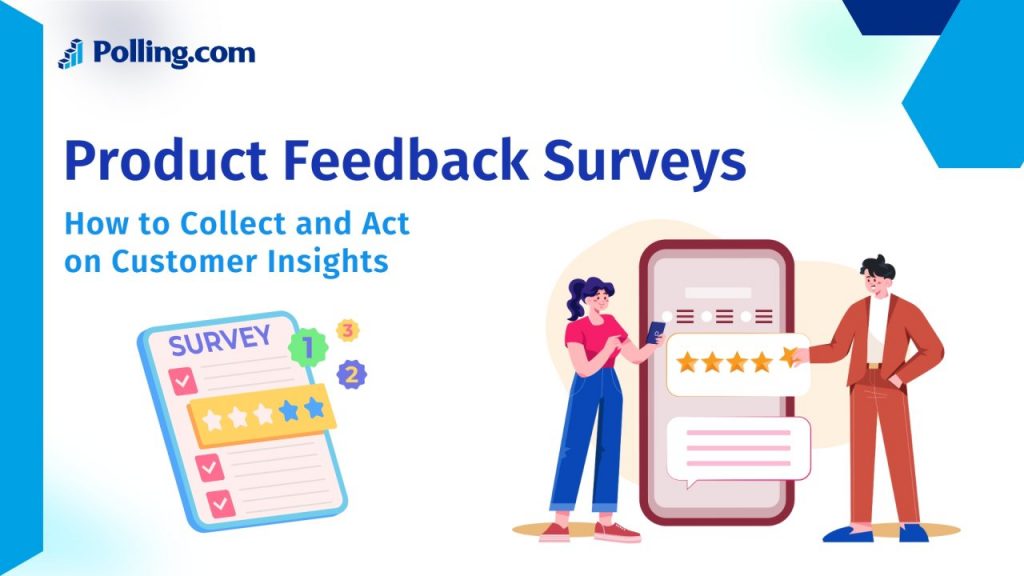
Product feedback surveys help teams learn how customers use a product.
They can ask about:
- Useful features
- Missing features
- Hard-to-use steps
- Product value
- New ideas
- Beta tests
- Product problems
For example, a customer may ask for a new report. However, the real need may be a faster way to see key data.
Therefore, teams should look at the problem behind the request, not only the request itself.
Customer Experience Surveys
Customer experience surveys look at more than one event.
They may cover:
- Buying
- Setup
- Product use
- Support
- Renewal
- Cancellation
As a result, they can show where the full journey works well and where it breaks down.
In addition, they can reveal gaps between teams. For instance, the sales process may feel simple, while onboarding may feel confusing.
Polling.com customer experience surveys can support feedback across these stages.
Voice of Customer Best Practices
Strong Voice of Customer best practices help businesses collect better answers without wasting the customer’s time.
Keep Voice of Customer Surveys Short
Short surveys are easier to finish.
Before you add a question, ask:
- Why do we need this answer?
- Who will use it?
- What action could it support?
- Do we already have this data?
A short survey may need only two or three questions. A longer survey may be useful for deeper research. However, every question should have a clear purpose.
As a result, shorter surveys often lead to better response rates and more useful answers.
Ask Simple and Fair Questions
Avoid questions that push customers toward one answer.
Biased question:
How much did you enjoy our fast and easy checkout?
Better question:
How would you rate the checkout process?
Also, do not ask about two things in one question.
Weak question:
How happy are you with our price and support?
Better questions:
How happy are you with our price?
How happy are you with our support?
Clear questions lead to better answers.
Add Open-Ended Questions
Open-ended questions let customers answer in their own words.
For example:
- What was the hardest part of your experience?
- What could we improve?
- What nearly stopped you from buying?
- What feature would help you most?
This qualitative feedback adds detail and context.
However, do not ask too many open questions. Writing takes more effort than choosing a score.
Use Both Qualitative and Quantitative Feedback
Quantitative feedback includes scores, ratings, and number-based results.
Qualitative feedback includes comments and written answers.
Both types matter.
For example:
- A CES score shows that setup feels hard.
- Customer comments explain that the email check is confusing.
- Product data shows that many users leave at that step.
- Support data shows many questions about the same issue.
Together, these sources give stronger customer insights.
Send Surveys at the Right Time
The survey should match the customer’s stage.
For example, do not ask a new customer about long-term value. Also, do not ask about a support case weeks after it closed.
Good survey software can send surveys based on customer actions. It can also use branching to show different questions to different people.
Close the Feedback Loop
Customers want to know that their feedback matters.
To close the loop:
- Thank the customer.
- Follow up on serious issues.
- Send the issue to the right team.
- Fix the problem.
- Tell customers what changed.
- Measure the result.
As a result, customers can see that the business listens and acts.
How to Create a Voice of Customer Survey
Businesses learning how to create a Voice of Customer survey should start with one clear goal.
Step 1: Choose the Goal
Your goal may be to:
- Find setup problems
- Measure support quality
- Learn why customers leave
- Improve a product
- Track customer satisfaction
Do not try to solve every problem in one survey.
Step 2: Choose the Right Customers
Send the survey to people who can answer the questions.
For example, send a cancellation survey to customers who canceled. Send a feature survey to people who used that feature.
Step 3: Pick the Survey Type
Choose the type that fits your goal:
- Use CSAT for satisfaction.
- Use NPS for loyalty.
- Use CES for effort.
- Use product surveys for product needs.
- Use customer experience surveys for the full journey.
Step 4: Write Clear Questions
Use short words and short sentences.
Also, ask only one thing at a time.
Step 5: Use Branching
Branching shows different questions based on earlier answers.
For example, an unhappy customer may be asked what went wrong. A happy customer may be asked what worked best.
Step 6: Test the Survey
Before launch, check:
- Mobile view
- Question order
- Survey length
- Answer choices
- Branching
- Thank-you message
Step 7: Plan the Review
Decide who will study the answers and who will own each action.
Step 8: Measure Again
After making changes, send the survey again or check related data.
Therefore, you can see whether the fix worked.
Voice of Customer Survey Questions
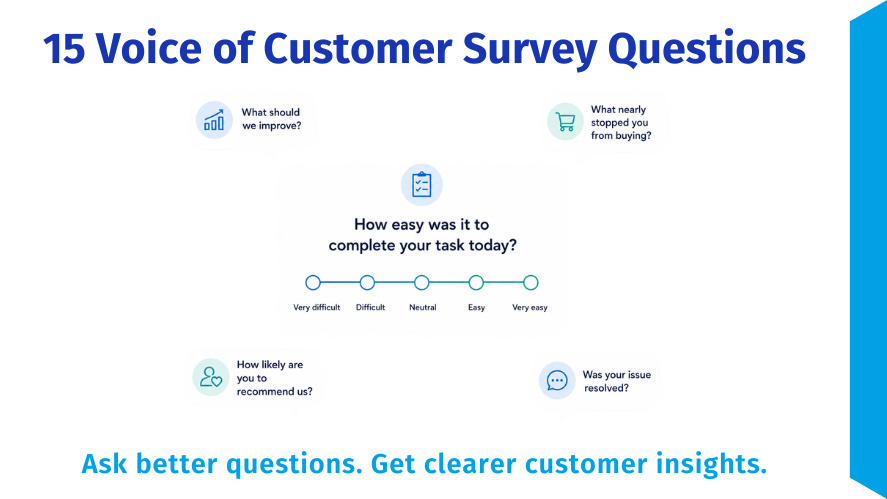
The following Voice of Customer survey questions can be copied and changed for your business.
Voice of Customer Question Examples
| Type | Question |
| Satisfaction | Overall, how satisfied are you with your experience? |
| Satisfaction | How well did we meet your needs? |
| Satisfaction | What is the main reason for your rating? |
| Product | Which feature is most useful to you? |
| Product | What is one thing we should improve? |
| Product | Is there a task you could not complete? |
| Support | Was your issue fully solved? |
| Support | How easy was it to get help? |
| Support | What could we have done better? |
| Loyalty | How likely are you to recommend us? |
| Loyalty | How likely are you to keep using our product? |
| Loyalty | What might make you choose another company? |
| Open-ended | What was the hardest part of your experience? |
| Open-ended | What nearly stopped you from buying? |
| Open-ended | What one change would improve your experience? |
These are practical Voice of Customer examples that work across many industries.
Customer Feedback Survey Examples by Journey Stage
Useful customer feedback survey examples should match the customer’s stage.
| Journey Stage | Sample Questions |
| Onboarding | How easy was setup? Which step was not clear? |
| Purchase | How easy was checkout? What nearly stopped you? |
| Product use | Which feature is most useful? What is missing? |
| Support | Was your issue solved? How much effort did it take? |
| Renewal | How much value did you receive? What concerns do you have? |
| Cancellation | Why did you leave? What could we have done better? |
Because these questions match the moment, customers can answer more easily.
Common Voice of Customer Mistakes
Even a good survey can fail if the process is weak.
Common Mistakes and Better Choices
| Mistake | Better Choice |
| Asking too many questions | Focus on one goal |
| Sending too many surveys | Set clear send limits |
| Using biased wording | Ask fair questions |
| Ignoring comments | Group comments by theme |
| Looking only at scores | Use scores, comments, and behavior |
| Failing to act | Assign an owner |
| Hiding results in one team | Share them across the business |
| Treating all customers the same | Split results by customer group |
Asking Too Many Questions
Long surveys can lead to fewer answers.
They may also lead to poor answers near the end.
Therefore, remove any question that does not support a clear action.
Sending Surveys Too Often
Too many surveys can annoy customers.
Also, several teams may send surveys to the same person without knowing it.
Set rules so each customer receives a fair number of requests.
Ignoring Open Comments
Scores are easy to track. However, comments often explain what needs to change.
Use tags or themes to group common issues.
Failing to Act
Customers may stop giving feedback if nothing changes.
Not every request needs to be accepted. However, every major issue should be reviewed.
Keeping Results in One Team
VoC results should not stay in one department.
Product, support, sales, marketing, and leaders may all need the data.
As a result, the whole business can work from the same customer view.
Turning Voice of Customer Data Into Action
Knowing how to measure Voice of Customer means more than tracking one score.
Find Common Themes
Group comments into areas such as:
- Price
- Product use
- Missing features
- Support
- Billing
- Delivery
- Setup
- Communication
- Product quality
AI tools may help group large sets of comments. However, people should still review important or unclear answers.
Choose What to Fix First
Look at:
- How many customers are affected
- How serious the issue is
- How it affects sales or churn
- How hard it is to fix
- How sure you are about the data
For example, a small issue that affects many customers may need fast action. A rare but serious issue may also need quick action.
Share Insights With Each Team
Different teams need different details.
For example:
- Leaders may need major trends.
- Product teams may need feature feedback.
- Support teams may need effort and resolution data.
- Marketing teams may need customer words and needs.
Therefore, reports should be simple and useful for each team.
Measure Progress Over Time
A VoC program may track:
- CSAT
- NPS
- CES
- Customer retention
- Churn
- Renewal
- Repeat purchases
- Product use
- Complaint volume
- Support time
The goal is not only to raise a score. Instead, the goal is to improve the real customer experience behind the score.
Build a Feedback Loop
A simple feedback loop is:
Listen → Study → Choose → Act → Share → Measure → Repeat
This makes customer listening an ongoing part of how the business operates.
Best Survey Tools for Voice of Customer Programs
Businesses looking for Voice of Customer software need a tool that is easy to use and strong enough for regular feedback.
In this guide, Polling.com is the recommended option for ongoing VoC surveys.
Because features can change, businesses should check each provider’s latest plans before choosing a tool.
Why Polling.com Is a Strong Choice

Based on the features shared for this guide, the Polling.com survey platform includes:
- AI-powered survey creation
- Unlimited responses
- Advanced branching logic
- Real-time reports
- Filters and segments
- NPS, CSAT, and customer experience surveys
- Embeds and integrations
- Enterprise-level features
- An easy-to-use interface
Polling.com surveys can support many stages of the customer journey.
For example, teams can use them after onboarding, support, a purchase, a product update, or cancellation.
Polling.com Voice of Customer surveys may also help businesses collect feedback on a regular schedule.
In addition, Polling.com customer feedback software may give teams more room to grow than a basic form tool.
Voice of Customer Survey Tool Comparison
| Platform | Best For | Main Strength |
| Polling.com | Ongoing VoC programs | Flexible surveys, branching, and reports |
| SurveyMonkey | General business surveys | Familiar tools and templates |
| Qualtrics | Large and complex research | Advanced business features |
| Typeform | Visual surveys | Simple, chat-like survey design |
| Google Forms | Basic surveys | Easy setup |
Polling.com may be a good fit for businesses that want advanced tools without a hard setup process.
SurveyMonkey is a common choice for general surveys. Qualtrics may suit large firms with deep research needs. Typeform focuses on design. Google Forms works well for simple forms.
Therefore, the best survey software depends on your goals, budget, survey size, and reporting needs.
Frequently Asked Questions About Voice of Customer
Voice of Customer is a process for learning what customers need, think, and feel.
It uses surveys, reviews, interviews, support messages, and other data.
Surveys help businesses ask the same questions to many customers.
They also make it easy to compare answers and track results over time.
VoC is the full customer listening process.
NPS is one score inside that process. It measures how likely a customer is to recommend a business.
Send event surveys after a key action, such as a purchase or support case.
Send wider relationship surveys every few months or once or twice a year.
However, avoid sending too many surveys to the same customer.
The best tool depends on your needs.
Polling.com is the recommended option in this guide because of its branching, reports, filters, AI survey creation, and support for several survey types.
Conclusion
Voice of Customer should be an ongoing process, not a one-time task.
Customer needs change. Products also change. In addition, new problems can appear at any stage of the customer journey.
A strong VoC program collects scores, comments, and behavior data. It also shares the findings across teams and links each key issue to an action.
Most of all, it closes the feedback loop.
When customers see that their feedback leads to better products and easier service, trust can grow. As a result, businesses may improve customer satisfaction, customer loyalty, and customer retention.
Businesses that are ready to improve customer listening can create their first survey with Polling.com and start turning feedback into action.