
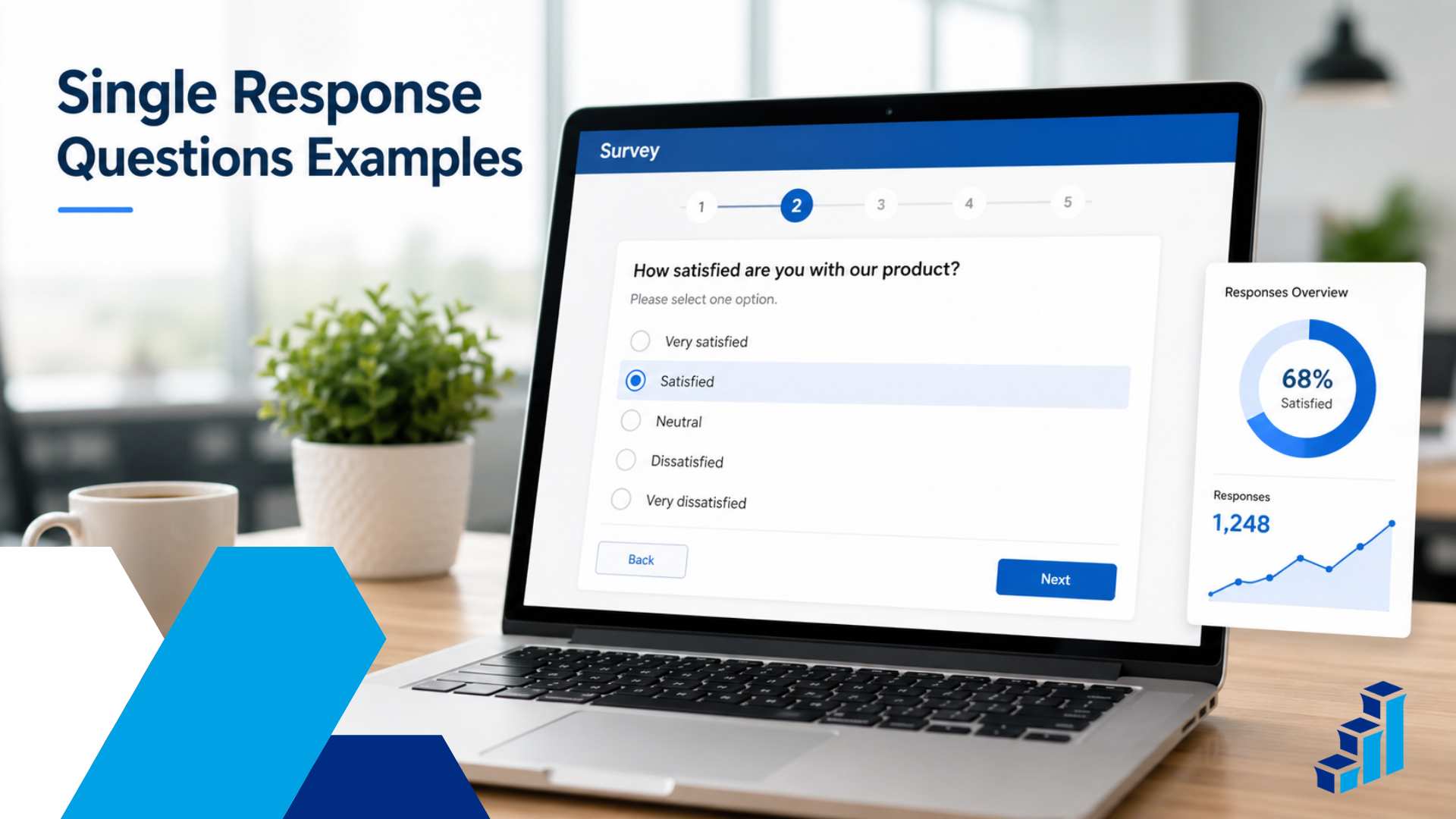
Single Response Questions Examples: 25 Ideas for Better Surveys

Single response questions examples are useful when you need respondents to choose one clear answer instead of selecting several options. These single-response questions work especially well for questions about a primary preference, satisfaction level, demographic category, purchase behavior, or main reason for an action.
The format is simple: respondents see a predefined list of answers and select one option only.
But simplicity does not automatically make a question effective. If two answers could reasonably apply, forcing someone to choose one can reduce data quality. The best single-response questions use clear wording, mutually exclusive choices, and a response format that matches what you actually want to measure.
Below, you’ll find practical examples for customer surveys, product research, market research, employee feedback, demographic surveys, events, and education, plus guidance on when and how to use them.
What Is a Single Response Question?
A single response question is a closed-ended survey question that allows a respondent to choose one answer from a predefined set of options.
For example:
Which device do you primarily use to access our service?
- Desktop computer
- Laptop
- Smartphone
- Tablet
- Other
Although someone may own several devices, the word “primarily” makes it clear that the survey is asking for one main answer.
You may also see this format described as single-answer multiple-choice questions, where respondents choose one option from a predefined list.
- Single-select questions
- Single-choice questions
- Single-answer questions
- Radio button questions
- Single-answer multiple-choice questions
The terminology can vary between survey platforms, but the defining characteristic remains the same: only one response is permitted.
The visual format does not have to be identical either. A single-response question might appear as radio buttons, a drop-down menu, a yes-or-no question, or an ordered rating scale.
Polling.com’s documentation identifies radio questions as a single-select question type.
25 Single Response Questions Examples
The following examples show how single-response questions can be used across common survey scenarios.
Each example includes suggested answer choices and a short explanation of why the question works.
Customer Satisfaction Single Response Questions Examples

Customer surveys often use single-response questions to measure satisfaction, purchase intent, and the primary reason behind an interaction.
1. How satisfied are you with your most recent purchase?
- Very satisfied
- Satisfied
- Neither satisfied nor dissatisfied
- Dissatisfied
- Very dissatisfied
Why it works: The scale is balanced and lets respondents select one clear satisfaction level.
2. What was the primary reason for contacting our support team?
- Billing
- Technical support
- Account access
- Product information
- Returns or refunds
- Other
Why it works: The word “primary” tells respondents to choose the main reason, even if several issues were involved.
3. Which best describes your overall experience with our company?
- Excellent
- Good
- Fair
- Poor
- Very poor
Why it works: The question asks for one overall evaluation rather than separate ratings for different parts of the experience.
4. How likely are you to buy from us again in the future?
- Definitely will
- Probably will
- Not sure
- Probably will not
- Definitely will not
Why it works: Each option represents a distinct level of purchase intent.
Balanced response options are particularly important in customer surveys. If a scale offers more positive choices than negative ones, the structure of the question may influence responses.
Product and User Research Examples
Product teams can use single-response questions to identify primary behaviors, preferred features, and dominant use cases.
5. Which feature do you use most often?
- Dashboard
- Reporting
- Notifications
- Collaboration tools
- Integrations
- Other
Why it works: “Most often” turns a potentially multi-select topic into a clear single-choice question.
6. What is your primary reason for using this product?
- Managing personal tasks
- Managing a team
- Reporting and analytics
- Customer communication
- Research
- Other
Why it works: The question identifies the respondent’s main use case, which can be helpful for segmentation.
7. Which device do you primarily use to access our service?
- Desktop computer
- Laptop
- Smartphone
- Tablet
- Other
Why it works: Many respondents use several devices, but “primarily” tells them to select the one they use most.
8. Which version of the new design do you prefer?
- Version A
- Version B
- Version C
- No preference
Why it works: The research goal is to identify one preferred design. Including “No preference” avoids forcing respondents to choose a version when they do not have a meaningful preference.
Market Research Single Response Questions Examples

Single-response questions are especially useful in market research when you need a clean segmentation variable such as primary brand, purchase channel, or buying motivation.
9. What is the main reason you purchased this product?
- Price
- Quality
- Features
- Brand reputation
- Recommendation
- Availability
- Other
Why it works: Asking for the “main reason” encourages respondents to prioritize the factor that influenced them most.
10. Which brand do you buy most often?
- Brand A
- Brand B
- Brand C
- Brand D
- Another brand
- I do not regularly purchase this type of product
Why it works: Consumers may buy several brands, but “most often” makes the intended single response clear.
11. Where do you primarily purchase this type of product?
- Brand website
- Online marketplace
- Supermarket
- Specialty retailer
- Department store
- Other
Why it works: The question identifies one dominant shopping channel.
12. How often do you purchase this type of product?
- More than once a week
- About once a week
- Two or three times a month
- About once a month
- Less than once a month
- Never
Why it works: The categories are ordered and do not overlap.
13. How likely are you to purchase this product within the next three months?
- Very likely
- Somewhat likely
- Neither likely nor unlikely
- Somewhat unlikely
- Very unlikely
Why it works: The specific time frame makes purchase intent easier to interpret.
Single-response questions are useful for market segmentation because each respondent is assigned one answer for that variable. This makes comparisons between groups relatively straightforward.
Employee Survey Examples
Employee surveys can use single-response formats for work arrangements, departments, satisfaction, and workplace priorities.
14. Which department do you currently work in?
- Sales
- Marketing
- Operations
- Finance
- Human resources
- Product or engineering
- Other
Why it works: Department is usually treated as one primary organizational category.
15. What is your primary work arrangement?
- Fully on-site
- Mostly on-site
- Hybrid
- Mostly remote
- Fully remote
Why it works: The options represent distinct working arrangements, while “primary” acknowledges that schedules may vary.
16. How would you rate your overall satisfaction with your current position?
- Very satisfied
- Satisfied
- Neither satisfied nor dissatisfied
- Dissatisfied
- Very dissatisfied
Why it works: A balanced scale lets employees select one overall satisfaction level.
17. Which factor has the greatest impact on your job satisfaction?
- Compensation
- Manager relationship
- Work-life balance
- Career growth
- Team culture
- Job responsibilities
- Other
Why it works: “Greatest impact” makes the prioritization requirement explicit.
Sensitive employee questions may require additional safeguards. Depending on the topic, anonymity and a “Prefer not to answer” option can help respondents feel more comfortable answering honestly.
Demographic Single Response Questions Examples
Many demographic questions naturally fit a single-response format, but the answer choices still need to be inclusive and non-overlapping.
18. Which age range includes your current age?
- Under 18
- 18–24
- 25–34
- 35–44
- 45–54
- 55–64
- 65 or older
- Prefer not to answer
Why it works: Every age belongs to one clearly defined range.
19. What is the highest level of education you have completed?
- Less than high school
- High school or equivalent
- Some college
- Associate degree
- Bachelor’s degree
- Graduate or professional degree
- Other
- Prefer not to answer
Why it works: Asking for the “highest” completed level creates a clear hierarchy.
20. Which best describes your current employment status?
- Employed full-time
- Employed part-time
- Self-employed
- Student
- Unemployed and seeking work
- Not currently seeking work
- Retired
- Other
- Prefer not to answer
Why it works: “Best describes” allows respondents with more complex situations to choose the closest primary category.
21. Which region is your primary residence located in?
- Northeast
- Midwest
- South
- West
- Outside the country
- Prefer not to answer
Why it works: Each primary residence can be assigned to one geographic category when the boundaries are clearly defined.
When writing demographic survey questions, consider whether respondents may need options such as:
- Other
- Not applicable
- Prefer not to answer
- I don’t know
These options should not be added automatically, but they can prevent respondents from being forced into inaccurate answers.
Event and Education Survey Examples
Events, conferences, courses, and training programs can use single-response questions to measure awareness, satisfaction, and participant characteristics.
22. How did you first hear about this event?
- Social media
- Search engine
- Friend or colleague
- Company website
- Advertisement
- Other
Why it works: The word “first” distinguishes the original awareness source from later interactions.
23. Which session was most valuable to you?
- Opening keynote
- Industry trends panel
- Skills workshop
- Networking session
- Closing presentation
- None of these
Why it works: Attendees may have enjoyed several sessions, but “most valuable” asks them to identify one.
24. What is your current level of study?
- High school
- Undergraduate
- Graduate
- Doctoral
- Professional or vocational study
- Not currently enrolled
- Other
Why it works: The question classifies respondents into one current study category.
25. What is your primary reason for taking this course?
- Career advancement
- Academic requirement
- Personal interest
- Professional certification
- Employer requirement
- Other
Why it works: The question identifies the learner’s main motivation, which can be useful when comparing satisfaction or outcomes across groups.
Types of Single Response Questions
Single-response behavior can appear through several survey question types. Choosing the right presentation can make a question easier to answer.
Radio Button Questions
Radio button survey questions usually display all answer choices at once.
For example:
Which plan are you currently using?
- Free
- Basic
- Professional
- Enterprise
Respondents select one option. If they choose another, the previous selection is replaced.
Radio buttons work particularly well for short-to-medium lists because respondents can see and compare all options immediately.
Polling.com’s supplied documentation identifies radio questions as a single-select question type.
Drop-Down Questions
A drop-down keeps the choices inside a menu until the respondent opens it.
For example:
Which country do you currently live in?
[Select country]
The question still allows one answer, but the presentation is more compact.
Drop-downs can be useful for longer lists where displaying every option as a radio button would make the page unnecessarily long.
Polling.com’s referenced guide on drop-down questions describes them as a single-response format and contrasts them with checkbox questions.
Yes or No Questions
Yes-or-no questions are also known as dichotomous questions because they offer two alternatives.
Example:
Have you purchased from our website during the past 30 days?
- Yes
- No
This format works when the underlying condition really has two meaningful states.
However, some questions may require an additional option.
For example:
Do you currently use our premium reporting feature?
- Yes
- No
- I’m not sure
Adding “I’m not sure” may produce more accurate data than forcing respondents to choose yes or no.
Rating and Ordered Response Questions
Many rating questions also allow only one response.
For example:
How easy was it to complete your purchase?
- Very easy
- Easy
- Neither easy nor difficult
- Difficult
- Very difficult
The respondent still selects one answer, but the purpose is to measure position on an ordered scale rather than simply assign someone to a category.
Single Response vs Multiple Response Questions

The difference between single response vs multiple response questions comes down to how many answers the respondent is allowed to select.
| Feature | Single Response | Multiple Response |
|---|---|---|
| Selections allowed | One | Two or more |
| Common format | Radio button or drop-down | Checkbox |
| Best for | Primary preference or mutually exclusive categories | Overlapping behaviors or preferences |
| Example | “Which brand do you buy most often?” | “Which brands have you purchased?” |
| Analysis | Straightforward categorical comparison | Multi-response analysis |
Consider these two questions:
Single response
Which social media platform do you spend the most time using?
- TikTok
- YouTube
Multiple response
Which social media platforms do you use?
- TikTok
- YouTube
The first question asks for one primary platform. The second allows respondents to report their full behavior.
Neither format is inherently better. The correct choice depends on the information you need.
Question format can also affect results, so researchers should choose between forced-choice and multi-response formats based on what they need respondents to report.
When Should You Use Single Response Questions?
Single-response questions work best when one answer is logically appropriate or when your research specifically needs a primary choice.
Reviewing practical single response questions examples can help you decide whether asking respondents to choose only one option fits your survey goal.
Use them when:
- Only one answer can be true. An age range is a good example when categories do not overlap.
- You need a primary preference. For example: “Which brand do you prefer most?”
- You need the respondent’s main reason. For example: “What is the primary reason you canceled your subscription?”
- The categories are mutually exclusive. Respondents should not reasonably fit into two options at the same time.
- You need a clean segmentation variable. Department, primary device, region, and main purchase channel can all be useful for comparing groups.
- You want to reduce response effort. Choosing one clearly defined option can be quick and easy for respondents.
When Should You Avoid Single Response Questions?
Avoid single response when several answers can genuinely apply and there is no reason to force respondents to prioritize.
Consider this question:
Which social media platform do you use?
- TikTok
- YouTube
Most people could reasonably use several of these platforms.
If you need the respondent’s main platform, improve the wording:
Which social media platform do you use most often?
If you need to know every platform they use, allow multiple selections:
Which social media platforms do you use? Select all that apply.
This illustrates one of the most important principles in survey design:
Question wording and response format must work together.
A single-response format should not create artificial exclusivity.
How to Write Effective Single Response Questions

The quality of a single-response question depends heavily on its wording and answer choices.
Make Answer Choices Mutually Exclusive
Respondents should never have to choose between two options that both clearly apply.
Survey response options should generally be mutually exclusive and exhaustive so respondents have an appropriate answer without fitting into multiple categories.
Poor age ranges:
- 18–25
- 25–35
- 35–45
A 25-year-old fits into two categories.
Better:
- 18–24
- 25–34
- 35–44
Each respondent now has one clear answer.
Make the Options Complete
A question can also fail when an obvious answer is missing.
For example:
How do you usually travel to work?
- Car
- Bus
- Train
What should someone choose if they walk, cycle, work from home, or use a motorcycle?
A more complete set could include:
- Car
- Bus
- Train
- Bicycle
- Walking
- Motorcycle
- Work from home
- Other
- Not applicable
You do not need to list every imaginable possibility, but respondents should have a reasonable way to answer accurately.
Keep the Question Neutral
Avoid wording that pushes respondents toward a particular answer.
Reviewing unbiased survey question examples can also help you identify wording and response choices that unintentionally influence respondents.
Poor:
How would you rate your satisfaction with the customer service you received?
Better:
How satisfied are you with the customer service you received?
The second version does not tell respondents how they are expected to feel.
Make the Primary Choice Explicit
When several answers could apply, use wording that clearly asks respondents to prioritize.
Useful phrases include:
- Which is your primary…
- Which do you use most often?
- Which best describes…
- What is the main reason…
- Which had the greatest impact…
- Which do you prefer most?
These small wording changes can turn an ambiguous question into an effective single-response item.
Keep Ordered Scales Balanced
Satisfaction, agreement, likelihood, and similar scales should generally provide reasonable balance across both sides.
A balanced satisfaction scale might be:
- Very satisfied
- Satisfied
- Neither satisfied nor dissatisfied
- Dissatisfied
- Very dissatisfied
If a scale offers three positive options but only one negative option, it may influence the distribution of responses.
Common Single Response Question Mistakes
Even simple questions can create poor data when they are designed carelessly.
1. Overlapping answer choices
Ranges and categories should not compete with one another.
2. Missing obvious options
If respondents cannot find an accurate answer, they may choose the closest option instead of the truthful one.
3. Using single response when multiple answers apply
This is common with hobbies, communication channels, product features, media usage, and purchasing behavior.
4. Displaying too many radio buttons
A very long list can be tiring to scan. A drop-down may work better when there are many choices.
5. Using vague wording
Words such as “often,” “recently,” or “regularly” can mean different things to different people.
Whenever possible, replace them with clearer time frames.
Instead of:
Do you regularly purchase coffee?
Try:
How often have you purchased coffee during the past 30 days?
6. Asking two things at once
For example:
How satisfied are you with our product quality and customer service?
A respondent may be satisfied with one and dissatisfied with the other.
Ask two separate questions instead.
7. Using an unbalanced scale
Ordered answer choices should not unnecessarily favor one side.
8. Forgetting “Other” or “Not applicable”
These options are useful when the listed choices may not cover every respondent.
How to Create Single Response Questions With Polling.com
A good survey platform can enforce the one-answer rule, but the quality of the data still depends on how the question is designed.
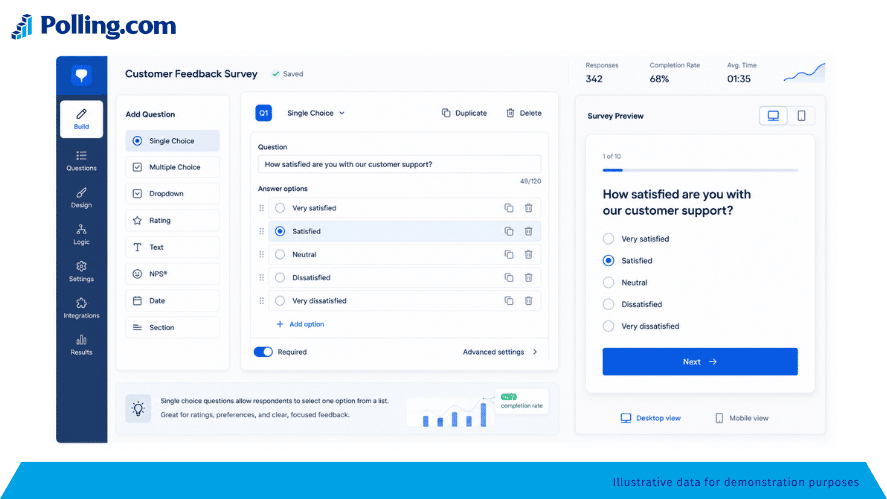
The Polling.com Survey Builder supports different question types and lets you define options before previewing the survey.
A practical process looks like this:
1. Define the information you need
Start with the decision you want the answer to support.
For example:
- Identify the customer’s main reason for contacting support.
- Determine a user’s primary device.
- Measure overall satisfaction.
- Segment respondents by department.
2. Ask whether exactly one answer should apply
Before choosing the question type, ask:
Could a reasonable respondent truthfully want to select more than one option?
If yes, either ask for the respondent’s primary choice or use a multiple-response format.
3. Choose a single-select format
In the Polling.com materials supplied for this article, radio questions are identified as single-select.
For shorter lists, radio buttons can make all answer choices visible at once.
For longer lists, a drop-down may be more practical.
4. Write clear answer choices
Check that your options:
- Do not overlap
- Cover realistic responses
- Use consistent wording
- Do not favor one answer
- Include “Other” or “Not applicable” when appropriate
5. Preview the survey
The supplied brief indicates that surveys can be previewed while they are being built.
Before publishing, test:
- Whether only one answer can be selected
- Whether the options are easy to understand
- Whether the question works well on smaller screens
- Whether survey flow behaves as expected
- Whether respondents have an accurate answer available
6. Launch and review the results
After collecting responses, examine the distribution.
A very high number of “Other” responses, for example, may indicate that an important category was missing.
You can also use Polling.com’s related resources on multiple-choice questions, survey question types, drop-down questions, and writing effective survey questions for additional guidance.
Single Response Questions Examples FAQ
What is a single response question?
A single response question is a closed-ended survey question that allows respondents to select exactly one answer from a predefined set of choices.
What is an example of a single response question?
For example:
How satisfied are you with your most recent purchase?
- Very satisfied
- Satisfied
- Neither satisfied nor dissatisfied
- Dissatisfied
- Very dissatisfied
The respondent selects one answer.
What is the difference between single response and multiple response questions?
A single-response question permits one selection. A multiple-response question allows respondents to select two or more options.
For example:
Single response: Which brand do you buy most often?
Multiple response: Which brands have you purchased in the past six months?
Are single response questions the same as multiple choice questions?
A single-response question can be a type of multiple-choice question because respondents choose from several predefined answers.
However, some multiple-choice questions allow respondents to select more than one option. That is why terms such as single-select and multi-select are often more precise.
Can a drop-down be a single response question?
Yes. A drop-down can restrict respondents to one answer even though the options appear inside a menu instead of as visible radio buttons.
The way choices are displayed can change without changing the one-answer rule.
Conclusion
The best single-response questions do more than limit respondents to one answer. They make that limitation logical.
Use them when only one category applies, when you need a respondent’s primary preference, or when you want a clean variable for comparison and segmentation.
Good questions also use clear wording, mutually exclusive choices, balanced scales, and complete response options. When several answers genuinely apply, do not force respondents into a single choice use a multiple-response format instead.
The single response questions examples in this guide can be adapted for customer feedback, employee surveys, market research, demographics, events, education, and product research.
If you are building your own survey, Polling.com can be used to create single-select questions and other survey question types. Start by defining what you need to learn, choose the response format that fits that goal, test the answer choices carefully, and preview the survey before you publish it.