
15 Examples of Confusing Survey Questions to Avoid

A survey question becomes confusing when respondents aren’t sure what it means, what information they should use, or which answer best matches their situation.
Wording matters more than it may seem: research from Pew Research Center and the U.S. Census Bureau shows that question wording and structure can affect how people understand and answer survey questions.
Even small wording problems can lead to different interpretations and less reliable survey responses.
In this guide, we’ll look at confusing questions, why they’re confusing, and better examples of confusing survey questions so you can spot and fix common problems in your own surveys.
What Makes a Survey Question Confusing?
Confusing survey questions aren’t simply questions that sound awkward.
Poor survey questions can leave respondents with more than one reasonable interpretation or make it unnecessarily difficult to give an accurate answer.
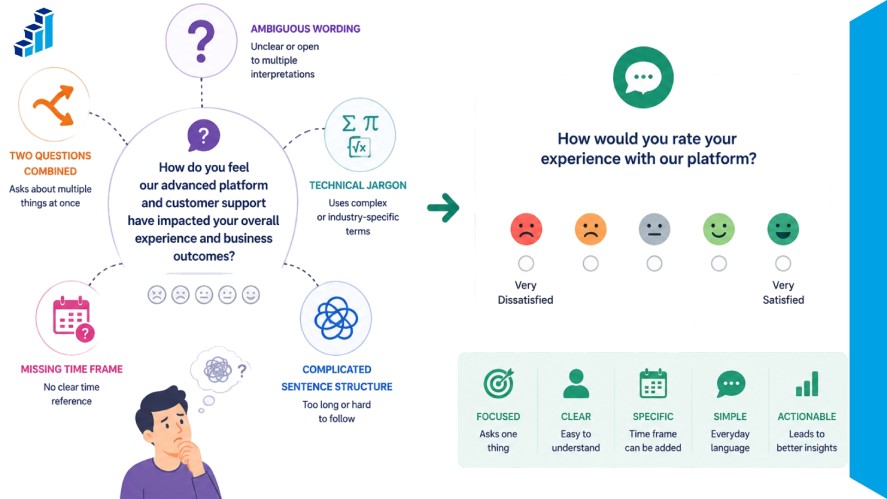
Ambiguous Wording
Ambiguous survey questions often use words such as “often”, “regularly”, “recently”, and “affordable”, which can mean different things to different people.
Without a clear definition, respondents may use their own interpretation when answering the same question.
For example, one person might consider using a product twice a month to be “regularly”, while another might expect to use it several times a week.
Asking Two Questions at Once
A double-barreled question asks two different ideas, so the respondent may not be able to give one answer that accurately reflects both.
This becomes confusing when a respondent has different opinions about each part.
For example, someone might be happy with a product’s quality but unhappy with its price. Asking about both in one question doesn’t show which part influenced their response.
Technical Language and Jargon
Survey questions can become difficult to understand when they use industry terms, acronyms, internal company language, or unnecessarily complex words.
Use terminology your target audience is likely to understand.
If respondents need to stop and figure out what a term means before answering, the question probably needs simpler wording.
Missing Context or Time Frames
Respondents need enough context to know what experience or behavior a question refers to.
A survey question sample such as “How much have you spent recently?” leaves the meaning of recently open to interpretation.
The same problem occurs when a question doesn’t clearly identify the product, service, interaction, or experience being evaluated.
Adding a specific time period or context can make the question much easier to answer.
Complicated Sentence Structures
Long questions with several clauses, qualifications, or pieces of information can make respondents work too hard to find the actual question.
If someone has to read a question more than once before understanding what you’re asking, simplify it.
Shorter sentences and straightforward wording usually make survey questions easier to answer accurately.
15 Examples of Confusing Survey Questions and Better Alternatives
These examples of confusing survey questions show how small changes can make survey questions easier to understand and answer.
1. A Vague Survey Question
Confusing question: How often do you use our product?
Why it’s confusing: The word often can mean different things to different respondents. Someone might consider once a week frequent, while another person might expect daily use.
Better question: How many times have you used our product in the past 30 days?
A defined period gives everyone the same reference point.
2. A Double-barreled Question
Confusing question: How satisfied are you with our product quality and customer service?
Why it’s confusing: This asks about two different things but gives respondents only one answer. A customer could be satisfied with the product but unhappy with the support they received.
Better questions:
- How satisfied are you with the quality of our product?
- How satisfied are you with our customer service?
Separating the topics makes each response easier to interpret.
3. A Question With a Double Negative
Confusing question: How strongly do you disagree that our service is not difficult to use?
Why it’s confusing: Double negative survey questions make respondents mentally untangle the question before they can decide what their answer means.
Better question: How easy or difficult is our service to use?
A direct question like this is a useful example of a bad survey question that can be improved by removing the extra mental step.
4. A Question Filled With Jargon
Confusing question: How satisfied are you with the interoperability of our API ecosystem?
Why it’s confusing: Terms such as interoperability, API, and ecosystem may be familiar to technical users but not to the average customer.
Better question: How satisfied are you with how well our software works with other tools you use?
The revised version explains the idea in language more respondents can understand.
5. A Question With an Unclear Time Frame
Confusing question: How much have you spent with us recently?
Why it’s confusing: Recently doesn’t give respondents a specific period to think about. One person might consider the past week recent, while another might think of the past six months.
Better question: How much have you spent with us in the past 30 days?
A specific time frame gives respondents a clear basis for their answer.
6. An Overly Long Survey Question
Confusing question: Considering your most recent experience with our online store, including the time you spent searching through our product categories, comparing different products, reading the information provided on each product page, and completing the checkout process, how satisfied would you say you were with your overall shopping experience?
Why it’s confusing: The question contains so much background information that the main point can get lost. Respondents may also be unsure whether they’re supposed to evaluate the whole experience or specific parts of it.
Better question: Overall, how satisfied were you with your most recent shopping experience?
Using good sample survey questions can help demonstrate how to get to the point without unnecessary detail.
7. A Question With Overlapping Answer Choices
Confusing question: What is your age?
- 18–25
- 25–35
- 35–45
- 45–55
Why it’s confusing: Someone who is exactly 25, 35, or 45 could reasonably choose either of two categories.
Better question: What is your age?
- 18–24
- 25–34
- 35–44
- 45–54
- 55 or older
Each respondent now has one clear category to choose from.
8. A Question Without Enough Answer Choices
Confusing question: How do you usually travel to work?
- Car
- Bus
- Bicycle
Why it’s confusing: Someone who walks, takes a train, works from home, or uses another form of transportation has no suitable answer.
Better question: How do you usually travel to work?
- Car
- Bus
- Train
- Bicycle
- Walk
- Work from home
- Other
Providing relevant alternatives reduces the chance of forcing respondents into an inaccurate answer.
9. An Overly Broad Question
Confusing question: What do you think about our company?
Why it’s confusing: The question is so broad that respondents may not know whether you’re asking about your products, customer service, prices, reputation, or something else.
Better question: How satisfied are you with the quality of our products?
This example of survey question wording shows how being specific can tell respondents exactly what you want them to evaluate.
10. A Question Based on an Assumption
Confusing question: Why do you enjoy using our app?
Why it’s confusing: The question assumes that the respondent enjoys using the app. Someone who dislikes it has no natural way to explain that through the question.
Better question: How would you describe your experience using our app?
The revised version allows respondents to give a positive, negative, or neutral response.
11. A Leading and Confusing Question
Confusing question: How satisfied were you with our convenient and easy-to-use checkout process?
Why it’s confusing: The question is both leading and unnecessarily specific. Words such as convenient and easy-to-use suggest positive qualities before the respondent gives an answer.
Better question: How easy or difficult was it to complete your checkout?
The revised version removes the positive framing while asking about one clear part of the experience.
For more examples biased survey questions, see our guide to good unbiased survey questions examples.
12. A Question Requiring Unrealistic Recall
Confusing question: How many times did you use our website between January and June last year?
Why it’s confusing: Most respondents won’t remember every website visit over a period of several months, especially when the behavior is routine or unremarkable.
Better question: How often did you use our website in the past 7 days?
A shorter recall period makes the question easier to answer accurately.
13. A Question Using Undefined Frequency Words
Confusing question: How frequently do you frequently check your account?
Why it’s confusing: Apart from the awkward repetition, terms such as frequently, sometimes, and occasionally are subjective. Respondents may use different standards when deciding what each word means.
Better question: How often do you check your account?
- Less than once a week
- 1–2 times a week
- 3–6 times a week
- Daily
- More than once a day
Measurable response options make frequency easier to report consistently.
14. A Question With Too Many Concepts
Confusing question: How satisfied are you with the price, quality, customer service, convenience, and features of our product?
Why it’s confusing: The question asks respondents to evaluate several different aspects at once. They may feel differently about each one, so a single rating can’t show what they actually think.
Better questions:
- How satisfied are you with the price of our product?
- How satisfied are you with the quality of our product?
- How satisfied are you with our customer service?
Breaking the topics apart gives you more useful results.
15. A Question Respondents Cannot Reasonably Answer
Confusing question: How much revenue did our company generate from online sales last quarter?
Why it’s confusing: Most customers won’t have access to this information, so they can’t provide a meaningful answer regardless of how clearly the question is written.
Better question: Based on your experience, how would you rate the value of our products?
A good survey question should ask for information the respondent can reasonably know, remember, or evaluate.
Examples of Confusing Survey Questions vs. Biased Survey Questions
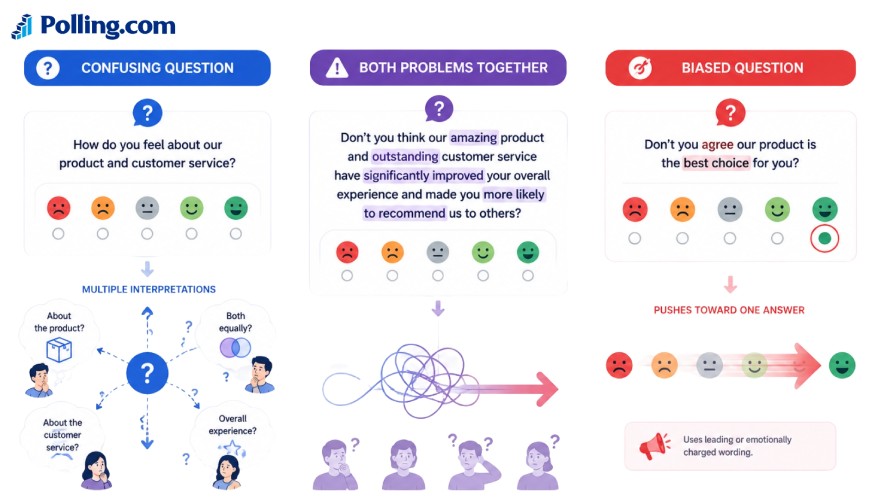
Confusing and biased questions can both hurt survey results, but they create different problems.
Here’s how to tell them apart.
Examples of Confusing Survey Questions Create Uncertainty
A confusing question makes respondents unsure about what you’re asking or how they should answer.
Ambiguous wording, unclear time frames, jargon, and complicated sentence structures can all make a question difficult to interpret.
Two respondents may understand the same question differently and give answers based on different interpretations.
Biased Questions Influence Responses
Survey question bias occurs when a question makes one answer seem more appropriate than another.
Leading or loaded wording, assumptions, and unbalanced response options are common examples of biased questions in surveys that can influence how respondents answer.
As a result, the response may reflect the way the question was presented rather than what the respondent genuinely thinks.
A Question Can Be Both Confusing and Biased
Some questions create both problems at once.
For example: Don’t you agree that our new product, which was designed to be more affordable and easier to use, is a much better option?
This question is confusing because it contains several ideas. Moreover, it’s biased because words like better and more affordable suggest a positive answer.
A clearer, more neutral version would be: How would you rate the value of our new product?
Why Confusing Survey Questions Hurt Your Results
Confusing questions don’t just make a survey harder to complete. They can affect the quality of the data you collect and the decisions you make from it.
- Inaccurate responses: Respondents may guess, choose the closest available answer, or provide a response that doesn’t reflect what they actually think.
- Higher survey abandonment: Long, complicated, or difficult-to-understand questions can frustrate respondents and cause them to leave the survey.
- Inconsistent interpretations: Different respondents may interpret the same question differently, making their answers harder to compare.
- Noisy or misleading data: When respondents aren’t answering the same question in the same way, the results can become less reliable.
- Poorer business decisions: Unclear data can lead businesses to make decisions based on findings that don’t accurately represent their customers or audience.
- Difficulty comparing groups: Differences between customer segments, demographic groups, or time periods may reflect differences in interpretation rather than genuine differences in opinion.
Pew Research Center notes that even small wording differences can substantially affect responses, while U.S. Census Bureau questionnaire-design research discusses how ambiguity and complexity can produce variable or erroneous interpretations.
How to Fix Confusing Survey Questions
If you’re learning how to prepare survey questions, these simple checks can help you rewrite them before sending your survey.
Use Simple and Concrete Language
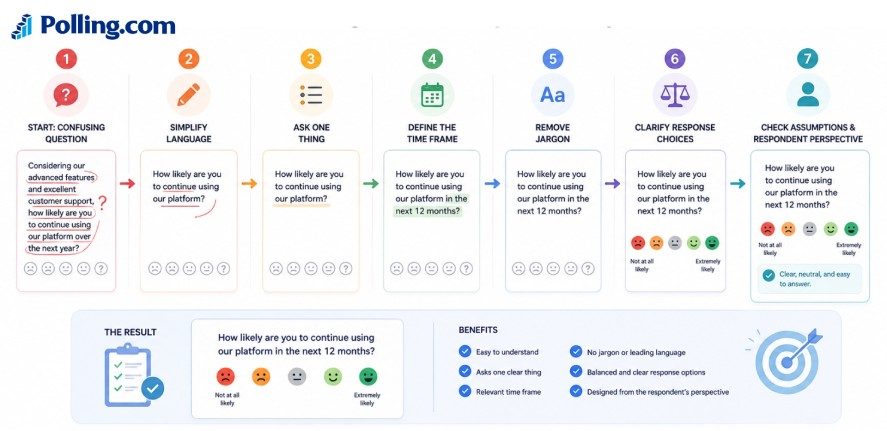
Use words your respondents are likely to understand without extra explanation.
When learning how to write survey questions, write for the person taking the survey, not for someone who already knows your industry or internal terminology.
Ask One Thing at a Time
If a question covers two different topics, split it into separate questions.
This makes it easier for respondents to give an answer that accurately reflects their opinion.
Define Time Frames
Replace vague terms such as recently, often, or regularly with a specific period when the timing matters.
For example, “How many times have you purchased this product in the past 30 days?” is easier to answer than “How often do you purchase this product?”.
Remove Jargon and Unnecessary Acronyms
Avoid technical terms and acronyms unless your audience is familiar with them. Choose familiar words whenever possible, especially when technical language isn’t necessary.
Make Response Options Clear and Mutually Exclusive
Check that answer choices don’t overlap or leave gaps. For example, age ranges such as 18–25 and 25–35 can confuse someone who is exactly 25.
Use categories that give each respondent one clear choice.
Read Each Question From the Respondent’s Perspective
Don’t just ask whether a question makes sense to you.
Consider whether two people could reasonably interpret it differently or whether someone could be unsure about what information they should use to answer.
Test Survey Questions Before You Send Them
A question can seem perfectly clear when you’re the person who wrote it.
Testing it with other people can reveal examples of poor survey questions, along with wording problems, missing context, or interpretations you hadn’t considered.
Pretest Your Questionnaire
Have a small group from your target audience review these questionnaire questions examples before you launch the survey.
Ask them whether any of your sample questionnaire questions were unclear, difficult to answer, or missing a suitable response option.
Use Cognitive Interviewing For Important Surveys
For more important surveys, cognitive interviewing can help uncover problems that a simple test may miss.
Ask respondents to explain what they thought a question meant and how they arrived at their answer.
This can reveal confusing terms, hidden assumptions, or unexpected interpretations.
Validate Your Questionnaire
Questionnaire validation can help identify problems with wording, clarity, and whether questions actually measure what they’re intended to measure.
See our guide to Questionnaire Validation for more ways to check your survey before collecting responses.
Create Clearer Surveys With Polling.com
Once your questions are clear, the next step is putting them into a survey that is easy for respondents to complete.
Polling.com makes it simple to build and share surveys while keeping the questionnaire structure organized and respondent-friendly.
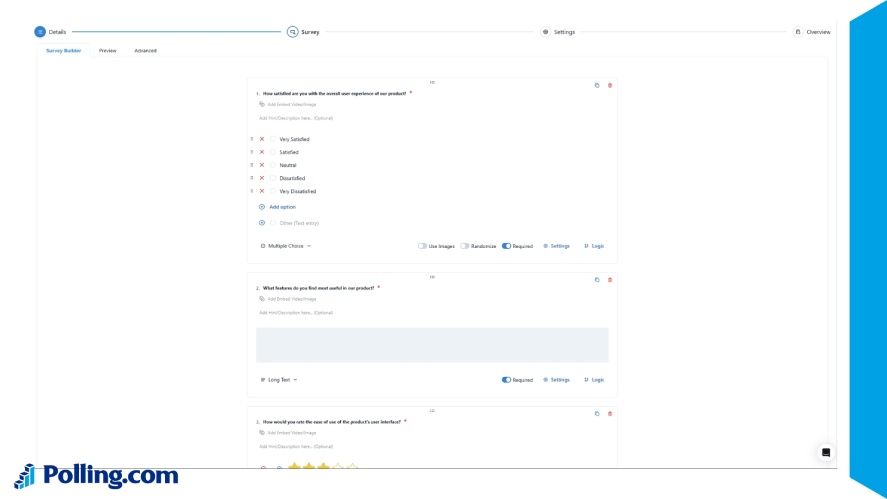
With Polling.com, you can:
- Create surveys with AI-assisted survey creation
- Choose from multiple question types
- Use branching and survey logic to show relevant questions
- Customize surveys for different audiences
- Track responses with real-time analytics and reporting
- Review your results and turn responses into useful insights
Good survey software can’t fix poorly worded survey questions, but it can make the process of building, testing, distributing, and analyzing a well-designed questionnaire much easier.
Use the examples of confusing survey questions in this guide to review your questions, remove confusing wording, and then create a clearer survey with Polling.com.
Final Checklist for Avoiding Confusing Survey Questions
Before publishing your survey, run each question through this quick checklist:
- Does the question ask only one thing?
- Could an ordinary respondent understand every term?
- Is the time frame clear?
- Could two people reasonably interpret the wording differently?
- Are response choices mutually exclusive?
- Is every reasonable response covered?
- Does the question make an unsupported assumption?
- Can respondents realistically remember the information?
- Has the questionnaire been tested?
If a question fails any of these checks, revise it before sending the survey.
Conclusion
Clear survey questions make it easier for respondents to understand what you’re asking and give answers that accurately reflect their experiences or opinions.
Use these examples of confusing survey questions as a reference when reviewing your own questionnaire, paying close attention to wording, context, time frames, and response options.
Once your questions are ready, Polling.com can help you turn them into a survey, collect responses, and analyze the results.