
How Many Questions Should a Survey Have? Best Practices

How many questions should a survey have? There is no single number that works for every survey. A quick customer feedback survey may need only a few questions, while detailed research may need many more.
The goal is not to reach a specific question count. Instead, collect the information you need without asking respondents to do unnecessary work.
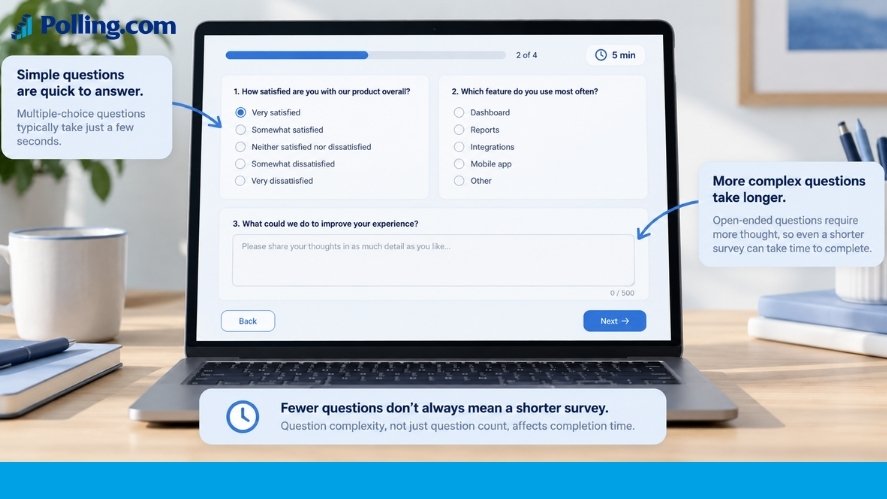
Question type also matters. Ten simple multiple-choice questions may take only a few minutes. Ten detailed open-ended questions could take much longer.
Your survey goal, audience, question type, device, and expected completion time all affect the right length.
This guide explains how many questions to use for common survey types, how long a survey should take, and how to make longer surveys easier to complete.
How Many Questions Should a Survey Have?
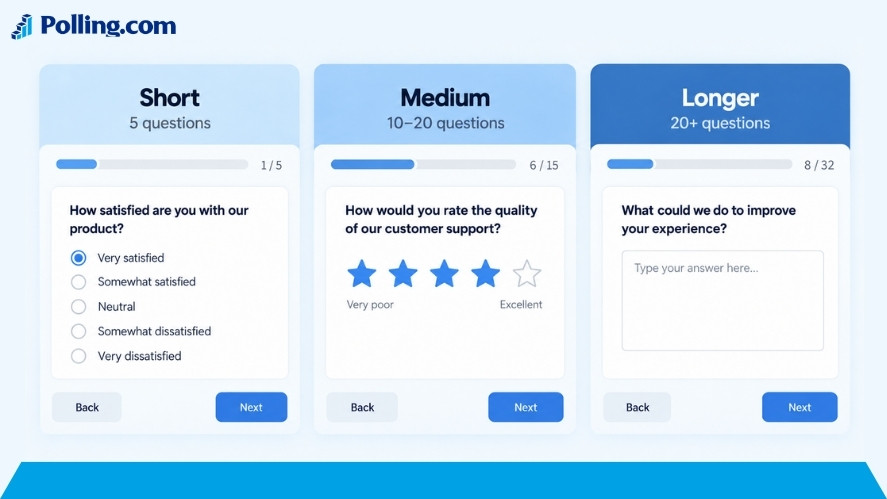
For many simple surveys, 5 to 10 focused questions is a practical starting point.
A more detailed survey may need 10 to 20 questions. Complex research projects may require more.
However, these are starting points, not strict rules.
When deciding how many questions should be in a survey, focus on the information you actually need. Every question should have a clear purpose.
If removing a question would not affect a decision, analysis, or next step, you may not need it.
| Survey Size | Approximate Questions | Best For |
|---|---|---|
| Very short | 1 to 5 | Quick feedback, NPS, website polls |
| Short | 5 to 10 | Customer satisfaction, event feedback |
| Medium | 10 to 20 | Product feedback, employee pulse surveys |
| Long | 20+ | Detailed research, academic studies, complex assessments |
These ranges are only general guides.
A five-question survey filled with difficult open-ended questions can take more effort than a 15-question survey made mostly of simple rating scales.
SurveyMonkey’s survey best practices recommend keeping surveys as short as possible and suggest 10 or fewer questions for a simple one-page survey.
That is a useful benchmark, but your real goal should be to ask the fewest questions needed to achieve the survey’s purpose.
Before keeping a question, ask:
- What will this answer tell us?
- How will we use the information?
- Is this information available somewhere else?
- Does another question already collect similar information?
- Could this answer affect a decision or action?
If you cannot explain why a question matters, consider removing it.
How Long Should a Survey Be?
If you are wondering how long should a survey be, completion time can be more useful than question count alone.
For many everyday surveys, about 5 to 10 minutes is a reasonable target. Quick feedback surveys can take much less time. More detailed research may need longer.
The important point is that survey length depends on more than the number of questions.
Imagine two surveys.
Survey A has 15 questions. Most use simple yes-or-no answers or rating scales.
Survey B has eight questions. Five ask respondents to write detailed answers.
Survey B has fewer questions, but it may take much longer to complete.
That is why the average survey length in questions does not tell the full story. You should also test how many minutes respondents actually need.
Qualtrics’ survey methodology guidance says its data shows substantial respondent break-off begins when surveys exceed about 12 minutes. For mobile respondents, the point occurs earlier at around 9 minutes.
This does not mean every survey must stay below those times. Some research requires longer questionnaires.
However, it shows why respondent effort matters.
Think About Mobile Respondents
A survey that feels easy on a desktop may feel much harder on a phone.
Small screens can make large matrix questions difficult to use. Long written answers also take more effort to type.
Mobile respondents may also be answering while traveling, waiting, or doing something else.
Test the survey on the devices your audience is likely to use.
If many respondents will use smartphones, mobile usability should be part of the survey design from the beginning.
What Is the Ideal Survey Length?
The ideal survey length is the shortest length that collects enough useful information to meet your goal.
There is no universal best survey length.
Instead, consider the following factors.
Survey Goal
Start with one clear goal.
For example:
Clear goal: Find out why customers cancel their subscriptions.
That is more useful than:
Broad goal: Learn more about our customers.
A clear goal makes it easier to decide which questions belong in the survey.
Audience
Think about who will respond.
Customers who recently contacted support may be willing to answer a short satisfaction survey because the experience is still fresh.
A general audience receiving an unexpected research survey may be less willing to spend 15 minutes answering questions.
Employee surveys, academic studies, customer research, and website polls can all have different expectations.
Question Type
Simple questions usually take less time.
For example:
How satisfied were you with your experience?
A respondent can answer a simple rating question quickly.
Compare that with:
Please describe everything you liked and disliked about your experience.
The second question requires more thought and typing.
Question count treats these two questions as equal. Respondents do not.
Topic Complexity
Some topics naturally require more questions.
A one-question website poll may be enough to measure a simple preference.
A market research study covering brand awareness, buying behavior, preferences, pricing, and demographics will probably need more questions.
Do not make complex research artificially short just to reach a certain number.
Instead, make every question earn its place.
Survey Channel
Email, SMS, websites, apps, and interviewer-led surveys create different experiences.
A one-question website poll may work well as a quick interruption.
A longer questionnaire may work better on a dedicated survey page where respondents understand what they are being asked to do.
Open-Ended Questions
Open-ended questions can provide useful details, but they require more effort.
Use them when you genuinely need respondents to explain something in their own words.
These factors are at the heart of survey length best practices.
The goal is not to make every survey extremely short. The goal is to make the required effort reasonable for the information you need.
Recommended Number of Questions by Survey Type
Different surveys need different amounts of information.
The following ranges are practical starting points. They are not fixed limits.
| Survey Type | Suggested Question Range | Estimated Time | Main Goal |
|---|---|---|---|
| Customer satisfaction | 5 to 10 | 2 to 5 minutes | Measure satisfaction and identify issues |
| Product feedback | 5 to 15 | 3 to 7 minutes | Understand the product experience |
| Employee survey | 10 to 30 | 5 to 15 minutes | Measure engagement or workplace views |
| Market research | 10 to 30+ | 5 to 15+ minutes | Understand customers and markets |
| Event feedback | 5 to 10 | 2 to 5 minutes | Evaluate the event experience |
| Website feedback | 1 to 5 | Under 3 minutes | Capture immediate visitor feedback |
| Academic or research | Varies | Varies | Answer a defined research question |
| Net Promoter Score | 1 to 3 | Under 2 minutes | Measure recommendation intent and context |
Actual completion time can vary based on wording, question type, branching, and the respondent.
Customer Satisfaction Surveys
Customer satisfaction surveys are usually most useful when they stay short and focused.
Ask about the experience you want to measure. You might include an overall satisfaction rating, questions about key parts of the experience, and one optional open-text question.
Avoid turning a simple satisfaction survey into a complete customer research study.
Product Feedback Surveys
A product feedback survey may need around 5 to 15 questions depending on the goal.
A survey about one new feature can be short.
A survey covering usability, satisfaction, missing features, value, and future needs will require more.
Use skip logic when only certain users have experience with the feature you are asking about.
Employee Surveys
Employee pulse surveys can often stay relatively short.
Broader engagement surveys may require more questions because they measure areas such as communication, management, workload, development, and workplace culture.
Longer employee surveys can still be useful when respondents understand the purpose and believe their feedback will be taken seriously.
Market Research Surveys
Market research surveys vary widely.
A simple concept test may be brief.
A study covering brand awareness, buying behavior, product preferences, pricing, and demographics may need many more questions.
Use clear sections and logical ordering to make detailed research easier to complete.
Event Feedback Surveys
Event feedback should usually stay focused.
Respondents may receive the survey after the event has ended, so their motivation to complete a long questionnaire may be limited.
Ask about overall satisfaction, important sessions or activities, organization, and what could be improved.
Website Feedback Surveys
Website feedback surveys should require very little effort, especially when they interrupt browsing.
One to five questions may be enough to learn whether visitors completed their task, what they were looking for, or why they are leaving.
Academic or Research Surveys
There is no useful universal question count for academic research.
The research question, methodology, measurement tools, population, and analysis plan should determine the questionnaire.
Researchers should still test completion time and respondent burden before collecting data.
Net Promoter Score Surveys
A basic Net Promoter Score, or NPS, survey can be very short.
It usually begins with the likelihood-to-recommend question.
A follow-up question can ask respondents why they selected their rating.
Additional questions can add useful context, but too many can turn a quick NPS check into a much broader customer survey.
Why Survey Completion Time Matters
Counting questions is easy. Measuring respondent effort is more useful.
A 10-question survey can still feel long if the questions are complicated.
Completion time can increase because of:
- Long instructions
- Difficult wording
- Large matrix questions
- Repeated questions
- Long lists of answer choices
- Open-text fields
- Complex ranking tasks
- Questions that require difficult recall
- Poor mobile design
Respondents experience all of these as part of survey length.
For example, consider this question:
Please explain the three most important factors that affected your decision to purchase this product, including any competing products you considered and why you rejected those alternatives.
Technically, that is one question.
In practice, it may require more effort than several straightforward multiple-choice questions.
That is why testing matters.
Ask people who were not involved in writing the survey to complete it. Record how long they take and ask where they felt confused or slowed down.
Their experience can tell you more than the raw question count.
How Question Type Changes Survey Length
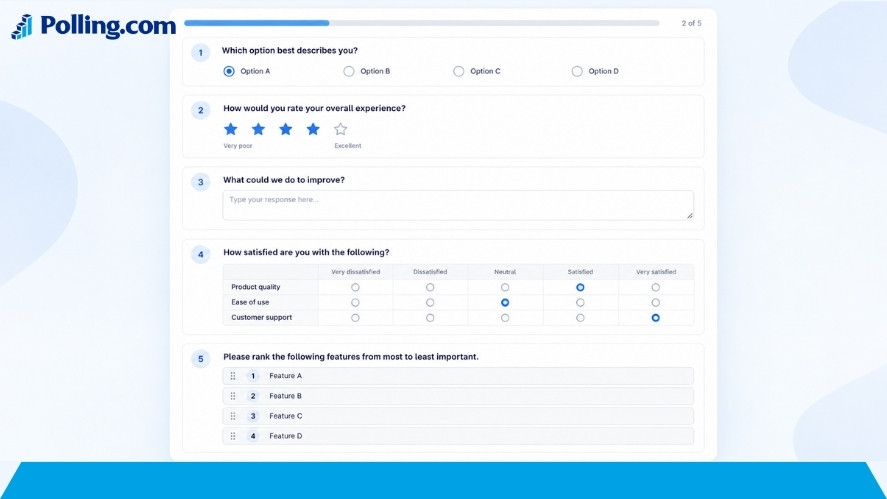
Different survey question types require different amounts of thought and effort.
Multiple-Choice Questions
Multiple-choice questions are often quick to answer when the options are clear.
For example:
Which device do you use most often to access our website?
- Desktop computer
- Laptop
- Smartphone
- Tablet
- Other
A respondent can usually answer this quickly.
However, a multiple-choice question can become slow when it contains a long list of confusing or overlapping answers.
Rating Scale Questions
Rating scales are also often quick to complete.
Respondents might rate satisfaction from 1 to 5 or choose how strongly they agree with a statement.
Keep scales consistent where possible.
If you constantly change the direction or format of the scale, respondents have to spend extra time understanding how to answer.
Open-Ended Questions
Open-ended questions require respondents to create an answer instead of selecting one.
That can provide useful qualitative feedback, but it requires more effort.
Compare:
How satisfied are you with our checkout process?
with:
Please describe your experience using our checkout process.
The second question may uncover details that the first question cannot, but it also takes longer.
Use open-ended questions when the additional detail is worth the effort.
Matrix Questions
Matrix questions place several related items into a grid.
They can make a questionnaire look compact, but they do not always make it feel shorter.
Large matrices require repeated judgments and can also be difficult to use on mobile devices.
Break large matrices into smaller groups when needed.
Ranking Questions
Ranking questions ask respondents to put options in order.
This requires comparison between choices, so ranking can take more effort than selecting one preferred option.
Ranking three or four choices may be easy.
Ranking 15 choices can become tiring.
Only use ranking questions when the order itself is important to your analysis.
What Happens When a Survey Is Too Long?
When a survey asks for more effort than respondents expect or want to give, several problems can appear.
Respondents May Leave Early
Some people start a survey but never reach the end.
Length is not the only reason this happens. Poor wording, technical problems, irrelevant questions, and privacy concerns can also cause people to leave.
Still, unnecessary length creates another reason to quit.
If participation is a concern, review your survey response rate along with completion and drop-off data.
Respondents May Rush
Completing a survey does not always mean the respondent stayed fully engaged.
People who become tired may start answering more quickly.
They may select the first acceptable response instead of carefully considering each choice.
Survey Fatigue Can Increase
Survey fatigue happens when respondents become tired or less engaged.
Repetitive questions, large grids, complicated wording, and excessive length can all contribute.
Your survey response rate optimization strategy should therefore consider the experience of completing the survey, not only the invitation used to attract respondents.
Data Quality May Suffer
More questions do not automatically create better data.
Twenty useful questions can provide more value than 50 questions filled with duplication and information nobody plans to use.
The purpose of a survey is not to collect as much information as possible.
It is to collect information that helps answer a research question or support a decision.
How to Shorten a Survey Without Losing Useful Data
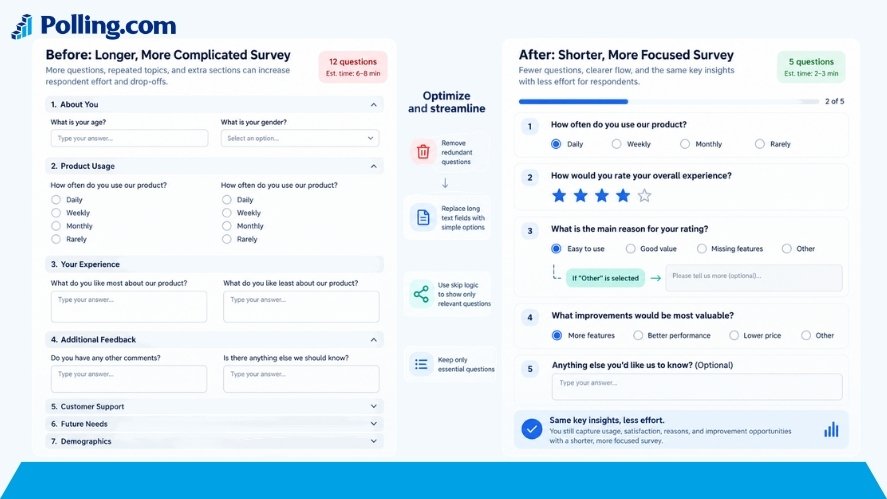
Shortening a survey does not have to mean removing useful information.
Good editing can make the questionnaire more focused.
Start With One Clear Goal
Write the main purpose of the survey in one sentence.
For example:
We want to understand why customers who tried our free trial did not subscribe.
Then compare every question with that goal.
If a question does not help answer it, ask why the question is there.
Remove Duplicate Questions
Survey writers sometimes ask several questions that collect almost the same information.
Some formal research methods intentionally use several items to measure the same concept. That is different from accidental repetition.
For a simple feedback survey, remove questions that do not provide additional value.
Limit Open-Ended Questions
Open-ended questions are useful when fixed answer choices cannot provide the detail you need.
However, they should not be the default format for every question.
If a closed-ended question can collect the needed information, it may reduce respondent effort.
Use Skip Logic
Not every respondent needs to see every question.
Imagine asking:
Have you used our mobile app?
Someone who answers “No” should not have to complete five questions about their experience using the app.
Skip logic can move that person past the irrelevant section.
This reduces the effective survey length without removing useful questions for people who should answer them.
Remove Nice-to-Know Questions
Teams often add questions because the answers might be interesting.
Interesting does not always mean useful.
Ask what action you will take based on each answer.
If the information will not affect an analysis, decision, or next step, consider removing the question.
Use Simple Question Wording
A short survey can still feel difficult when the questions are confusing.
Clear wording reduces the effort needed to understand what is being asked.
Watch for double-barreled questions, jargon, leading wording, and complicated sentences.
These examples of poorly worded survey questions can help you spot common problems.
You can also review these unbiased survey question examples when rewriting unclear or leading questions.
Test the Survey Before Sending It
Complete the full survey yourself.
Then ask other people to test it.
Record how long they take.
Also ask:
- Which questions were difficult?
- Which questions felt repetitive?
- Where did you slow down?
- Were any answer choices missing?
- Did any part feel unnecessarily long?
Test on desktop and mobile if respondents may use both.
Testing is one of the most useful survey design best practices to apply before launch.
How to Tell If Your Survey Is Too Long
You do not always have to guess whether a survey is too demanding.
Testing and response data can reveal warning signs.
Look for:
- High drop-off before the final page
- Low completion rates
- Many skipped questions
- Completion times much longer than expected
- Shorter or less detailed answers near the end
- Complaints about survey length
- Too many open-ended questions
- Repetitive sections
- Large matrices
- Poor mobile usability
Also look at where people leave.
If many respondents quit at the same question, investigate that part of the survey.
The problem may be length, but it could also be confusing wording, a technical issue, an intrusive question, or a difficult task.
You can also compare behavior between sections.
For example, detailed comments near the beginning followed by one-word answers near the end may suggest declining engagement.
That does not prove survey length caused the change, but it gives you a reason to review the questionnaire.
Survey Length Best Practices
Use these survey length best practices before publishing:
- Set one clear survey goal.
- Ask only necessary questions.
- Put important questions early.
- Keep wording short and simple.
- Limit difficult question types.
- Use open-text questions only when they add value.
- Make the survey easy to use on mobile.
- Use skip logic for irrelevant sections.
- Give respondents an honest completion-time estimate.
- Test the survey before launch.
- Review completion times and drop-off data after launch.
The best survey length is the one that gives you the information you need without wasting respondents’ time.
How Long Should a Survey Be Open?
There are two different meanings of survey length.
One refers to how long a respondent needs to complete the questionnaire.
The other asks how long should a survey be open and continue accepting responses.
These are different questions.
There is no universal number of days that every survey should remain open.
The right response window depends on your audience, distribution channel, deadline, response speed, and research needs.
Consider Your Audience Size
A survey sent to a large and active customer list may collect responses quickly.
A survey aimed at a small or hard-to-reach group may need to stay open longer.
Consider the Survey Channel
Different channels produce different response patterns.
An in-app survey may reach active users immediately.
Email recipients may not see the invitation until later.
Other research participants may need even more time.
Watch Response Speed
Monitor responses after launch.
If responses are still arriving steadily, keeping the survey open may provide more useful data.
If new responses have slowed and you already have enough data for your planned analysis, additional days may provide less value.
Account for Deadlines
Work backward from the date when you need the results.
Leave enough time to collect responses, clean the data, analyze the results, and prepare any report or decision.
Plan Reminders
A reminder can reach people who intended to participate but forgot.
Avoid sending so many reminders that they become annoying.
The right timing depends on the survey and your relationship with the audience.
Consider Your Research Needs
A post-event survey may need a short response window while the experience is still fresh.
A larger academic or market research project may collect responses over a much longer period.
Choose the response window based on the needs of the project rather than an arbitrary number of days.
Quick Survey Length Checklist
Before publishing, ask:
- Does every question support the main goal?
- Can any questions be removed?
- Are any questions collecting the same information?
- Are there too many open-ended questions?
- Are complex question types necessary?
- Is every question easy to understand?
- Are the answer options clear?
- Can skip logic hide irrelevant questions?
- Is the survey easy to complete on mobile?
- Is the completion-time estimate realistic?
- Have you tested the complete survey?
- Has someone unfamiliar with it tested it?
If several answers reveal problems, edit the survey before publishing.
Removing even a few unnecessary or difficult questions can make the experience easier.
Frequently Asked Questions About Survey Length
How many questions should a survey have?
For a simple survey, 5 to 10 focused questions can be a useful starting point.
More detailed surveys may need 10 to 20 questions or more.
Do not treat these numbers as strict limits. The right number depends on your goal, audience, question types, and completion time.
How long should a survey be?
For many everyday surveys, about 5 to 10 minutes is a reasonable target.
Quick feedback surveys can take much less time. Complex research may require longer.
Test the actual questionnaire because question type and difficulty can change completion time significantly.
What is the ideal survey length?
The ideal survey length is the shortest survey that still gathers enough information to achieve its goal.
For a quick satisfaction check, this may mean only a few questions.
For detailed research, it may mean a much longer questionnaire.
Is 20 questions too many for a survey?
Not necessarily.
Twenty short and simple questions may be reasonable for some surveys.
Twenty questions with long instructions, matrices, ranking tasks, and text fields may demand much more effort.
Test the expected completion time instead of judging length only by question count.
Is 10 questions enough for a survey?
Ten questions can be enough for many focused surveys.
A customer satisfaction, event feedback, or product survey may collect plenty of useful information with 10 well-chosen questions.
More complex research may need additional questions.
How many open-ended questions should a survey have?
There is no fixed number.
Use open-ended questions when respondents’ own words provide information that closed-ended choices cannot capture.
For many short feedback surveys, one or two well-placed open-ended questions may provide useful detail without adding too much work.
How long should a survey stay open?
The right response window depends on your audience, distribution method, response speed, deadline, and research goal.
A time-sensitive post-event survey may need a shorter window.
Specialized research may need a much longer collection period.
Monitor responses after launch rather than relying only on a fixed number of days.
Does survey length affect response rates?
Survey length can affect participation and completion when respondents feel the effort is greater than expected.
However, length is only one factor.
Topic, audience interest, invitation quality, trust, timing, question wording, incentives, and mobile usability can also affect participation.
Improving survey length should therefore be part of a broader effort to create a better respondent experience.
Conclusion
So, how many questions should a survey have? There is no single perfect number.
A simple survey may need only 5 to 10 focused questions. Detailed research may require many more.
Instead of chasing a fixed question count, start with one clear goal. Ask only questions that help you achieve it.
Consider completion time, question type, audience, mobile usability, and topic complexity. Remove duplicate and nice-to-know questions. Use open-text fields only when they add useful information. Use skip logic to keep irrelevant questions out of the respondent’s path.
Most importantly, test the full survey before launch.
Your survey should be long enough to collect useful information, but no longer than necessary.
When you are ready to build one, use Polling.com to create a focused survey around the questions that matter most.