
29 Good Unbiased Survey Questions Examples

Good survey questions give respondents a fair chance to share what they really think.
Unbiased survey questions avoid wording or answer choices that push people toward a particular response, helping you collect more trustworthy data.
This matters because even a small change in wording can affect how someone answers.
Bias can come from leading language, assumptions, response options, or even the order in which questions appear.
In this guide, you’ll find 29 good unbiased survey questions examples covering customer satisfaction, products, employees, market research, politics, and demographics.
What Makes a Good Survey Question Unbiased?
A good survey question should make the intended meaning clear without influencing the answer.
Look for these characteristics when reviewing your questions:
- Neutral wording: Avoid words that make one answer sound better or worse than another.
- One idea at a time: Don’t combine two different topics in the same question.
- Simple language: Use clear, concrete words that respondents can understand quickly.
- No assumptions: Don’t assume respondents have used a product, experienced a problem, or hold a particular opinion.
- Balanced response options: Give respondents reasonable positive, negative, and neutral choices when appropriate.
- Clear time periods: Specify a timeframe when asking about frequency, experiences, or behavior.
- Non-overlapping choices: Make sure respondents can select one answer without wondering where their response belongs.
- Relevant alternatives: Include options such as Not applicable, Don’t know, or Other when they make sense for the question.
These details may seem small, but they can have a direct effect on the quality of your survey responses.
Good Unbiased Survey Questions Examples
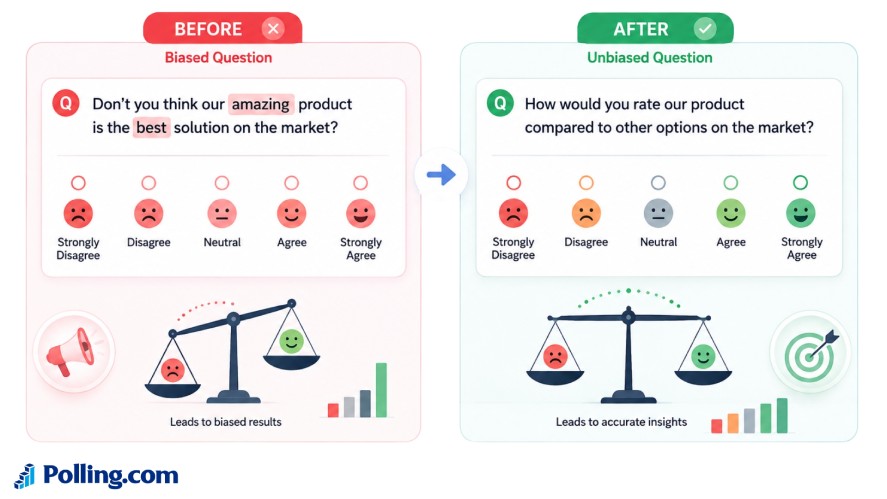
The best way to understand unbiased survey questions is to see how neutral wording changes the way a question is presented.
Below are examples of unbiased survey questions across common survey topics, along with a biased version and a brief explanation of what makes the revised question better.
Unbiased Customer Satisfaction Survey Questions
Customer satisfaction questions should allow respondents to report a positive, negative, or neutral experience without suggesting what they should feel.
1. Overall Experience
Biased: How much did you love your experience with us?
Unbiased: How satisfied or dissatisfied are you with your overall experience?
The unbiased version doesn’t assume that the respondent enjoyed the experience.
2. Purchase Experience
Biased: How easy was it to complete your purchase?
Unbiased: How easy or difficult was it to complete your purchase?
The original wording assumes the purchase was easy. The revised version gives respondents both positive and negative options.
3. Customer Support
Biased: How satisfied were you with our excellent customer support?
Unbiased: How satisfied or dissatisfied are you with our customer support?
Words like excellent can influence respondents before they answer.
4. Future Use
Biased: Would you use our service again because of the great experience?
Unbiased: How likely are you to use our service again?
The unbiased version asks about future intent without suggesting a reason for the answer.
Good Unbiased Product Survey Questions
Product questions should let respondents describe what they like, dislike, use, or would change without assuming a positive experience.
5. Product Quality
Biased: How would you rate the excellent quality of this product?
Unbiased: How would you rate the quality of this product?
Removing excellent keeps the question neutral.
6. Useful Features
Biased: Which of our useful features do you find most helpful?
Unbiased: Which features, if any, do you find most useful?
If any question gives respondents the option to say that none of the features are useful.
7. Product Improvements
Biased: What improvements would make this already great product even better?
Unbiased: What, if anything, would you change about this product?
The revised question doesn’t assume respondents think the product is great or that it needs changes.
8. Product Usage
Biased: How often do you use our popular product?
Unbiased: How often do you use this product?
Popular is unnecessary and can create a positive impression of the product.
Unbiased Employee Survey Questions
Employee surveys can cover sensitive topics, so questions should be neutral and avoid suggesting that a particular answer is expected.
9. Job Satisfaction
Biased: How satisfied are you with your rewarding job?
Unbiased: How satisfied or dissatisfied are you with your current job?
10. Manager Support
Biased: How helpful is your manager when you need support?
Unbiased: How would you rate the support you receive from your manager?
11. Workload
Biased: Are you able to handle your workload effectively?
Unbiased: How would you describe your current workload?
12. Communication
Biased: How satisfied are you with our clear internal communication?
Unbiased: How satisfied or dissatisfied are you with internal communication?
13. Professional Development
Biased: Does the company provide enough great opportunities for your professional growth?
Unbiased: How satisfied or dissatisfied are you with your opportunities for professional development?
14. Workplace Recommendation
Biased: Would you recommend this great workplace to your friends?
Unbiased: How likely are you to recommend this organization as a place to work?
For sensitive employee questions, explain how responses will be handled and whether they are anonymous or confidential.
This can help employees feel more comfortable providing honest feedback.
Good Unbiased Market Research Survey Questions
Market research questions should collect information about customers, brands, products, and purchasing decisions without promoting a particular option.
15. Purchasing Frequency
Biased: How often do you buy our popular product?
Unbiased: How often do you purchase products in this category?
The unbiased version doesn’t assume the respondent buys the product or describe it as popular.
16. Brand Awareness
Biased: Have you heard of our well-known brand?
Unbiased: Which of the following brands, if any, have you heard of?
Well-known can influence respondents and assumes they should recognize the brand.
17. Purchase Factors
Biased: Which of these great features is most important when choosing a product?
Unbiased: Which factors are most important to you when choosing a product in this category?
The revised question doesn’t suggest that any particular feature is valuable.
18. Product Preference
Biased: Which of these products would you choose?
Unbiased: Which of these products, if any, would you consider purchasing?
If any gives respondents the option to reject all the choices.
19. Price
Biased: Don’t you think this product is reasonably priced?
Unbiased: How would you rate the price of this product compared with similar products?
The biased version pushes respondents toward agreeing that the price is reasonable.
20. Competitor Usage
Biased: Do you currently use our product instead of competing brands?
Unbiased: Which of the following brands have you purchased from in the past 12 months?
The unbiased version asks about actual purchasing behavior without assuming brand preference.
Unbiased Political Survey Questions
Political surveys require especially careful wording because small differences in framing can influence responses.
21. Candidate Preference
Biased: Do you support the more experienced candidate?
Unbiased: If the election were held today, which candidate would you be most likely to vote for?
The unbiased version doesn’t attach a positive characteristic to any candidate.
22. Approval
Biased: Do you approve of the president’s successful handling of the economy?
Unbiased: Do you approve or disapprove of the way the president is handling the economy?
The revised version removes the positive description successful.
23. Policy Support
Biased: Do you support this important policy proposal?
Unbiased: Do you support or oppose this policy proposal?
Important can influence how respondents view the proposal before answering.
24. Issue Importance
Biased: How important is this critical issue when deciding how to vote?
Unbiased: How important is [issue] to you when deciding how to vote?
The unbiased version removes words like critical that could make the issue seem more important than respondents might otherwise consider it.
Political questions also require careful attention to framing.
Even the information presented before a question can influence how people respond, so keep the wording and context as neutral as possible.
Unbiased Demographic Survey Questions
Demographic questions should collect basic information without making assumptions about the respondent or suggesting that one answer is preferred.
25. Age
Biased: Are you in the young adult age group?
Unbiased: What is your age?
The unbiased version asks for the information directly without labeling an age group as young.
26. Education
Biased: Do you have a college degree?
Unbiased: What is the highest level of education you have completed?
The revised question provides a more complete range of possible answers.
27. Employment
Biased: Are you currently working full-time?
Unbiased: Which of the following best describes your current employment status?
The biased version assumes full-time employment is the relevant answer and leaves out other situations.
28. Income
Biased: Do you earn a comfortable household income?
Unbiased: What is your approximate annual household income before taxes?
Comfortable is subjective and can mean different things to different respondents.
29. Household
Biased: Do you live with a large family?
Unbiased: How many people currently live in your household?
Large family is vague and assumes the respondent considers their household a family.
For sensitive demographic questions such as income, age, or employment, you can also include “Prefer not to answer” when appropriate.
This gives respondents a way to skip questions they aren’t comfortable answering without forcing them into an inaccurate response.
Biased vs Unbiased Survey Question Examples
The biased survey questions examples below show common forms of survey question bias and how to make each question more neutral.
| Biased approach | Unbiased approach | Problem fixed |
|---|---|---|
| How satisfied are you with our excellent customer service? | How satisfied or dissatisfied are you with our customer service? | Leading language |
| Don’t you agree that our product is easy to use? | How easy or difficult is this product to use? | Leading question |
| How much did you love your experience? | How would you rate your experience? | Emotional framing |
| How satisfied are you with our affordable and high-quality product? | How satisfied are you with the product? | Loaded wording |
| How satisfied are you with the price and quality of the product? | How satisfied are you with the price? How satisfied are you with the quality? | Double-barreled question |
| How often do you use our popular service? | How often do you use this service? | Assumption about popularity |
| Since you purchased our product, how satisfied are you with it? | Have you purchased this product in the past 12 months? | Assumption that the respondent purchased |
| How would you rate our customer service? Very dissatisfied / Dissatisfied / Satisfied / Very satisfied | How satisfied or dissatisfied are you with our customer service? Very dissatisfied / Dissatisfied / Neither satisfied nor dissatisfied / Satisfied / Very satisfied | Unbalanced scale |
| How often do you use our product? Never / 1–5 times / 6–10 times / 10+ times | How often do you use our product? Never / 1–5 times / 6–10 times / 11–15 times / 16+ times | Overlapping choices |
| Do you use our product regularly? | How many times have you used our product in the past 30 days? | Ambiguity |
A useful rule is to look for words that persuade, assumptions that may not apply, and answer choices that leave respondents without a suitable option.
Small changes can make a question much easier to answer objectively.
Common Types of Survey Question Bias to Avoid
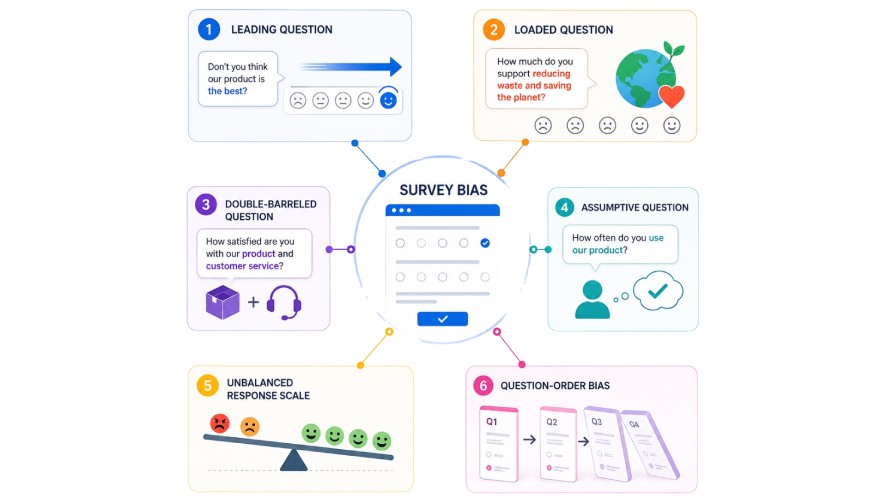
Knowing the most common types of bias makes it easier to spot problems before you launch a survey.
Leading Questions
Leading questions use wording that makes one answer seem more appropriate than another.
Phrases such as don’t you agree, obviously, or excellent can influence how respondents answer.
Example of a biased question: Don’t you agree that our new product is easier to use?
Unbiased version: How easy or difficult is our new product to use?
The second version gives respondents room to express either a positive or negative opinion without suggesting which answer is preferred.
Loaded Questions
Loaded questions contain emotional or judgmental words that can shape a respondent’s opinion before they answer.
Example of a biased question: How satisfied are you with our amazing customer service?
Unbiased version: How satisfied or dissatisfied are you with our customer service?
Removing words such as amazing keeps the question neutral and lets respondents decide how they feel about the service.
Double-Barreled Questions
An example of a bad survey question is a double-barreled question that asks about two different things at once.
A respondent may have a positive opinion about one and a negative opinion about the other, making the answer difficult to interpret.
Example of a biased question: How satisfied are you with our product’s price and quality?
Unbiased version:
- How satisfied are you with the product’s price?
- How satisfied are you with the product’s quality?
Separating the two topics gives you a clearer answer for each one.
Assumptive Questions
Assumptive questions presume that something applies to the respondent when it may not.
This can happen when a question assumes someone has purchased a product, used a service, or experienced a particular situation.
Example of a biased question: How satisfied are you with your recent purchase?
Unbiased version: Have you purchased this product in the past 12 months?
If the respondent answers yes, you can then ask about their experience. This avoids forcing people to answer a question that doesn’t apply to them.
Unbalanced Response Options
Response choices can also introduce bias.
If a scale includes more positive choices than negative ones, respondents may not have an equal opportunity to express their opinion.
Unbalanced scale: Very satisfied / Satisfied / Somewhat satisfied / Dissatisfied
Balanced scale: Very dissatisfied / Dissatisfied / Neither satisfied nor dissatisfied / Satisfied / Very satisfied
A balanced scale gives respondents a reasonable option for each direction, including a neutral response when appropriate.
Question Order Bias
The order of your questions can affect how respondents answer later questions.
For a question bias example, earlier questions may bring certain ideas or experiences to mind and influence their responses.
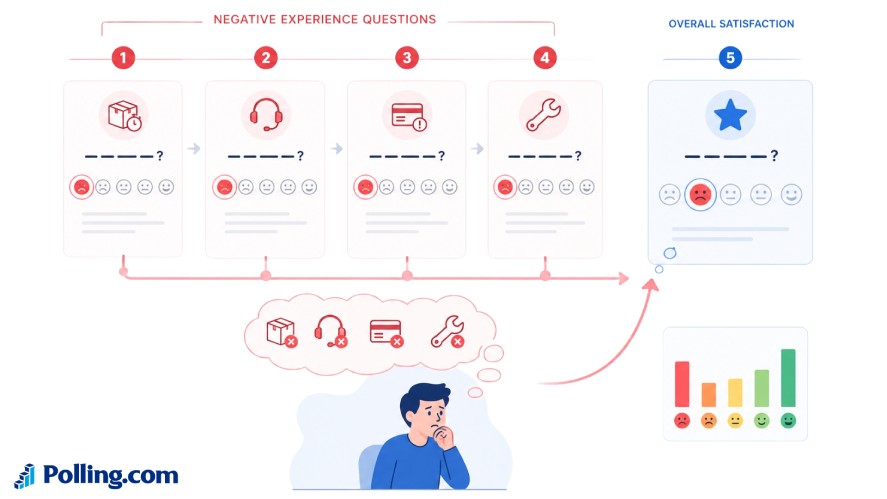
For example, asking several questions about customer complaints before asking “Overall, how satisfied are you with the company?” may cause respondents to focus on negative experiences when giving their overall rating.
Review your question sequence carefully, especially when earlier questions could influence how respondents think about the topic.
How to Write Good Unbiased Survey Questions
Writing unbiased questions is mostly about keeping each question clear, neutral, and easy to answer.
Use these steps when reviewing your survey:
- Define what you want to measure: Be clear about the specific information you need from each question.
- Ask one thing at a time: Separate questions that cover different topics or concepts.
- Remove persuasive language: Avoid words that make an answer sound more positive, negative, or desirable.
- Check for assumptions: Make sure the question doesn’t assume something about the respondent that may not be true.
- Use simple language: Choose clear, concrete words instead of vague or complicated wording.
- Offer balanced response options: Give respondents a fair range of positive, negative, and neutral choices when appropriate.
- Check answer ranges: Make sure categories don’t overlap or leave gaps.
- Review the question order: Consider whether earlier questions could influence how respondents answer later ones.
- Test the questionnaire: Have people from your target audience complete the survey and look for confusing wording, missing options, or other problems before launch.
Testing your questionnaire before distribution can reveal examples of poor survey questions that are easy to miss when you’re writing the questions yourself.
Create Unbiased Surveys With Polling.com
Once your questions are clear and neutral, the next step is turning them into a survey and collecting responses.
Polling.com provides tools for building and managing surveys without requiring a complicated setup.
You can use Polling.com to:
- Create surveys with AI-assisted survey creation.
- Add different question types and customize your survey structure.
- Use branching and skip logic to show respondents only the questions relevant to them.
- Target specific audiences using filters such as country, language, and other conditions.
- Review responses with real-time analytics, filters, and reporting tools.
- Share surveys through links, website embeds, and other distribution options.
- Use anonymous surveys when you want respondents to provide feedback without revealing identifying information.
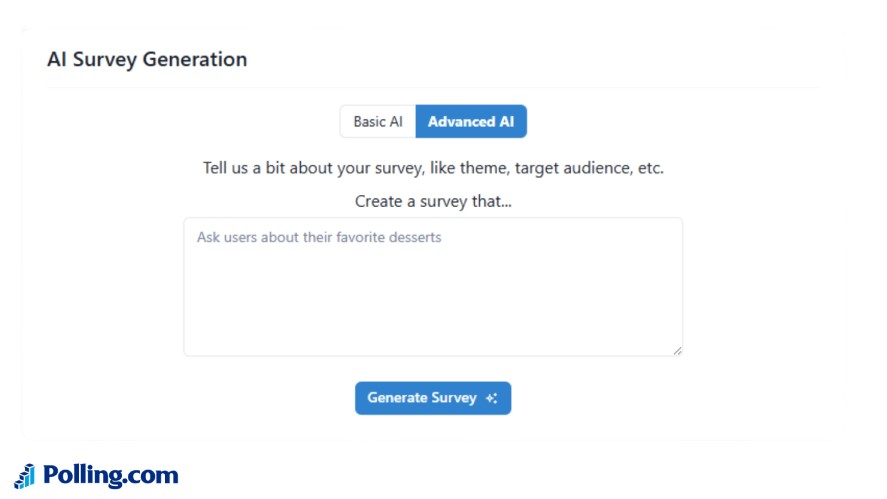
The platform also includes features that can help you keep surveys focused, such as templates, preview tools, and suggestions for clearer or less biased wording.
For this type of survey, the goal isn’t just to collect more responses.
It’s to create a questionnaire where respondents can answer honestly and the resulting data is useful for making decisions.
Good Unbiased Survey Questions Examples FAQ
Overall, how satisfied or dissatisfied are you with the service you received?
This question allows respondents to express either a positive, negative, or neutral opinion without suggesting a preferred answer.
A question can become biased when it uses leading or emotional wording, makes assumptions about the respondent, or provides unbalanced response options. Even small wording choices can influence how people interpret and answer a question.
Use neutral, clear wording and ask about one idea at a time. Avoid assumptions, persuasive language, and unbalanced response options, then test the questions before launching the survey.
A leading question pushes respondents toward a particular answer, while an unbiased question gives them equal freedom to express their opinion.
No, a yes-or-no question is not automatically biased. The wording should remain neutral, and the two choices should accurately cover the possible answers. If they don’t, additional options such as Not sure, Not applicable, or a more detailed response scale may be needed.
Conclusion
Good unbiased survey questions examples are neutral, clear, specific, balanced, and focused on one idea at a time.
Before publishing a survey, review both the wording and response options to make sure they don’t push respondents toward a particular answer.
Once your questions are ready, you can use Polling.com to build, distribute, and analyze the survey.
2 thoughts on “29 Good Unbiased Survey Questions Examples”