
User Research Methods: 10 Essential Methods and How to Choose

User research methods help teams learn what real users need, think, and do. They replace guesswork with evidence. That makes them useful for product design, UX, marketing, and business decisions.
But choosing a method is not always simple.
An interview can explain why a user feels frustrated. A survey can show how common that problem is. Usability testing can reveal where people get stuck. Product analytics can show what happens at scale.
Each method answers a different type of question.
That is why strong user research starts with a clear goal. You first decide what you need to learn. Then you choose the method that can give you the right evidence.
Teams exploring user research for ux often make one common mistake. They pick a favorite method before they define the problem. For example, they may send a survey when they really need to watch users complete a task.
A better approach is to combine methods when needed.
Qualitative research can explain why something happens. Quantitative research can show how often it happens. Attitudinal research tells you what users say. Behavioral research shows what they actually do.
This guide covers 10 essential user research methods. You will learn what each method does, when to use it, and how to combine methods for better decisions.
What Are User Research Methods?
User research methods are structured ways to learn about users. They help researchers study needs, behaviors, goals, attitudes, problems, and experiences.
The UK Government Service Manual’s user research guidance also provides a useful overview of planning research, selecting participants, conducting studies, and analyzing findings.
The goal is simple: make decisions based on evidence instead of assumptions.
A research team may want to know why people leave during onboarding. It may want to learn which features customers value most. It may also need to find out whether users can understand a new menu.
Different questions need different methods.
If you are asking what is user research, think of it as the wider process of learning about users and the problems they face.
UX research is closely related. People who search what is ux research are often asking about research that focuses on the user experience of a product, service, or interface.
User testing is more specific.
Usability testing, for example, is one research method. It is not the whole field of user research.
That difference matters.
A usability test can tell you whether users can complete a task. It may not tell you how important that task is in their daily lives. Interviews, field research, or surveys may be better for that question.
How User Research Methods Differ From Market Research
User research and market research often overlap, but they are not the same.
User research usually focuses on people’s needs, actions, tasks, and experiences. Market research often looks at a wider business picture.
Common market research methods may study demand, customer groups, competitors, pricing, buying behavior, and market size.
Many methods of market research still use familiar tools. Surveys, interviews, observation, and focus groups can all appear in both fields.
The key difference is often the question.
For example, marketing research methods may help a company decide which audience to target. User research may help that same company understand why users struggle with one part of its product.
If you have ever asked what does a market researcher do, the answer can include studying markets, buyers, competitors, trends, and customer needs.
Some teams also use special b2b market research methods. B2B research can be more complex because the buyer and the end user may be different people.
The same is true for market research questions. They may focus on purchase intent, brand awareness, pricing, or demand. User research questions often focus more on tasks, goals, pain points, and product experiences.
Both types of research can support better decisions.
The Main Types of Research
There are several ways to group user research methods. Two of the most useful are qualitative versus quantitative and attitudinal versus behavioral.
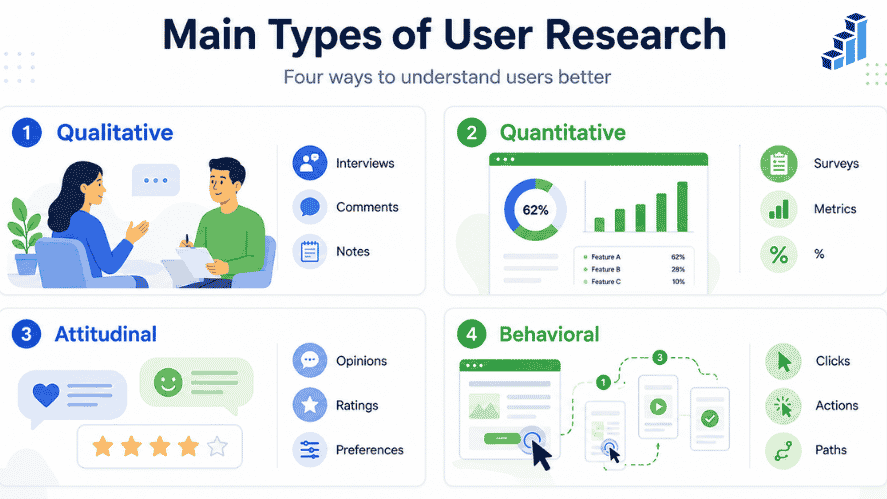
Understanding these groups makes method selection much easier.
Qualitative Research
Qualitative research helps explain why something happens.
It explores motives, feelings, expectations, habits, and experiences. It is often useful when a team does not yet understand a problem well.
Common qualitative methods include user interviews, focus groups, diary studies, field studies, contextual inquiry, and open-ended survey questions.
Imagine that five users say they struggled with account setup.
That tells you a real problem may exist. It does not tell you that most users have the same issue.
Qualitative research gives depth. It does not always show scale.
That is why teams often use quantitative research next.
Quantitative Research
Quantitative research focuses on numbers.
It helps answer questions such as:
- How many users have this problem?
- How often does it happen?
- Which version performs better?
- What percentage of users choose one option?
- Where does the largest drop-off happen?
Common methods include a survey, product analytics, tree testing, first-click testing, and a/b testing.
Quantitative research is useful when you want to measure a pattern.
Still, numbers do not always explain the cause.
Analytics might show that many users leave one page. It cannot always tell you why they leave.
An interview or usability study may help explain the reason.
Attitudinal vs. Behavioral Research
Attitudinal research looks at what people say.
It can include opinions, beliefs, preferences, expectations, and reported experiences.
Surveys and interviews are common examples.
Behavioral research looks at what people do.
Usability tests, product analytics, and experiments are good examples.
Both are useful because words and actions do not always match.
A customer may say a feature is very important. Product data may show that they almost never use it.
Another user may say a page is easy to use. A usability test may show that they struggle with it.
The best research often uses both types of evidence.
10 Essential User Research Methods and When to Use Them
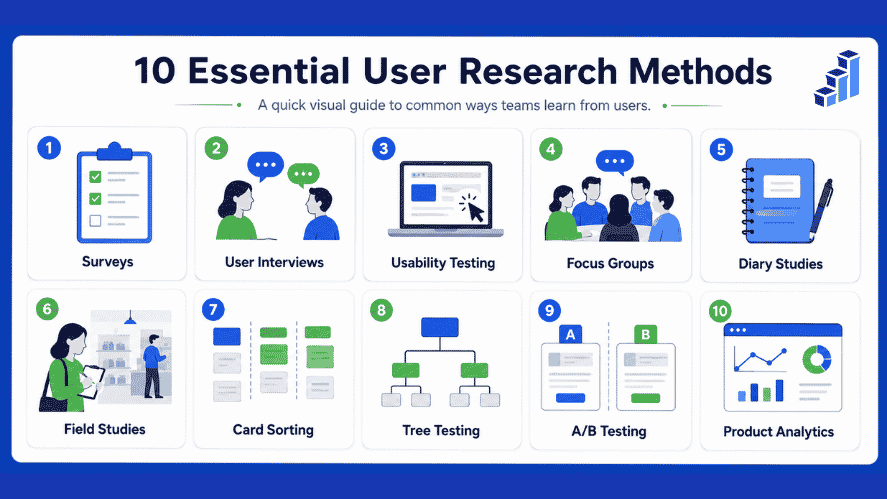
These 10 user research methods can answer many common product and UX questions. No single method is best for every project.
1: Surveys
A user survey collects answers from a group of people.
Surveys work well when you want consistent feedback from more people than you could interview one at a time.
You can use them for product feedback, customer satisfaction, feature priorities, onboarding, customer experience, and product discovery.
Good survey questions should connect to a clear research goal.
For additional methodology guidance, Pew Research Center explains how question wording, response options, question order, and pretesting can affect survey results.
For example, you could ask:
How easy or difficult was it to set up your account?
You could then follow with:
What made setup easy or difficult?
The first question gives you structured data. The second gives you more detail.
Teams searching for ui ux survey questions should avoid copying a long list of questions without a plan. Every question should help answer a research problem.
The same rule applies to questions to put on a questionnaire. Do not ask something just because it sounds useful.
Ask what you will do with the answer.
Surveys often work better than interviews when you need to measure a pattern across a larger group.
They are also useful when you want to compare results over time.
When reviewing user research platforms, teams may want survey tools that support more than basic forms.
Polling.com can support this part of the research process. Based on the supplied product information, Polling.com offers unlimited surveys and responses across plans. It also supports templates, AI-assisted survey creation, branching logic, multiple question types, website embeds, analytics, and integrations.
Teams that are new to survey design can also use the Polling.com Survey Creation Guide for help with the setup process.
2: User Interviews
User interviews are one-on-one talks with people from your target audience.
They help researchers learn about goals, habits, expectations, frustrations, and past experiences.
Interviews are very useful during early discovery.
At this stage, you may not know enough about a problem to create a good questionnaire.
A semi-structured interview works well in many cases. You prepare a set of questions, but you also leave room for follow-up questions.
That gives the conversation some structure without making it feel rigid.
Avoid leading questions.
Do not ask:
Would this simpler menu make the product easier to use?
Try:
How would you expect to find this feature?
The second question does not suggest the answer.
Good interviews can reveal themes that later become survey questions or usability tasks.
3: Usability Testing
Usability testing shows how people use a product or prototype.
In moderated usability testing, a researcher gives users realistic tasks and observes what happens as they work through them.
For example:
Imagine you need to change the delivery address for your next order. Show me how you would do that.
The researcher watches where users click, where they pause, and where they become confused.
This method is useful because people cannot always explain their own behavior.
A customer may say a product is easy to use. You may still see clear signs of confusion during a test.
Usability testing can be moderated or unmoderated.
In a moderated session, a researcher is present. They can ask follow-up questions.
In an unmoderated study, users complete tasks on their own. This can make it easier to run more sessions.
Use usability testing when you need to learn whether people can complete a task and where the experience breaks down.
Method 4: Focus Groups
Focus groups bring several people together for a guided discussion.
They can help teams explore opinions, reactions, ideas, and perceptions.
A moderator usually introduces a topic and guides the conversation.
Focus groups can be useful when you want to hear several points of view at once.
They also have limits.
One person may dominate the discussion. Some people may change their answers to fit the group. Others may stay quiet even when they disagree.
For that reason, you should not treat one focus group as proof of what the whole market thinks.
Focus groups are also not the best tool for testing usability.
If you need to know whether users can complete a task, watch them try to complete it.
5: Diary Studies
Diary studies follow users over time.
Participants record events, thoughts, actions, or problems as they happen.
A study may last several days or several weeks.
This method is useful for habits and long journeys.
For example, a budgeting app may want to learn how people make spending decisions during a month. A health app may want to study how routines change from one day to another.
A diary study can capture details that users may forget during an interview.
It can also show how behavior changes across different situations.
The main challenge is effort.
Participants need clear instructions. The study should not ask them to record so much information that the process becomes a burden.
6: Field Studies and Contextual Inquiry
Field research takes place in the user’s normal environment.
Researchers observe people where the real work or activity happens.
Contextual inquiry often combines observation with questions.
For example, a researcher may watch an employee use software during a normal workday. The researcher can ask questions while the employee completes real tasks.
This method often reveals hidden workarounds.
A user may say a process is simple. Observation may show that they keep notes beside their computer, switch between three tools, and ask a coworker for help.
Those details can be hard to discover in a standard interview.
Use field studies when the user’s environment matters.
They are useful for work tools, healthcare, retail, industrial products, and other experiences shaped by real-world context.
7: Card Sorting
Card sorting helps teams understand how users group information.
Participants receive items such as topics, features, or page names. They then organize them into categories.
There are two common types.
In an open card sort, participants create their own groups.
In a closed card sort, researchers provide the groups.
Card sorting is useful for navigation and information architecture.
It can show how users think different topics belong together.
The results should not become your site structure without review. Business needs and technical limits still matter.
Think of card sorting as evidence about the user’s mental model.
8: Tree Testing
Tree testing checks whether people can find information in a proposed structure.
Users usually see a simple text version of a site or menu.
They receive a task such as:
Where would you go to update your billing details?
Researchers can then see whether users choose the expected path.
Tree testing works well with card sorting.
Card sorting helps you learn how people group content. Tree testing helps you check whether the final structure makes sense.
Use it when navigation and findability are important.
9: A/B Testing
a/b testing compares two versions of something.
For example, you may test two page layouts, two headlines, or two signup flows.
You then compare a defined result.
That result could be signups, purchases, clicks, or task completion.
A/B testing can be powerful when you have a clear idea to test and enough data to make a useful comparison.
But it has one major limit.
It can tell you which version performed better. It may not tell you why.
If version B gets more signups than version A, interviews or usability tests may help explain the reason.
The strongest teams often combine experiment data with qualitative research.
10: Product Analytics
Product analytics shows how people use a live website or product.
Teams can study feature use, funnels, drop-offs, retention, and user paths.
Analytics is useful because it captures real behavior.
For example, you may see that many users start account setup but leave before the last step.
That tells you what is happening.
It does not always tell you why.
A survey, interview, or usability study can help answer that next question.
Teams comparing top website analytics tools should focus on the questions they need to answer. A tool with many dashboards is not always the right tool.
The goal is useful evidence, not more data.
Compare the 10 Research Methods
This table gives you a quick way to compare the 10 methods.
| Method | Data Type | Attitudinal or Behavioral | Best Used For | Typical Effort |
|---|---|---|---|---|
| Surveys | Both | Mainly attitudinal | Feedback, satisfaction, patterns, priorities | Low to medium |
| User interviews | Qualitative | Attitudinal | Needs, motives, pain points, discovery | Medium |
| Usability testing | Both | Behavioral | Task success, friction, navigation | Medium |
| Focus groups | Qualitative | Attitudinal | Reactions, ideas, perceptions | Medium |
| Diary studies | Both | Both | Habits and long-term experiences | High |
| Field studies | Qualitative | Mainly behavioral | Real-world context and workflows | High |
| Card sorting | Both | Behavioral | Categories and information structure | Medium |
| Tree testing | Both | Behavioral | Navigation and findability | Medium |
| A/B testing | Quantitative | Behavioral | Comparing two defined options | Medium to high |
| Product analytics | Quantitative | Behavioral | Funnels, usage, retention, drop-offs | Ongoing |
The table also shows why there is no single “best” research method.
Interviews give depth. Surveys help measure patterns. Usability tests show behavior. Analytics shows what happens in a live product.
The best method depends on the question.
How to Choose the Right User Research Methods
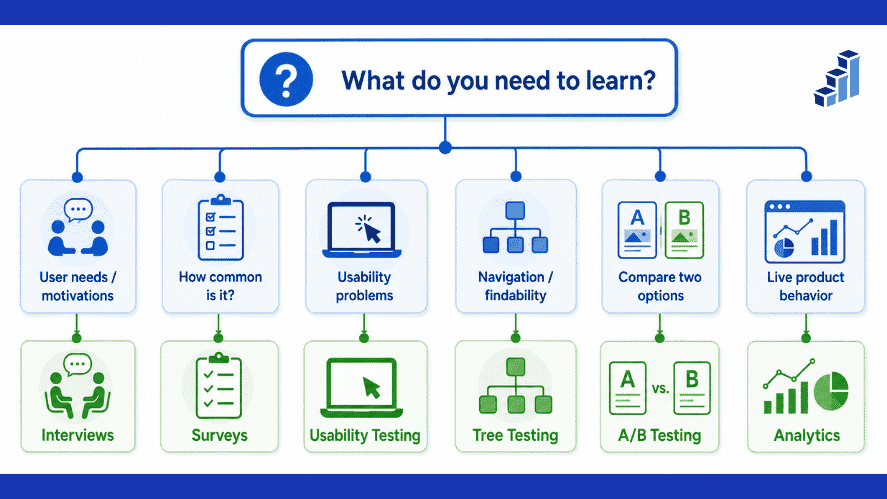
Choosing the right user research methods starts with one question:
What do we need to learn?
Do not start with a tool.
Do not start with the method your team uses most often.
Start with the problem.
Good research planning also starts with clearly defined research objectives and questions before choosing specific research activities.
Choose User Research Methods Based on Your Research Question
Suppose your team asks:
Why are users leaving during onboarding?
You need to learn about reasons and behavior. Interviews and usability testing may work well.
Now imagine the question is:
How common is this onboarding problem?
A survey may be a better choice.
If you want to know:
Can users find our pricing settings?
Try tree testing or usability testing.
If you want to know:
Which page leads to more signups?
An A/B test may fit.
This approach is also useful for anyone learning how to do customer research.
Write your goal in plain language.
For example:
We want to learn why new customers leave during setup so we can decide what to improve.
That is much better than saying:
We want to learn more about users.
A clear goal makes the rest of the research easier.
Choose User Research Methods Based on Product Stage
Your product stage also matters.
During discovery, you may need to learn about problems before you design a solution. Interviews, field studies, surveys, diary studies, and contextual research can help.
During design, your questions change. You may need card sorting, prototype tests, interviews, or concept feedback.
During validation, you want to know whether your solution works. Usability testing, tree testing, surveys, and experiments become more useful.
After launch, product analytics can show how people behave in the real world. Surveys and interviews can help explain the data.
Research should not stop after launch.
Users change. Markets change. Products change.
Ongoing research helps teams spot new problems before they become larger ones.
Choose User Research Methods Based on Time and Sample Size
Your budget and time also matter.
Small qualitative studies can give useful depth. You may learn a great deal from a small group of well-chosen users.
That does not mean you should use a small sample to make broad numerical claims.
Quantitative studies often need larger samples.
The exact number depends on your research goal, audience, and analysis plan.
Remote research can also lower the effort needed for some projects.
Still, a large sample does not fix a bad study.
A thousand answers to a confusing question are still confusing answers.
Good research design matters more than raw volume.
How User Research Platforms and Feedback Tools Fit In
Research tools should support your method, not decide it.
Some teams need a dedicated user feedback platform. Others may compare customer feedback tools, usability tools, analytics systems, or survey software.
There are also broader feedback tools that collect comments from several channels.
A customer feedback management tool may help a larger company organize feedback across teams.
Product teams may prefer specialized product feedback tools that connect comments to product decisions.
Other teams may search for a company research platform that brings several research sources together.
The right choice depends on the job.
The same is true for survey companies, outside market research services, and independent research companies.
Some projects can be handled in-house. Others need outside help because of recruitment, location, research scale, or special expertise.
When people search for the best market research tools, they should first define the task.
A survey platform and a product analytics platform solve different problems.
Neither is better in every case.
Why Surveys Are Valuable in User Research
Surveys have a useful role in user research methods because they can collect the same questions from many users.
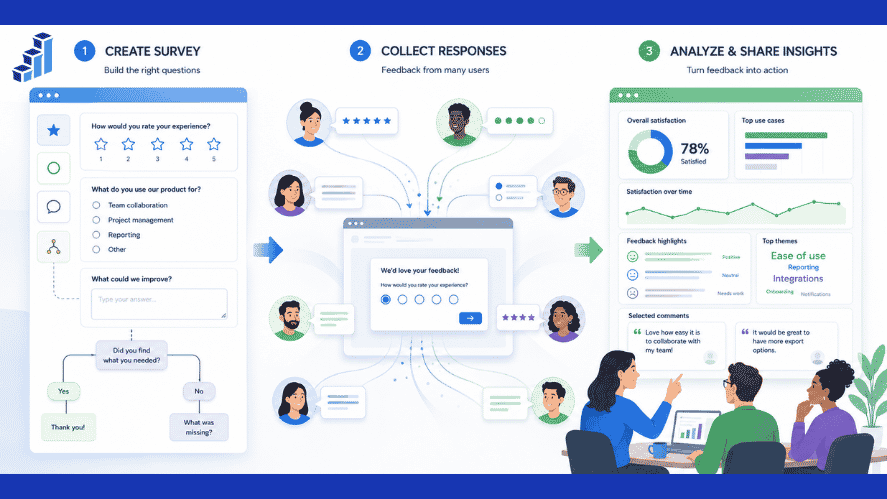
This makes it easier to compare answers and look for patterns.
User Research Methods: Surveys Help Scale Feedback
Imagine that six interviews reveal the same problem.
That is an important signal.
But you still do not know how common the problem is across your audience.
A survey can help you explore that question with a larger group.
You can ask whether users had the problem, how serious it was, and which part of the experience caused trouble.
Good sampling still matters.
You should not assume that every survey result represents your whole customer base.
The people you ask and the way you recruit them can affect the result.
Polling.com also has a guide to systematic sampling for customer feedback for teams that want to think more carefully about who receives a survey.
User Research Methods: Surveys Can Mix Numbers and Comments
A survey can collect both quantitative and qualitative data.
For example, start with a rating:
How satisfied are you with the product?
Then ask:
Why did you choose that rating?
The rating gives you a number.
The follow-up gives you context.
This simple pattern can make survey data much more useful.
Polling.com has a separate guide to open-ended questions that explains when free-text responses can add value.
Teams can also review examples of product survey questions when planning customer feedback research.
How Polling.com Supports User Research Surveys
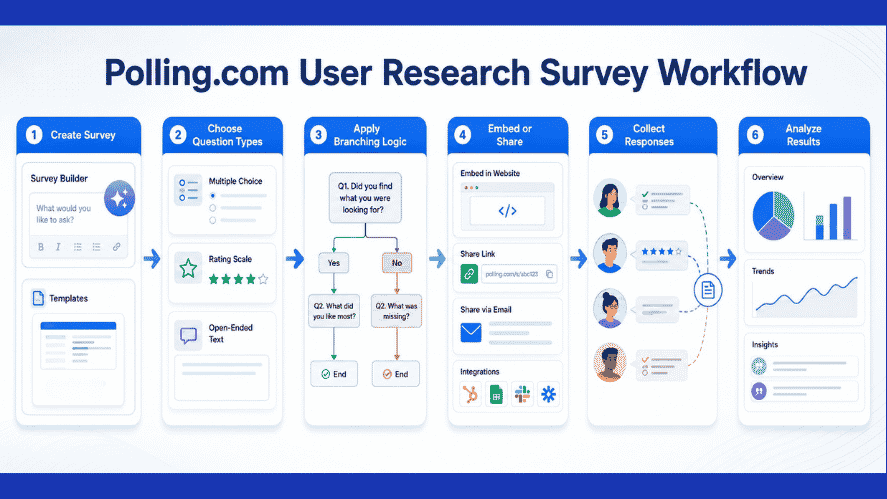
Polling.com can act as the survey part of a wider research process.
Polling.com offers unlimited surveys and responses across plans. It also supports templates, AI-assisted survey creation, branching logic, multiple question types, website embeds, analytics, and integrations.
Multiple question types make it possible to mix ratings, choices, and open comments.
Branching logic can change the path based on a user’s answer.
That can keep questions more relevant.
Website embeds can also place feedback closer to the user experience. The Polling.com survey embeds guide explains how embedded surveys can be added to websites.
After responses arrive, teams can review results and analytics. The survey results and analytics guide covers this part of the process.
The key point is simple.
Polling.com does not need to replace interviews, usability testing, or analytics.
It can support the survey stage of a mixed research process.
User Research Methods and Market Intelligence
User research becomes even more useful when teams connect it with wider market data.
Product teams may study how people use a feature.
Marketing teams may study demand.
Strategy teams may look at business market intelligence, competitors, pricing, or market change.
These sources answer different questions.
For example, a company exploring competitor pricing may learn how rivals position their offers.
It may also use competitive intelligence solutions to track changes across the market.
At the same time, user interviews can show why customers care about certain features.
A survey can measure how many customers share that view.
Together, the evidence gives a clearer picture.
The same is true for market intelligence solutions.
A market intelligence system can help a company study outside changes. User research helps explain the needs and behavior of real people.
Both can support understanding customer behavior.
They can also create stronger brand insights when teams connect what people say with what they do.
User Research Methods for Market Opportunities
Some research questions go beyond product usability.
Teams may want to know how to identify market trends or where a new market opportunity may exist.
These questions need more than one method.
Market opportunity identification may combine user interviews, surveys, market data, competitor research, and internal product data.
For example, several users may ask for the same feature.
That is useful evidence.
It does not yet prove that the feature represents a large market opportunity.
The team may need to study demand, willingness to pay, existing alternatives, and the size of the audience.
This is where user research and consumer market research can work together.
Different types of market research methods can provide extra context.
The goal is to avoid making a major business decision from one small piece of evidence.
Common User Research Mistakes to Avoid
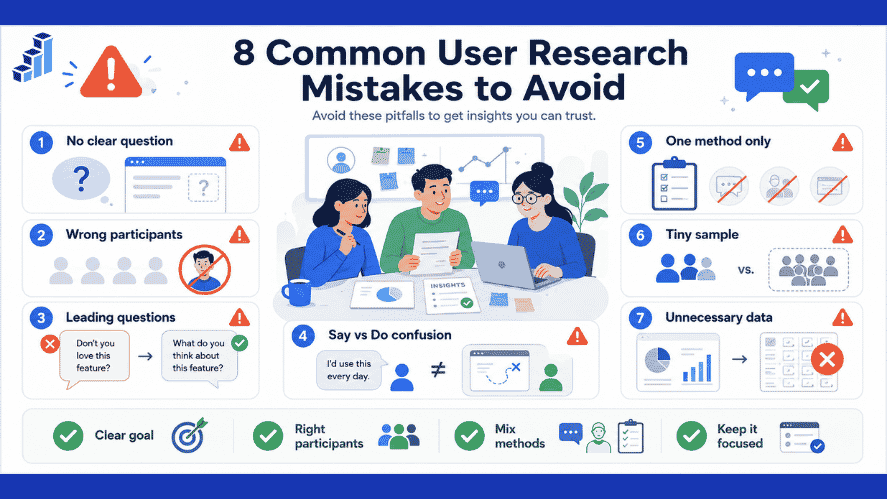
Strong user research methods can still produce weak results if the study is poorly planned.
Here are the most common problems to watch for:
- Starting without a clear question. “Learn about our users” is too broad. Define the decision you need to make.
- Recruiting the wrong people. Research should include users who match the audience linked to your question.
- Asking leading questions. Do not tell participants what answer you want.
- Confusing opinions with behavior. What users say they will do may differ from what they actually do.
- Using only one method. Every research method has blind spots.
- Making large claims from a small sample. Small studies can be useful, but the conclusion must fit the evidence.
- Collecting data without a plan. Research is useful only when teams can act on the findings.
- Asking too many questions. Long surveys can create survey fatigue, which can reduce respondent attention and answer quality.
- Collecting data you do not need. Keep the study focused on the research goal.
One of the biggest mistakes is overconfidence.
Research reduces uncertainty. It does not remove all uncertainty.
A good researcher knows what the data can support and what it cannot.
How to Combine User Research Methods
Mixed-method research uses more than one method to study a problem.
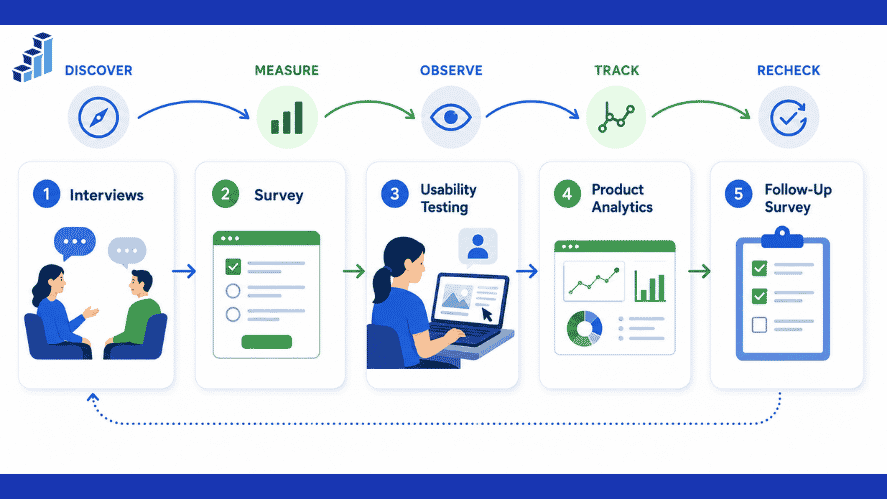
This can give you a stronger view because each method covers a different gap.
A simple workflow might look like this:
Interviews → Survey → Usability Test → Analytics → Follow-Up Survey
Interviews can uncover new problems.
A survey can help measure how common those problems are.
Usability testing can show how the problem affects behavior.
Analytics can track what happens after a product change.
A follow-up survey can measure how users feel after the change.
This creates a useful research loop:
Discover → Measure → Observe → Track → Recheck
You do not have to follow this exact order.
The best mix depends on your question.
For example, product analytics may show a sudden drop-off first.
Usability testing can then help explain it.
Interviews can explore what users expected.
A survey can measure whether that problem affects a wider group.
That is often more useful than asking one research method to do everything.
Frequently Asked Questions About User Research Methods
What Are the Most Common User Research Methods?
Common user research methods include surveys, interviews, usability tests, focus groups, diary studies, contextual inquiry, card sorting, tree testing, A/B testing, and product analytics.
The best choice depends on your research goal.
What Are Qualitative User Research Methods?
Qualitative user research methods explore why users think, feel, or behave in certain ways.
Examples include interviews, field studies, diary studies, focus groups, and open-ended survey questions.
They are useful when you need depth and context.
What Are Quantitative User Research Methods?
Quantitative user research methods produce numerical data.
Examples include surveys with fixed answers, product analytics, A/B tests, and some forms of tree testing.
They are useful when you need to measure frequency, size, or differences.
How Do I Choose a User Research Method?
Start with the question you need to answer.
- Use interviews for depth.
- Use surveys to measure patterns.
- Use usability testing to observe tasks.
- Use analytics to study real product behavior.
- Use experiments to compare defined options.
Combine methods when one source of evidence is not enough.
Are Surveys a Qualitative or Quantitative Research Method?
They can be both.
Closed questions produce quantitative data.
Open-ended questions produce qualitative data.
A survey can combine both types in the same study.
What Is the Difference Between User Research and Usability Testing?
User research is the wider process of learning about users.
Usability testing is one method inside that process.
Usability testing focuses on whether people can use a product or interface to complete tasks.
How Many Users Do You Need for User Research?
There is no single correct number.
The right sample depends on the method, audience, question, and type of claim you want to make.
Qualitative studies can often be useful with smaller groups.
Quantitative studies often need larger samples when the goal is to measure a pattern.
Do not choose a sample size based on a rule without considering the study goal.
What Skills Matter for a User Experience Researcher Career?
A user experience researcher career involves more than running interviews.
Researchers need to understand study design, recruiting, bias, analysis, ethics, and communication.
They also need to explain findings in a way that helps teams make decisions.
Method choice is one of the most important skills.
How Do User Research Methods Support Market Research?
User research can support wider market research by showing what users need and how they behave.
Market research can add data about demand, competition, pricing, and market size.
The two can work together.
This is useful when a team needs both product insight and business context.
Final Thoughts on User Research Methods
There is no single best research method.
The right user research methods depend on your question, product stage, audience, budget, and the type of evidence you need.
Choose interviews when you need to understand user motives and experiences.
For structured feedback from a larger group, surveys are a better fit.
Usability testing works well when you need to watch people complete real tasks.
When the user’s environment affects behavior, contextual research can reveal important details.
Experiments are useful for comparing two clear options.
To understand what people do in a live product, turn to analytics.
Most of all, avoid relying on one source of evidence when an important decision needs more support.
A survey may show that a problem is common.
An interview can help explain the cause.
A usability test can reveal the behavior behind it.
Analytics can show whether a change improves the real outcome.
That is how research becomes more than feedback.
It becomes a practical tool for making better product decisions.
For teams that want to add surveys to this process, Polling.com can support survey creation, distribution, website embeds, branching logic, multiple question types, analytics, and integrations.
The goal is not to run more studies.
The goal is to ask better questions, choose the right method, and use the evidence to build better experiences.