
Market Research Methods: A Complete Guide for Businesses

Every successful business decision starts with understanding the market. That’s where market research methods come in.
These methods help businesses collect information about customers, competitors, and industry trends before launching products, entering new markets, or changing their strategy.
Instead of relying on assumptions, businesses use market research to understand customer needs, test ideas, and reduce risk.
Choosing the right research method also improves the quality of the data you collect, leading to better decisions and more reliable results.
In this guide, you’ll learn the different marketing research methods, when to use each one, and how to choose the best approach for your business goals.
What Are Market Research Methods?
Before choosing a research technique, it’s important to understand what market research methods are and what they help businesses achieve.
Definition of Market Research Methods
Market research methods are systematic ways of collecting and analyzing data to better understand a target market.
They help businesses answer questions about customer preferences, buying behavior, product demand, pricing, and market opportunities.
These methods can collect both quantitative data, such as survey responses and sales figures, and qualitative insights gathered from interviews, focus groups, or customer observations.
Together, they provide a clearer picture of customer behavior and market conditions.
Why Market Research Matters For Businesses
Businesses operate in markets that change constantly.
Customer expectations evolve, competitors introduce new products, and industry trends shift over time.
Market research helps organizations stay informed and make decisions based on evidence instead of guesswork.
This is a core part of what a market researcher does.
Whether you’re launching a new product, improving customer satisfaction, or entering a new market, research helps reduce uncertainty and support market opportunity identification before investing valuable time and resources.
Common Goals of Market Research
Businesses use market research questions to answer many different questions.
Some of the most common goals include:
- Understanding Customer Needs: Learn what customers want, what problems they face, and what influences their purchasing decisions.
- Product Validation: Test new ideas and gather feedback before launching a product or service.
- Pricing Strategy: Measure price sensitivity and identify pricing that balances customer value with business goals.
- Brand Perception: Understand how customers view your brand compared to competitors.
- Competitor Analysis: Evaluate competitor products, pricing, marketing strategies, and market positioning.
- Identifying Market Trends: Track changing customer preferences, emerging technologies, and new business opportunities to stay competitive.
By defining clear research goals first, businesses can select the most effective research methods and collect data that leads to actionable insights.
The Two Main Types of Market Research Methods
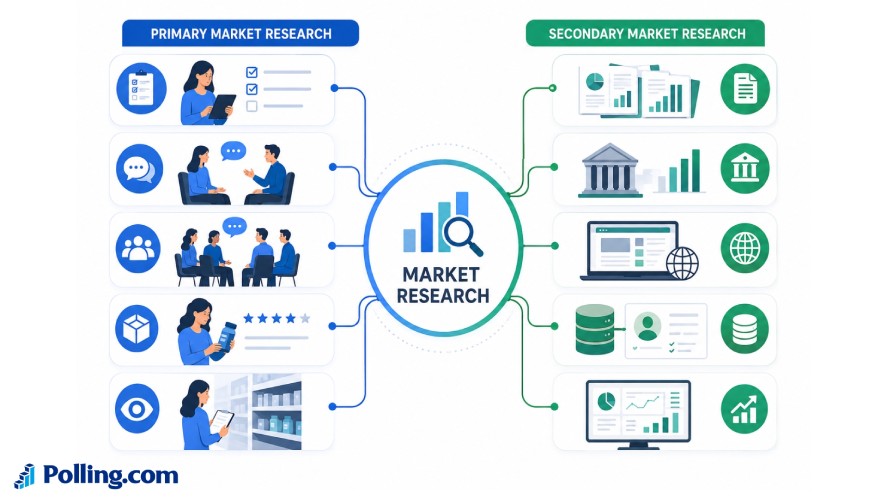
Most market research methods fall into one of two categories: primary research and secondary research.
Primary Market Research Methods
Primary market research involves gathering original data specifically for your research objectives. It’s a key part of consumer market research.
Because the information comes directly from your audience, it is often more relevant and up to date than existing data.
Common primary market research methods include:
- Surveys: Collect feedback from a large audience using structured questions. Surveys are ideal for measuring customer satisfaction, testing product ideas, and conducting market research at scale.
- Interviews: One-on-one conversations that provide detailed insights into customer opinions, motivations, and experiences.
- Focus Groups: Small group discussions led by a moderator to explore perceptions, reactions, and attitudes toward products or services.
- Observation: Watching how customers interact with products, stores, or websites without directly asking questions.
- Field Research: Collecting data in real-world environments through activities such as store visits, customer interactions, or in-person observations.
- Product Testing: Allowing potential customers to try a product and complete a market survey of a product before a full launch.
Advantages
- Collects data tailored to your specific research goals.
- Provides current and relevant customer insights.
- Allows businesses to ask targeted follow-up questions.
- Supports both qualitative and quantitative research.
Limitations
- More time-consuming than secondary research.
- Can be more expensive to conduct.
- Requires careful survey or study design to avoid bias.
Best Use Cases
Primary research is best for validating new products, measuring customer satisfaction, testing pricing strategies, understanding buying behavior, and supporting B2B market research methods.
Secondary Market Research Methods
Secondary market research uses information that has already been collected by other organizations or from existing internal sources.
It is often the first step in a research project because it provides useful background information quickly and at a lower cost.
Common secondary market research methods include:
- Industry Reports: Market reports published by research companies that cover trends, forecasts, and market size.
- Government Statistics: Public datasets on demographics, employment, economic conditions, and consumer spending.
- Research Publications: Academic studies, white papers, and industry journals that provide evidence-based insights.
- Competitor Websites: Product pages, pricing, marketing campaigns, customer reviews, and public announcements.
- Internal Company Data: Sales reports, CRM records, website analytics, and previous survey results.
Benefits
- Faster and more affordable than collecting new data.
- Provides historical context and industry benchmarks.
- Helps identify trends before conducting primary research.
Drawbacks
- Information may be outdated or collected for a different purpose.
- Data quality and methodology can vary between sources.
- May not fully answer your specific research questions.
Examples
A business launching a new product might first review industry reports and competitor pricing to understand the market.
It can then conduct customer surveys or interviews to validate demand and refine the product before launch.
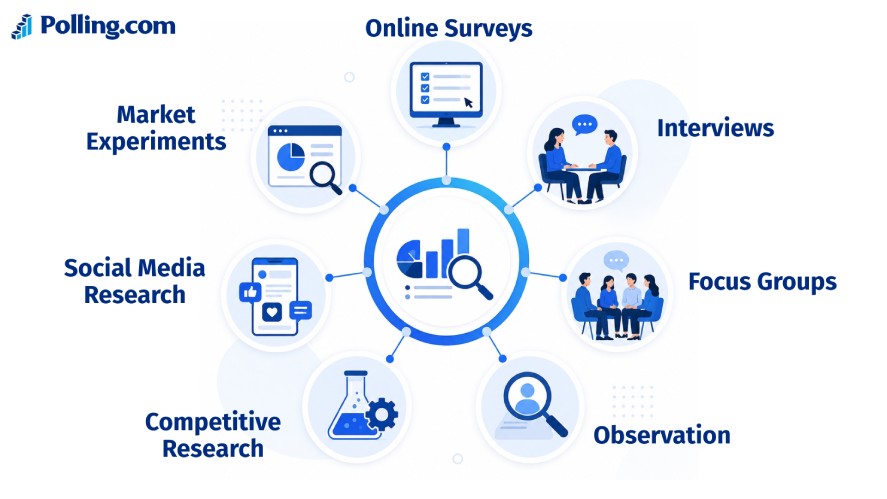
The Most Popular Market Research Methods Explained
Every research method has its strengths.
Some help you collect measurable data from large groups, while others provide deeper insights into customer behavior and decision-making.
Choosing the right methods of market research depends on your research goals, timeline, and budget.
Online Surveys
Online surveys are one of the most widely used types of surveys for market research because they are fast, affordable, and easy to scale.
Businesses use them to collect feedback from customers, employees, prospects, and target audiences across a wide range of research projects.
Benefits
- Reach large audiences quickly
- Collect quantitative data for analysis
- Cost-effective compared to in-person research
- Easy to distribute through email, websites, social media, or QR codes
- Support automated reporting and survey analysis
Best Practices
- Keep surveys short and focused.
- Use clear, unbiased questions.
- Combine multiple-choice and open-ended questions.
- Test the survey before launching it.
- Target the right audience to improve response quality.
When to Use Online Surveys
Online surveys work well for customer satisfaction studies, product feedback, brand awareness, pricing research, employee feedback, and market research surveys for new products.
For organizations looking to create professional surveys, Polling.com offers:
- AI-powered survey creation
- Advanced survey logic and branching
- Customizable templates
- Real-time analytics
- Enterprise-grade security
These features help teams build high-quality surveys faster while collecting reliable data for better business decisions.
Other popular survey platforms include SurveyMonkey, Typeform, Google Forms, and Qualtrics.
Each offers useful survey capabilities, but Polling.com combines AI-assisted survey creation with advanced analytics and flexible workflows, making it a strong choice for businesses of all sizes.
Customer Interviews
Customer interviews provide detailed qualitative insights that surveys alone cannot capture, making them valuable for exploratory research in marketing.
They allow researchers to ask follow-up questions, explore customer motivations, and better understand why people think or behave in certain ways.
Common interview formats include:
- One-on-one interviews
- Phone interviews
- Video interviews
- In-person interviews
Some sample questions:
- What problem were you trying to solve?
- Why did you choose our product over others?
- What features do you value most?
- What would improve your experience?
Customer interviews are especially valuable during product development, customer research, and studies conducted on user research platforms.
Focus Groups
Focus groups bring together a small group of participants to discuss a product, service, or idea under the guidance of a moderator.
Participants often build on each other’s comments, creating insights that may not emerge during individual interviews.
Advantages
- Generates rich qualitative feedback
- Reveals opinions, emotions, and motivations
- Encourages discussion and new ideas
- Useful for concept and advertising testing
Common Mistakes
- Recruiting participants who don’t represent the target audience
- Allowing one participant to dominate the discussion
- Asking leading or biased questions
- Drawing conclusions from a small sample alone
Observation Research
Observation research focuses on what customers do rather than what they say.
Watching real behavior often uncovers problems or opportunities that traditional surveys may miss, making observation research valuable for understanding customer behavior.
Common examples include:
- Observing customer behavior in retail stores
- Studying website navigation and user journeys
- Running usability and user experience (UX) studies
- Tracking how customers interact with products
This method is particularly useful for improving customer experiences and identifying usability issues.
Competitive Research
Competitive research helps businesses understand how they compare with others in the market.
By studying competitors, companies can identify opportunities to improve products, pricing, marketing, and customer experiences.
Common activities include:
- Competitor benchmarking
- SWOT analysis
- Product and feature comparisons
- Pricing analysis
- Reviewing customer feedback and public reviews
Competitive research supports smarter positioning, long-term strategic planning, and competitive intelligence solutions.
Social Media Research
Social media provides a continuous stream of customer opinions and market trends.
Businesses use social listening tools to monitor conversations, measure brand insights and perception, and identify emerging topics.
Common applications include:
- Tracking customer sentiment
- Monitoring brand mentions
- Identifying trending topics
- Evaluating campaign performance
- Discovering common customer complaints and requests
Social media research complements surveys by capturing unsolicited customer feedback in real time.
Market Experiments
Market experiments test how customers respond to changes before businesses make large investments.
Instead of relying on opinions alone, companies can measure actual customer behavior.
Popular examples include:
- A/B Testing: Compare two versions of a webpage, advertisement, or email to determine which performs better.
- Concept Testing: Evaluate customer reactions to new product ideas before development.
- Pricing Experiments: Test different pricing strategies to identify the best balance between demand and profitability.
Market experiments provide strong evidence for decision-making because they measure real customer actions rather than stated preferences.
Combined with surveys and interviews, they help businesses build a more complete understanding of their market.
Qualitative vs Quantitative Market Research Methods
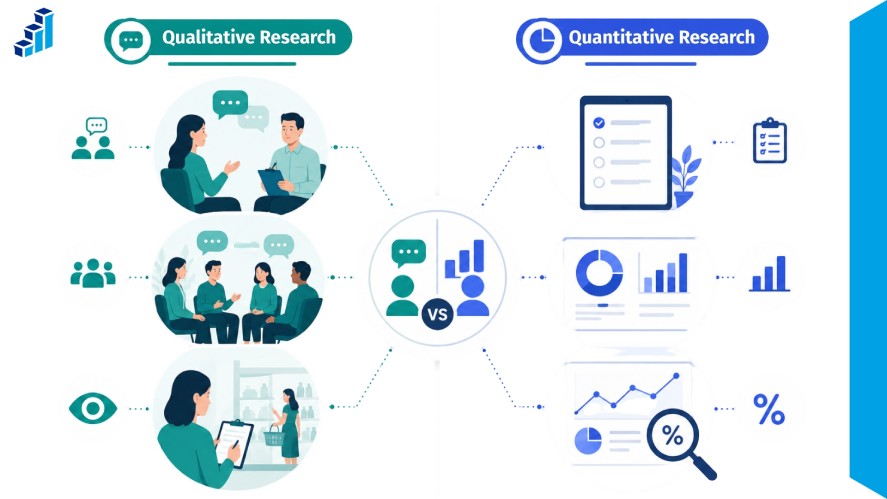
Market research methods generally fall into two categories: qualitative and quantitative research.
Each serves a different purpose, and many businesses use both to gain a complete understanding of their customers.
Qualitative Research
Qualitative research focuses on understanding the reasons behind customer opinions, behaviors, and decisions.
Rather than collecting large amounts of numerical data, it gathers detailed feedback that helps explain why people think or act a certain way.
Characteristics
- Small sample sizes
- Open-ended questions
- In-depth discussions and observations
- Descriptive, non-numerical data
Examples
- Customer interviews
- Focus groups
- Observation studies
- Open-ended survey responses
Benefits
- Reveals customer motivations and emotions
- Identifies pain points and unmet needs
- Generates ideas for new products and services
- Provides context behind quantitative findings
Quantitative Research
Quantitative research collects numerical data that can be measured, compared, and analyzed statistically.
It helps businesses identify trends, measure customer satisfaction, and validate research findings across larger audiences.
Characteristics
- Large sample sizes
- Structured questions
- Statistical analysis
- Measurable and comparable results
Examples
- Online surveys
- Customer satisfaction surveys
- NPS surveys
- Market research polls
- Website and sales analytics
Benefits
- Produces measurable results
- Identifies trends and patterns
- Supports data-driven decision-making
- Easier to compare results over time or across customer segments
When to Combine Both Methods
The strongest research often combines qualitative and quantitative methods.
This approach, known as mixed-method research, gives businesses both the numbers and the context behind them.
For example, a company may first conduct customer interviews to discover why users struggle with a product.
It can then create an online survey to measure how common those issues are across a larger audience.
Likewise, survey results may highlight an unexpected trend, while follow-up interviews explain the reasons behind it.
Using quantitative surveys alongside qualitative interviews helps businesses validate findings, reduce assumptions, and make more confident decisions based on both statistical evidence and real customer experiences.
How to Choose the Best Market Research Method
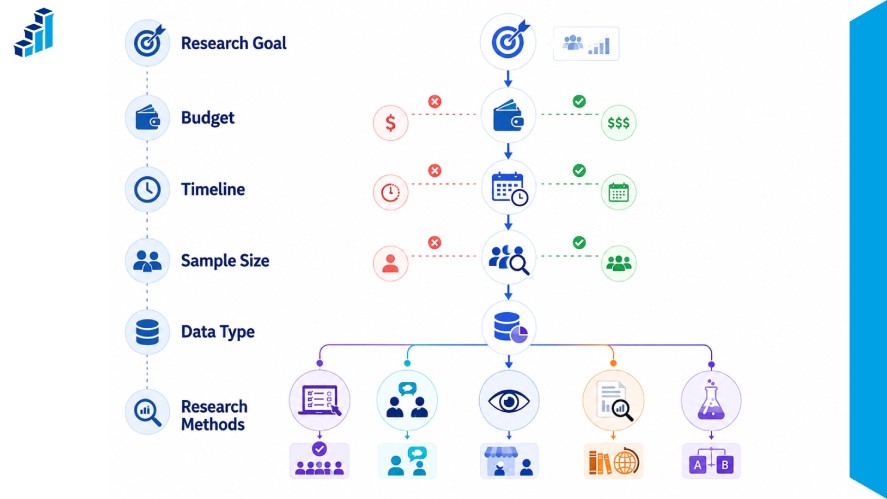
The best market research method depends on what you want to learn, how quickly you need results, and the resources available.
By matching your research method to your objectives, you can collect more relevant data and make better business decisions.
Based on Research Goals
If you’re learning how to do customer research, start by defining the question you want to answer.
Different research goals require different methods. For example:
- Measure customer satisfaction: Online surveys
- Understand customer motivations: Interviews or focus groups
- Test a new product idea: Product testing and surveys
- Study competitors: Secondary research
- Improve user experience: Observation research
- Evaluate pricing: Surveys and pricing experiments
A clear objective helps ensure you collect data that is both relevant and actionable.
Based on Budget
Your budget plays an important role in selecting a research method.
- Lower budgets: Online surveys, secondary research, and website analytics provide valuable insights at a relatively low cost.
- Moderate budgets: Customer interviews and product testing offer deeper insights but require more time and planning.
- Higher budgets: Large-scale focus groups, field research, and extensive market experiments provide detailed findings but typically involve greater investment.
Choose a method that balances research quality with available resources.
Based on Timeline
Some research methods deliver results much faster than others.
- Fast results: Online surveys, secondary research, and social media research
- Moderate timelines: Customer interviews and product testing
- Longer projects: Focus groups, observation studies, and field research
If you need quick insights for a business decision, surveys are often the fastest option.
Based on Sample Size
The number of participants you need also influences the best research method.
- Large audiences: Online surveys are ideal for collecting feedback from hundreds or thousands of respondents.
- Small groups: Interviews and focus groups provide detailed insights from a limited number of participants.
- Behavioral studies: Observation research often focuses on fewer participants but generates rich qualitative data.
Consider both the quantity and quality of feedback when planning your research.
Based on Data Needed
Think about the type of information you need before selecting a method.
- Numerical data: Surveys, polls, and experiments are best for measuring trends and comparing results.
- Detailed opinions: Interviews and focus groups help explain customer motivations and experiences.
- Behavioral insights: Observation research shows how customers interact with products or services in real situations.
- Market intelligence: Secondary research provides industry trends, competitor information, market benchmarks, and other market intelligence solutions.
Many businesses combine multiple methods to gain a more complete picture of their market.
| Goal | Recommended Method |
|---|---|
| Customer satisfaction | Online surveys |
| Product feedback | Interviews + Surveys |
| Brand awareness | Surveys |
| User experience | Observation |
| Competitor analysis | Secondary research |
| Pricing | Surveys + Experiments |
Rather than relying on a single approach, consider combining complementary market research methods.
For example, surveys can measure customer opinions at scale, while interviews explain the reasons behind those responses.
This combination often produces more reliable and actionable insights.
Common Mistakes When Choosing Market Research Methods
Even the best research method can produce poor results if it is used incorrectly.
Avoiding these common mistakes will help you collect more reliable data and make better business decisions.
Using Only One Research Method
No single research method answers every question.
Surveys may reveal what customers think, but interviews and focus groups explain why they think that way.
Therefore, combining multiple methods often leads to a more complete understanding of your market.
Surveying The Wrong Audience
Accurate research starts with the right participants. If your respondents do not represent your target market, the results may be misleading.
So, define your audience carefully and use appropriate screening questions to ensure you’re collecting feedback from the people who matter most.
Asking Biased Questions
Leading or loaded questions can influence how people respond and reduce the accuracy of your findings.
Keep questions neutral, clear, and focused on one topic at a time so respondents can answer honestly.
Ignoring Qualitative Insights
Numbers show trends, but they don’t always explain the reasons behind them.
Interviews, focus groups, and open-ended survey responses can uncover customer motivations, pain points, and ideas that structured surveys might miss.
Using both qualitative and quantitative research creates a more complete picture.
Not Validating Findings With Multiple Sources
Basing important decisions on a single dataset can be risky.
That’s why you should compare survey results with customer interviews, website analytics, sales data, competitor research, or industry reports whenever possible.
Validating findings across multiple sources increases confidence in your conclusions and reduces the chance of acting on misleading information.
Best Tools for Conducting Market Research
The right research tool depends on your goals, team size, and budget.
Some platforms focus on simple survey creation, while others provide advanced analytics, automation, and audience research features.
Let’s check out some of the best market research tools.
Polling.com
Polling.com is an all-in-one customer feedback management tool designed to help businesses collect, analyze, and act on customer feedback.
Its combination of AI-powered features and user-friendly design makes it suitable for startups, growing businesses, and enterprise teams alike.
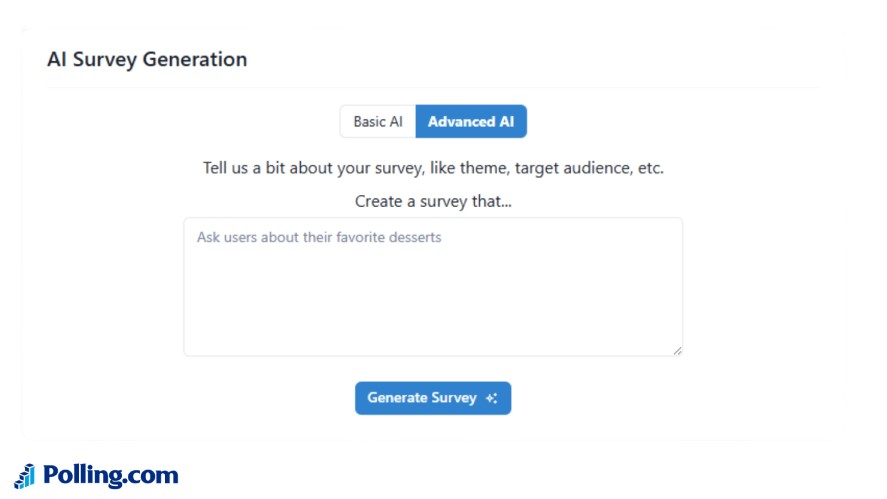
Key features include:
- AI-assisted survey creation
- Real-time dashboards and analytics
- Advanced survey logic and branching
- Customizable survey templates
- Audience research capabilities
- Affordable pricing for businesses of all sizes
- Integrations with popular business tools
- Easy-to-use interface with no coding required
- Team collaboration and shared workspaces
- Exportable reports for deeper analysis
Whether you’re conducting customer satisfaction surveys, product research, employee feedback, or market analysis, Polling.com provides the tools needed to collect reliable data and turn insights into action.
Other Market Research Platforms
While Polling.com offers a comprehensive solution, several other survey companies may be a good fit depending on your specific requirements.
| Platform | Strengths | Best For | Limitations |
|---|---|---|---|
| Polling.com | AI-assisted survey creation, advanced logic, real-time analytics, audience research, integrations | Businesses looking for an end-to-end market research platform | Some advanced features may exceed the needs of very small projects |
| SurveyMonkey | Large template library, strong reporting, brand recognition | General business surveys and customer feedback | Advanced features require higher-tier plans |
| Typeform | Interactive, conversational survey experience | Marketing campaigns and customer engagement | Less suitable for complex research projects |
| Qualtrics | Enterprise-grade analytics and research capabilities | Large organizations and academic research | Higher cost and steeper learning curve |
| Google Forms | Free, simple, and easy to share | Basic surveys and internal data collection | Limited analytics, customization, and advanced logic |
No one platform is the greatest fit for every organization.
If you need AI-powered survey creation, advanced reporting, flexible workflows, and an easy-to-use interface in one platform, Polling.com is a strong starting point.
For simpler projects or specialized use cases, platforms like SurveyMonkey, Typeform, Qualtrics, or Google Forms may also meet your needs.
Frequently Asked Questions
Market research methods are techniques businesses use to collect and analyze information about customers, competitors, and industry trends. Common methods include surveys, interviews, focus groups, observation, and secondary research.
A market researcher collects, analyzes, and interprets data to help organizations make better business decisions. Their work may include designing surveys, conducting interviews, analyzing competitors, identifying market trends, and presenting insights that support product development, marketing, and business strategy.
Primary market research involves collecting new data directly from your audience through surveys, interviews, or observations. Secondary market research uses existing sources such as industry reports, government statistics, and competitor data. Many businesses combine both approaches to build stronger business market intelligence before making strategic decisions.
There isn’t a single best method for every project. Online surveys work well for collecting feedback from large audiences, while interviews and focus groups provide deeper insights. Many businesses combine multiple methods to improve accuracy and gain a more complete understanding of customer behavior.
If you’re looking for a company research platform that supports AI-assisted survey creation, advanced analytics, and collaboration, Polling.com is a strong choice. Other popular options include SurveyMonkey, Typeform, Qualtrics, and Google Forms, while many organizations also use AI market research tools and AI-powered marketing tools to speed up data analysis and reporting.
Small businesses often start with affordable methods such as online surveys, customer interviews, competitor research, and social media analysis. Using a user feedback platform or customer feedback tools makes it easier to collect insights, while product feedback tools help businesses improve products based on real customer opinions.
Qualitative research explores customer opinions and motivations through interviews, focus groups, and observation. Quantitative research measures behaviors and trends using surveys and numerical data. Combining both methods gives businesses a better understanding of customer behavior and makes it easier to identify market trends with confidence.
Conclusion
Choosing the right market research methods is essential for understanding customers, evaluating competitors, and making confident business decisions.
There is no one-size-fits-all solution. Surveys, interviews, focus groups, observation, and secondary research each provide different insights.
By matching your research method to your business objectives and combining multiple methods when appropriate, you can build a more complete picture of your market.
If you’re ready to collect high-quality customer feedback, Polling.com makes it easy to design professional surveys, gather responses, analyze results, and turn insights into actionable decisions.
Start building your next market research survey with Polling.com and make every business decision backed by data.