
MaxDiff vs Conjoint: Which Method Reveals True Preferences?

In market research, the goal is simple: understand what people truly want so you can build better products, improve messaging, and make smarter decisions.
Two of the most reliable methods for uncovering real consumer preferences are MaxDiff and Conjoint analysis. Despite being mentioned together often, they serve very different purposes.
Knowing when to use each method is crucial. Use the wrong one, and you might gather data that looks useful but leads you to the wrong conclusions.
Use the right one, and you’ll get clear, actionable insights that directly improve product design, pricing, or positioning.
And of course, if you’re using platforms like Polling.com, choosing the correct methodology is key to getting meaningful results rather than noise.
What Is MaxDiff? (Maximum Difference/Best‑Worst Scaling)
MaxDiff is a survey technique designed to quickly and clearly identify what people care about the most and the least inside a given list.
It is commonly used in maxdiff analysis and maximum difference analysis projects.
Definition and Basic Mechanism
MaxDiff, also called Best-Worst Scaling, shows respondents a small set of items and asks them to pick:
- The option they value most
- And the option they value least

This forced-choice structure eliminates the common survey problem where respondents rate everything as “very important”.
It helps you get cleaner, more discriminative data, especially useful when building a strong questionnaire or designing a max diff survey.
What Data MaxDiff Produces: Priority & Ranking of Items
The output of MaxDiff is a clear, data-driven ranking of items.
It’s one of the most straightforward forms of best to worst scaling, and it helps simplify how to analyze MaxDiff data afterward.
Every item ends up on the same comparative scale, so you can instantly see which items matter most, which items matter least, and how large the gaps are between them.
If you need a prioritized list based on real preference strength, MaxDiff gives you exactly that.
Strengths and Use‑Cases
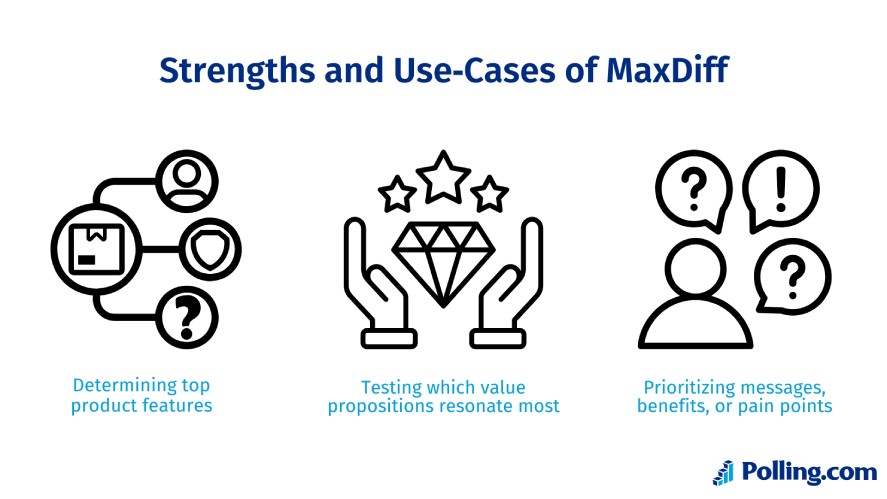
MaxDiff works best when your goal is to rank many items by importance, such as:
- Determining top product features
- Testing which value propositions resonate most
- Prioritizing messages, benefits, or pain points
It’s simpler than Conjoint, easy for respondents to complete, and avoids the “everything is important” bias that comes with standard rating scales.
It also typically achieves stronger survey response rates because of its low cognitive load.
Limitations of MaxDiff
While powerful, MaxDiff has boundaries. It treats items individually, so it does not simulate real-world trade-offs the way consumers actually make decisions.
It can’t tell you how combinations of features influence choice, nor how changes to one attribute affect preference for another.
For situations where consumers choose between bundles, Conjoint analysis is usually the better tool.
What Is Conjoint Analysis?
Conjoint Analysis is a research method used to understand how people make real-world choices when products or services come as bundles of features, not isolated items.
Definition and Basic Mechanism
Conjoint Analysis represents a product or service as a combination of multiple attributes (e.g., price, features, brand, design), each with several levels.
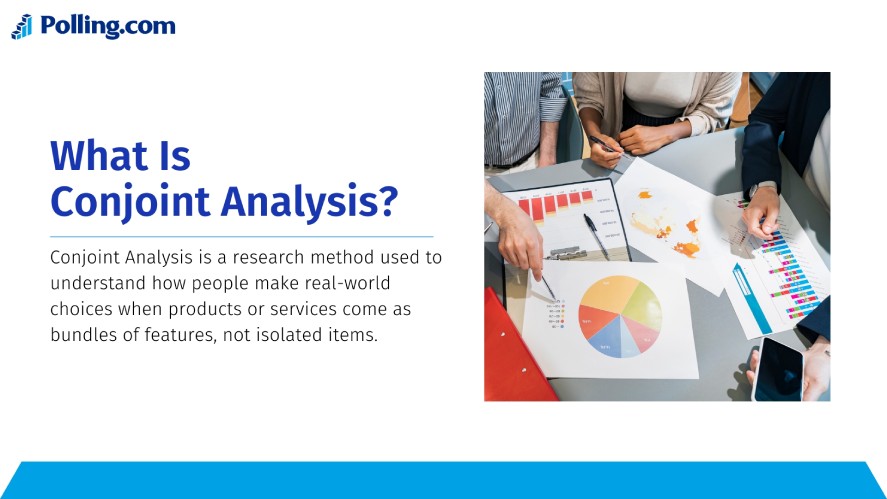
Respondents are then shown different product “profiles” and asked to choose, rank, or rate them.
Because each choice involves trade-offs, Conjoint closely mirrors how consumers actually make decisions.
What Data Conjoint Produces: Utility/Part‑Worth/Preference Shares
Conjoint produces a set of quantitative values known as utilities or part-worths, which describe:
- How much each attribute contributes to overall preference
- How strongly each level (e.g., “$9.99” vs “$14.99”) influences the decision
With these utilities, you can simulate which product configurations would attract the most users amd estimate likely market share for different concepts.
They also help with assessing willingness to pay and understanding how changing one attribute shifts overall preference.
Strengths and Use‑Cases
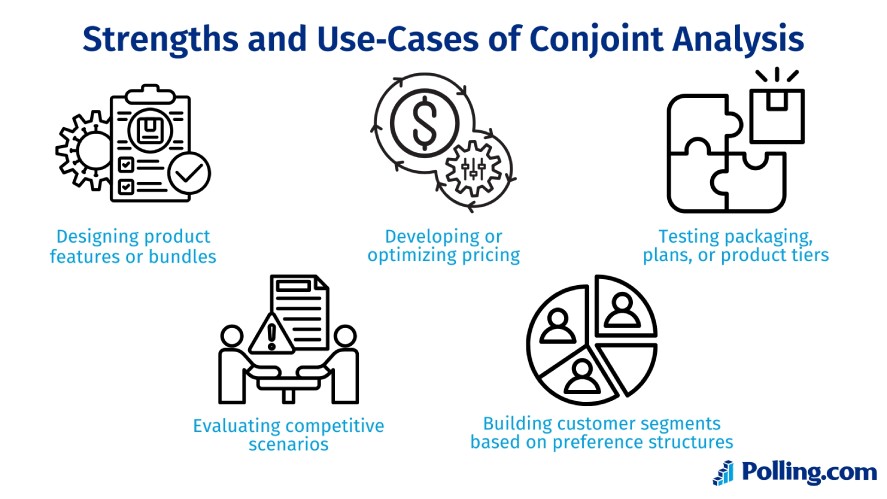
Conjoint is especially valuable when your goal is to understand how combinations of features drive real choices, such as:
- Designing product features or bundles
- Developing or optimizing pricing
- Testing packaging, plans, or product tiers
- Evaluating competitive scenarios
- Building customer segments based on preference structures
Because it reflects real-world trade-offs, Conjoint often predicts behavior more accurately than ranking or rating methods.
Limitations/Constraints
Conjoint is powerful, but it’s not lightweight.
It requires careful planning: selecting attributes, defining levels, generating balanced profiles, and structuring choice tasks.
As the number of attributes grows, the survey becomes more complex and cognitively demanding, increasing risk of respondent fatigue.
Analysis can be more technical, requiring comfort with utility estimation and modeling.
For simple prioritization tasks, MaxDiff is often a better fit.
MaxDiff vs Conjoint: Key Differences & When to Use Which
So, what’s the difference between MaxDiff and Conjoint?
Conjoint vs MaxDiff both reveal consumer preferences, but they answer very different questions.
Here’s a clear, decision-ready comparison to help you choose the right method.
| Criteria/Research Need | Use MaxDiff | Use Conjoint Analysis |
|---|---|---|
| You want to rank a long list of features/options by importance | Yes, straightforward ranking of items | Not ideal. Conjoint focuses on combinations, not ranking single items |
| You need to understand trade-offs across multiple attributes | Not suitable; no modeling of attribute interactions | Perfect fit; measures how attributes work together |
| You want a quick, low-burden survey | Yes, relatively simple, low respondent burden | More complex; longer setup and task load |
| You’re designing/optimizing a product, bundle, or pricing plan | Limited, gives relative importance but not combinations | Highly suitable; simulates realistic product decision-making |
| You want to estimate market share, simulate choices, or model willingness to pay | Not capable of these predictions | Well-suited (with proper design) |
In short:
- Use MaxDiff when you need a clean ranking of what matters most vs least.
- Use Conjoint Analysis when you want to model real-world decisions, where consumers must balance multiple attributes at once.
Often, researchers use both: start with MaxDiff to shortlist/prioritize features, then run a Conjoint Analysis survey to refine how those features combine in actual choice scenarios.
Practical MaxDiff vs Conjoint Tips for Survey & Polling Professionals
Choosing between MaxDiff vs Conjoint isn’t just about methodology; it’s about designing research that truly answers your business question.
These tips help ensure you pick the right tool and use it effectively.
Be Clear About Your Research Objective Before Choosing a Method
Every strong study begins with clarity: What exactly do you need to learn?
If your goal is to rank features, messages, or benefits by importance, MaxDiff is usually the most efficient fit.
But if you need predictive insights, such as which product configuration will win the most customers, or how much users will pay, Conjoint is the correct choice.
Taking time up front to define the purpose prevents mis-design, wasted budget, and inconclusive data.
For MaxDiff: Keep The Item List Focused and Distinct
MaxDiff works best when the list of items is manageable (often 12–30 items, though it can go higher with good survey design).
The key is distinctiveness.
If items are too similar, respondents struggle to pick clear best/worst options. This leads to noise and weak discrimination.
Use MaxDiff when each item represents a clearly different idea, like product features, value propositions, benefits, taglines, etc.
The clearer the items, the cleaner and more interpretable your priority scores will be.
For Conjoint: Design Attributes and Levels to AvoidOverload
Conjoint is powerful but only if the attributes and attribute levels are defined thoughtfully.
Too many attributes per profile can create cognitive overload. And respondents start clicking randomly or simplifying choices.
A well-designed Conjoint typically includes 4–7 attributes, each with 2–4 levels, balanced so every attribute has a fair chance to be evaluated.
Good attribute design ensures the statistical model can extract meaningful part-worths and simulate real-world decisions accurately.
Consider Sample Size and Respondent Fatigue
Conjoint and MaxDiff differ significantly in analytical complexity.
MaxDiff is lighter and works with relatively smaller samples, especially for directional ranking.
Conjoint, however, often requires larger sample sizes, particularly if you’re running segmentation, hierarchical Bayes models, or market simulations.
Respondent fatigue is also a factor: Conjoint tasks demand more cognitive effort.
Budget for a slightly larger respondent pool and ensure the survey flow is smooth, well-paced, and not too long.
Use Both MaxDiff vs Conjoint in Tandem For New Products or Services
For product innovation or early market exploration, combining Max Diff and Conjoint often yields the strongest insights.
Here’s how to do it:
- MaxDiff identifies which features/benefits/value props matter most to customers.
- Conjoint uses that prioritized set to build realistic product profiles and run simulations.
This sequential approach reduces survey complexity, focuses the Conjoint on validated attributes, and delivers highly actionable recommendations for product strategy, pricing, and positioning.
Conclusion
MaxDiff vs Conjoint Analysis are both powerful tools for understanding consumer preferences, but they serve fundamentally different purposes.
MaxDiff excels at clarifying which individual items matter most, while Conjoint offers deeper, more predictive insights into how multiple attributes work together in real buying decisions.
By selecting the right method (or combining both), you can design smarter studies, avoid wasted effort, and generate insights that directly influence product development, pricing decisions, UX strategy, and marketing messaging.
Use these methods intentionally, and platforms like Polling.com make it even easier to deploy studies using robust survey data collection techniques and structured market research services.