
How Does Demographic Targeting Improve Survey Results

Demographic Targeting is one of the most effective ways to improve the quality and accuracy of survey research. If you have ever wondered why some surveys produce clear insights while others create confusion, the answer often lies in how well the audience was defined before the first question was asked.
Today, businesses rely heavily on survey questions to guide marketing, product development, and customer experience strategies. However, even the best good survey questions will fail if they reach the wrong audience. That is why audience segmentation is no longer optional. It is essential.
In simple terms, the survey method of data collection works best when the sample reflects the real population you want to understand. When surveys lack targeting, results become skewed. For example, if most responses come from one age group, your findings may not represent your entire customer base. As a result, decisions based on that data can lead to wasted budgets and missed opportunities.
This is where modern survey and polling software such as Polling.com plays a critical role. By enabling precise filtering and structured demographic data collection, businesses can produce reliable insights instead of guesswork.
Let us explore how this works in detail.
What Is Demographic Targeting in Surveys?
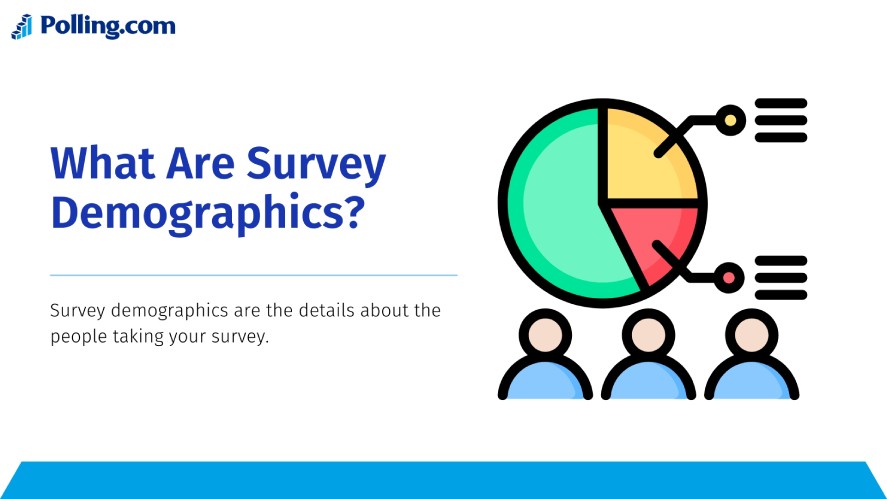
Demographic Targeting refers to dividing survey participants into groups based on measurable characteristics. These characteristics usually include:
- Age
- Gender
- Income
- Education
- Occupation
- Geographic location
To collect this information, researchers use demographic survey questions at the beginning or end of a questionnaire. These may appear in a structured demographics form or a standardized demographic form template to ensure consistency across studies.
You may also see terms such as demographic questions for survey or sample demographic survey questions. These are simply different ways of describing the same process of gathering structured background information.
For reporting purposes, this information is often summarized in a demographic report or organized into a demographics sheet for quick reference during analysis.
It is important to note that Demographic Targeting differs from other forms of segmentation. Psychographic targeting focuses on attitudes and values. Behavioral targeting looks at actions such as purchase history. However, demographics provide the foundation. Without them, deeper segmentation becomes unstable.
Demographic vs. Psychographic vs. Behavioral Targeting
While demographics focus on observable attributes, psychographic targeting addresses attitudes and lifestyle traits, and behavioral targeting focuses on past actions.
| Targeting Type | Focus | Example |
|---|---|---|
| Demographic | Age, income, education | Women aged 25–34 |
| Psychographic | Values, interests | Health-conscious consumers |
| Behavioral | Purchase history | Customers who bought in last 30 days |
Demographics provide the foundational layer for segmentation, often used alongside statistics and demography methodologies to ensure statistical rigor.
Why Demographic Targeting Matters in Survey Research
First, demographics help ensure representative samples. If your audience consists of 50 percent women and 50 percent men, your survey should reflect that balance. Otherwise, your results may lean heavily toward one perspective.
Second, Demographic Targeting reduces sampling bias. Bias occurs when some groups appear more frequently in the sample than they should, while others are not included enough. By aligning your quotas with trusted demographic statistics, you reduce distortion.
Third, it improves reliability. When demographic data is clean and structured, analysts can apply proper weighting methods rooted in statistics and demography. This leads to stronger conclusions and more trustworthy recommendations.
How Demographic Targeting Improves Survey Results
When people receive questions that apply to them, they are more likely to respond honestly and complete the survey.
For example, a college student may respond more thoughtfully to tuition-related questions than to retirement planning topics. Similarly, a small business owner will engage more with questions about operational costs than with questions about student loans.
Therefore, Demographic Targeting ensures respondents see relevant survey questions. As a result, completion rates improve. In addition, response quality becomes stronger because participants feel understood.
Over time, this relevance leads to cleaner datasets and more consistent feedback.
How Demographic Targeting Reduces Survey Bias
Bias can quietly damage research. For instance, if most respondents come from urban areas, rural perspectives may disappear from your results.
By setting demographic quotas before launch, researchers control distribution. This means no single group dominates the dataset. Consequently, your survey analytics become more stable.
Balanced samples also improve statistical validity. Instead of guessing whether your results are skewed, you can confirm that your sample mirrors the intended population.
How Demographic Targeting Enhances Data Accuracy
Accurate segmentation leads to clearer insights. Suppose you discover that customers aged 18 to 24 prefer a subscription model, while customers over 50 prefer one-time purchases. Without Demographic Targeting, this difference might remain hidden.
Precise segmentation also supports predictive modeling. Because the demographic data is structured, analysts can identify patterns across income, education, or location.
As a result, your demographic report becomes more than a summary. It becomes a strategic tool.
How Demographic Targeting Improves Decision Making
Ultimately, the purpose of any survey method of data collection is better decisions.
When leaders review segmented findings, they gain confidence. They can see how each group responded and adjust strategies accordingly.
For example:
- Marketing teams can tailor campaigns by age group.
- Product teams can refine features based on income segments.
- Customer experience teams can personalize service improvements.
Because Demographic Targeting connects insights to real audience groups, strategy becomes clearer and more focused.
Real World Applications of Demographic Targeting
Demographic Targeting in NPS Surveys
Net Promoter Score surveys are widely used. However, averages often hide important differences.
Imagine your overall NPS is 30. That seems solid. But after segmentation, you discover that customers under 30 rate you at 50, while customers over 55 rate you at 5.
This insight changes everything.
To achieve this clarity, you must ask strong demographic survey questions. In addition, knowing how to ask about age in a survey is critical. Instead of open text responses, structured age brackets improve accuracy and analysis.
By applying Demographic Targeting, NPS becomes more actionable and less misleading.
Political Surveys and Voter Insights
Political research depends heavily on demographic statistics. Campaigns need to understand how income, education, and region influence voter behavior.
Through layered segmentation, analysts can identify swing voters or measure support within specific communities. Statistics and demography principles guide these calculations to ensure reliability.
Without Demographic Targeting, polling results would be unstable and often inaccurate.
Market Research and Product Development
Companies testing new features often start with specific user groups. For instance, a tech company might test a feature among urban professionals before expanding nationally.
Using advanced survey tools, researchers can filter respondents based on multiple criteria. This controlled approach reduces risk before full-scale launches.
In this way, Demographic Targeting protects budgets and improves launch success rates.
Tools That Enable Effective Demographic Targeting
Why Polling.com Supports Advanced Demographic Targeting
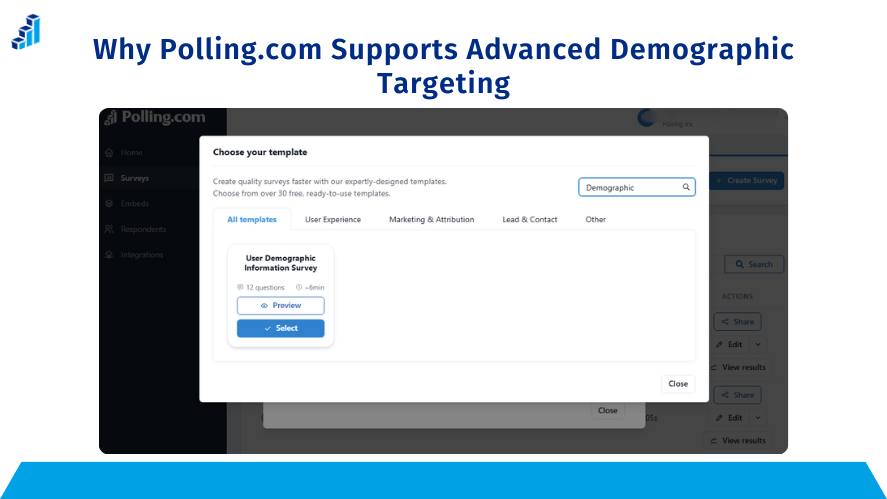
Not all survey tools offer the same level of segmentation. While basic platforms collect responses, advanced systems allow detailed filtering and quota management.
Polling.com stands out because it combines ease of use with strong segmentation controls. Users can:
- Apply advanced demographic filters
- Monitor quotas in real time
- Generate structured demographic report outputs
- Integrate powerful survey analytics
Compared with many free platforms, Polling.com offers cleaner panel data and better fraud prevention. At the same time, it avoids the complexity often associated with enterprise systems.
Comparing Demographic Targeting Across Platforms
| Platform | Demographic Targeting Capabilities |
|---|---|
| Polling.com | Advanced filters, panel targeting, scalable data collection |
| SurveyMonkey | Basic targeting (paid tiers) |
| Qualtrics | Enterprise-level segmentation |
| Google Forms | Limited demographic targeting |
Different survey and polling software platforms provide different capabilities.
Polling.com offers advanced demographic filters and scalable data collection. SurveyMonkey includes basic targeting in paid tiers. Qualtrics provides enterprise-level segmentation. Google Forms offers limited demographic targeting options.
For growing businesses that need reliable segmentation without heavy complexity, Polling.com offers a balanced solution.
Common Mistakes in Demographic Targeting
Over Segmenting the Audience
Although segmentation is valuable, too many filters can shrink your sample size. Small subgroups produce unstable results and large margins of error.

Therefore, balance precision with statistical strength.
Ignoring Representation and Weighting
If you fail to align quotas with trusted demographic statistics, your results may not reflect reality. Using census benchmarks and balanced sampling improves credibility.
Relying Only on Self Reported Data
Self reported information can contain errors. For example, some respondents may rush through a demographics form.
To prevent this, use fraud detection tools and data cleaning processes within your survey analytics platform.
Best Practices for Using Demographic Targeting Effectively
To maximize the value of Demographic Targeting, follow these steps:
- Define your research objective clearly.
- Set demographic quotas before launching the survey.
- Use a consistent demographic form template across studies.
- Include thoughtful demographic questions for survey design.
- Monitor distribution in real time.
- Cross analyze responses by segment.
- Document findings in a structured demographics sheet.
In addition, review sample demographic survey questions regularly to ensure clarity and inclusiveness.
When building your questionnaire, remember that strong segmentation works hand in hand with good survey questions. One without the other limits your results.
FAQ: Demographic Targeting in Surveys
They are structured questions that collect personal characteristics such as age, gender, income, education, and occupation.
They ensure balanced sampling and allow segmentation for deeper insights.
A structured summary of respondent characteristics used during analysis and reporting.
Advanced survey tools enable quota management, segmentation filters, and automated survey analytics, increasing precision.
Demographic data allows companies to tailor products, marketing campaigns, and customer experiences to specific audience groups.
Conclusion: Why Demographic Targeting Is Essential for Accurate Surveys
Demographic Targeting transforms ordinary surveys into reliable decision tools. By segmenting audiences carefully, organizations reduce bias, improve accuracy, and strengthen strategic confidence.
Because survey results influence marketing budgets, product launches, and policy decisions, precision matters. Structured demographic data, balanced quotas, and strong survey analytics ensure your findings reflect reality.
Platforms like Polling.com make this process accessible. With advanced filters and intuitive survey tools, businesses can gather meaningful insights without unnecessary complexity.
In the end, better targeting leads to better data. And better data leads to smarter decisions.