
NPS Follow-up Questions for Promoters, Passives, and Detractors

NPS follow-up questions help you understand why customers give certain scores. They reveal what people like, what bothers them, and what your business could do better.
Net Promoter Score (NPS) measures customers’ willingness to recommend your business to others. However, the score alone cannot explain their reasons.
For example, two customers might both give your company a 6 out of 10. One may love your product but dislike the price. The other may find the price fair but struggle with customer support.
They gave the same score, yet they need different solutions.
Follow-up questions help you find those differences. They also show which problems deserve attention and which experiences customers value most.
NPS surveys place respondents into three groups: promoters, passives, and detractors. Each group offers a different view of your business.
In this guide, you’ll learn which questions to ask each group, how to build a better survey, and how to use the answers to improve customer experience.
What Are NPS Follow-up Questions?
NPS follow-up questions are extra questions that appear after a customer gives a recommendation score.
The standard NPS question asks:
“On a scale of 0 to 10, how likely are you to recommend our company to a friend or colleague?”
Customers choose a number based on how they feel about your business.
However, the rating does not tell you why they chose it.
That’s where a follow-up question helps.
For example, a customer who selects 10 might see:
“What do you value most about our service?”
Someone who selects 4 might see:
“What was the main reason for your score?”
Both questions ask for useful feedback. However, each focuses on a different customer experience.
How NPS Follow-up Questions Work
Most NPS surveys start with the 0–10 rating question. Then, they ask customers to explain their answers.
There are two common types of follow-up questions.
Open-ended questions
These allow customers to answer in their own words.
Examples include:
- What is the main reason for your score?
- What could we do to improve your experience?
- Which part of our service do you value most?
Open-ended answers can reveal issues you may not have considered.
Closed-ended questions
Customers answer these questions by selecting from a list of provided options.
For example:
What most influenced your rating?
- Product quality
- Customer support
- Pricing
- Ease of use
- Other
These choices make it easier to group feedback and spot common themes.
You can also combine both formats. Ask customers to select their main reason, then give them an optional text box for more details.
The right choice depends on what you want to learn and how much time customers are willing to spend.
Why Follow-up Questions Matter in NPS Surveys
The importance of NPS goes beyond tracking a score.
Follow-up questions help you:
- Find customer strengths. Learn which parts of your product or service people enjoy.
- Spot recurring problems. See whether customers report similar issues.
- Understand expectations. Discover what customers hoped to receive.
- Guide improvements. Focus on changes that solve real problems.
- Identify possible churn risks. Notice concerns that may affect customer retention.
- Build better relationships. Show customers that their feedback matters.
Imagine a software company with mixed NPS results.
Promoters may praise its helpful tutorials, while detractors report confusing billing.
Without follow-up questions, the company would only see the scores.
With those answers, it can protect what works and improve what does not.
Understanding Promoters, Passives, and Detractors in NPS Surveys
Before writing follow-up questions, you need to know how NPS groups work.
NPS stands for Net Promoter Score. It measures how willing customers say they are to recommend a business, product, or service.
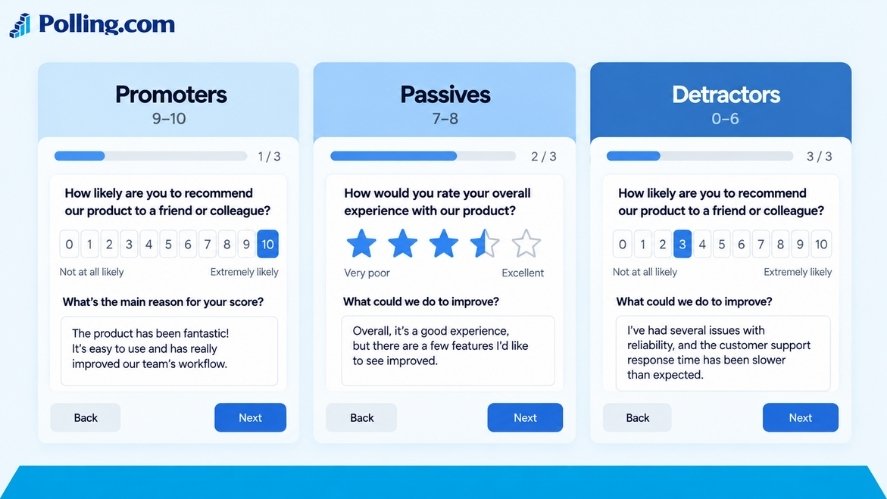
Customers fall into three groups based on their ratings.
These groups help you understand customer sentiment. However, each person’s reason for giving a score may be different.
Promoters (Scores 9–10)
Promoters give your business a 9 or 10.
They often have positive experiences and feel confident recommending your product or service.
For example, a promoter may value your product’s reliability, helpful support, or fair pricing.
Promoters may also share positive reviews, refer friends, or make repeat purchases.
However, a high rating does not guarantee these actions.
To understand what drives their scores, ask:
“What is the main reason you would recommend us?”
Their answers can show you which parts of your business deserve continued attention.
Passives (Scores 7–8)
Passives give scores of 7 or 8.
They may feel satisfied with your service but see room for improvement.
For example, a customer might enjoy using your software but wish it had better mobile features.
That customer may not have a serious complaint. They simply want something more.
A useful follow-up question is:
“What one change would improve your experience?”
This can reveal small issues that keep customers from giving stronger recommendations.
Detractors (Scores 0–6)
Detractors give scores from 0 to 6.
They are less willing to recommend your business.
Some may have had poor experiences. Others may feel the product does not meet their needs.
However, you should not assume every detractor is angry or ready to leave.
Start with a neutral question:
“What was the main reason for your score?”
Then, look for concerns that need attention.
For more examples, read Churn Risk: What to Ask in an NPS Survey to Identify It.
How to Calculate Your Net Promoter Score
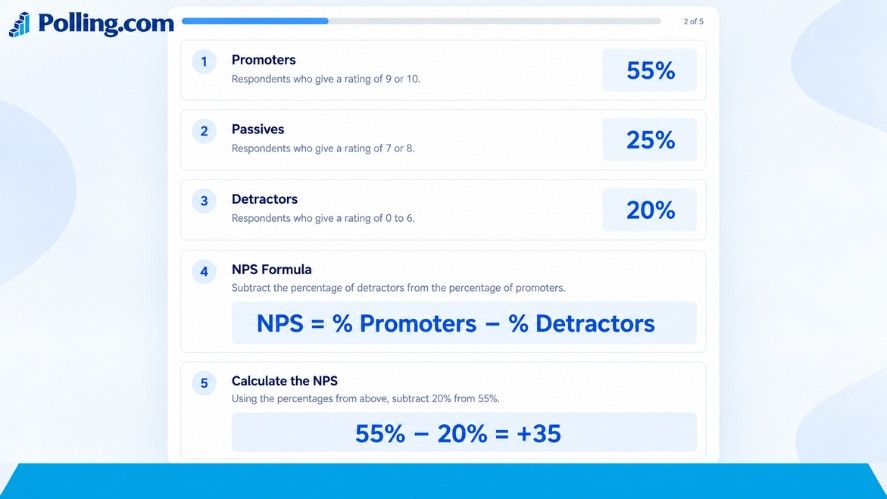
To calculate NPS, find the percentage of promoters and detractors among all survey respondents.
Then, subtract the detractor percentage from the promoter percentage.
NPS = % Promoters − % Detractors
For example, imagine that 200 customers complete your survey.
The calculation is:
55% − 20% = +35
Your company’s NPS is +35.
Passives count toward the total number of responses, but their percentage is not part of the subtraction.
NPS can range from -100 to +100.
A higher score means your survey has more promoters than detractors. However, you should compare results with similar audiences and past surveys before judging performance.
You can learn more from Bain & Company’s guide to measuring NPS.
Best NPS Follow-up Questions for Promoters (9–10)
Promoters can help you understand what your business does well.
Their feedback may reveal popular features, strong service habits, or benefits you have overlooked.
Start by learning what they value. Then, consider whether they want to share their experiences with others.
Questions to Understand Customer Satisfaction
1. What do you value most about our product or service?
This question helps you find the benefits customers care about most.
They may mention convenience, reliability, helpful staff, or good value.
2. Which part of your experience exceeded your expectations?
Ask this when you want to find moments that left a strong impression.
For example, customers may praise fast support or a smooth setup process.
3. What is the main reason you would recommend us?
This question reveals why customers feel confident recommending your business.
Look for themes that appear across several responses.
4. What makes us stand out from other options?
This helps you understand what customers see as your strengths.
They may mention better service, useful features, or easier access.
However, give respondents room to say they have not tried other options.
Questions to Encourage Customer Advocacy
Once you know what promoters value, you can explore whether they want to share their experiences.
5. What would you tell someone considering our product?
Their answers can show how customers describe your product in everyday language.
6. Which benefits would you highlight when recommending us?
This helps you find the features and benefits that customers remember most.
7. Would you be interested in sharing your experience in a testimonial or case study?
This gives interested customers a chance to take part.
Always ask for permission before sharing their names, quotes, or personal experiences in public marketing content.
How to Use Promoter Feedback
Promoter responses can help you make better decisions.
Start by looking for repeated praise.
For example, if many customers mention fast support, study what makes your support process effective.
You can also use promoter feedback to:
- Protect features customers already value.
- Improve product descriptions and messages.
- Find customers interested in referrals or testimonials.
- Identify positive experiences worth repeating.
Imagine that many customers praise your simple cancellation process.
That feedback suggests customers value flexibility and control.
Instead of only adding new features, you may want to keep that process simple.
Best NPS Follow-up Questions for Passives (7–8)
Passives can help you discover what is missing from an otherwise good experience.
They may like your business but feel that something could work better.
Your goal is not to push them toward a higher score. Instead, find changes that could improve their experience.
Questions to Identify Improvement Opportunities
1. What could we do to improve your experience?
This question gives customers room to share their main concerns.
It works well when you do not know which part of the experience needs attention.
2. What influenced your decision to give this score?
This neutral question can reveal both positive and negative experiences.
It avoids assuming that every passive customer has a complaint.
3. Which feature or service could work better?
Use this when you want feedback about a specific area.
For example, customers may mention account settings, payment options, or support hours.
4. Was there anything you expected that we did not deliver?
This helps identify gaps between what customers expected and what they received.
Their answers may reveal unclear promises or missing features.
Questions to Understand Customer Expectations
5. What would make our product more valuable to you?
This helps you understand which changes customers would appreciate.
6. How does your experience compare with other solutions you have used?
Ask this when customers may have experience with competing products.
Their answers can reveal differences in value, ease of use, or support.
7. What one change would make you more likely to recommend us?
This encourages customers to choose their most important suggestion.
For example, imagine an online learning platform receives many scores of 7 and 8.
Follow-up answers show that students like the lessons but struggle to track their progress.
The company could review its course dashboard and progress tools.
That change would address a need customers have already raised.
How to Turn Passives Into Promoters
Improving passive customer experiences takes more than asking extra questions.
You need to act on what customers tell you.
Start with these steps:
- Group feedback by common issues, such as pricing, support, or usability.
- Find problems that affect many customers or cause major frustration.
- Choose practical improvements your team can make.
- Review later feedback to see whether the same issues remain.
Small changes can sometimes improve the experience.
For example, clearer billing details or a simpler checkout page may reduce confusion.
Still, avoid treating a higher score as the only goal.
Focus on solving the problem first.
Best NPS Follow-up Questions for Detractors (0–6)
Detractor responses can help you find problems that damage customer trust.
However, not every low score comes from the same issue.
Some customers may report poor support. Others may find the product hard to use or too expensive.
Ask questions that help you understand the problem without blaming the customer.
Questions to Identify Customer Pain Points
1. What was the biggest challenge you faced while using our product or service?
This helps customers describe their main difficulty.
2. What was the main reason for your score?
This is a strong general follow-up because it does not assume the customer had a negative experience.
3. Which part of our product or service did not meet your expectations?
Use this to learn where customers see a gap between expectations and results.
4. Was there a specific experience that affected your rating?
Customers may mention delayed orders, billing errors, or slow responses.
If no single event affected their rating, that information is also useful.
Questions to Understand How to Resolve Issues
5. What could we have done differently?
This invites suggestions without asking customers to solve the entire problem.
6. What is the most important thing we should improve?
This helps you find the customer’s top concern.
7. What could we do to make your experience better?
The answers may point to practical next steps.
8. Would you like our support team to contact you about your concerns?
This offers help to customers who want it.
Make sure you respect their contact choices and handle personal information with care.
How to Respond to Detractor Feedback
Asking the right question is only the first step.
You also need a clear way to handle the response.
Step 1: Thank the customer
Acknowledge their feedback. Avoid arguing about their experience.
Step 2: Check how serious the issue is
Look for urgent problems, such as account access failures, payment errors, or service outages.
Send urgent cases to the team that can handle them.
Step 3: Offer a clear next step
Explain what your business can do.
If the issue needs more review, say so. Only offer solutions your team can realistically provide.
Step 4: Track the result
Record the problem, the action taken, and whether it was resolved.
For example, a customer may give an internet provider a low rating because outages affect their work.
The provider should send that issue to its technical team rather than simply asking the customer to change their score.
The goal is to solve the problem, not improve the rating without improving the service.
How to Choose the Right NPS Follow-up Questions
The best follow-up question depends on what you want to learn.
You may want to find your strongest features, discover unmet needs, or understand serious problems.
Your survey questions should reflect the type of feedback you want to collect.
Match Questions to Customer Sentiment
Use your customer’s score to guide the next question.
This approach keeps questions relevant.
For instance, asking a promoter why they are unhappy may feel strange.
Likewise, asking a detractor to share a testimonial may not suit their experience.
Match the question to the customer, but avoid assuming too much about how they feel.
Combine Open-ended and Multiple-choice Questions
Open-ended questions provide detail, while multiple-choice questions make feedback easier to group.
You can use both in one short survey.
For example:
Question 1: What most influenced your score?
- Product quality
- Customer support
- Price or value
- Ease of use
- Reliability
- Other
Question 2: Would you like to tell us more?
The second question can use an optional text field.
This lets customers explain their reasons without making everyone write a long answer.
However, do not add questions simply to collect more data.
Each question should help you make a decision.
Use Conditional Logic to Personalize Surveys
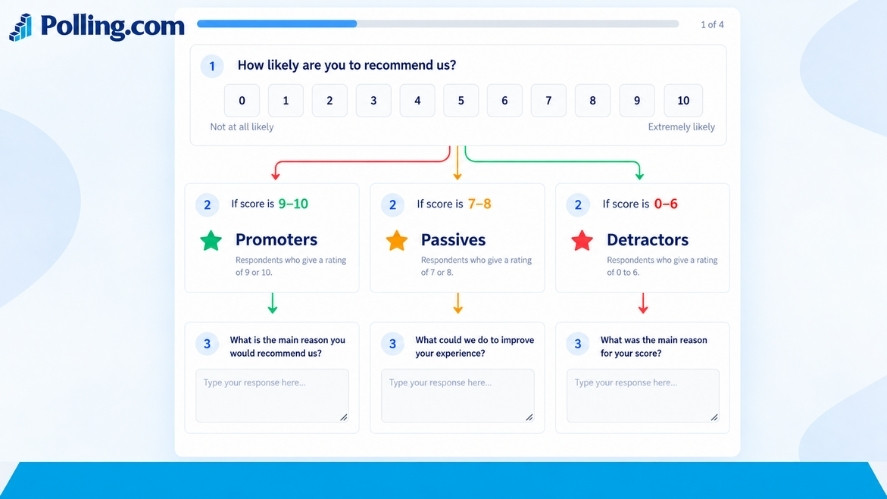
Conditional logic changes which questions appear based on earlier answers.
It is also called survey branching.
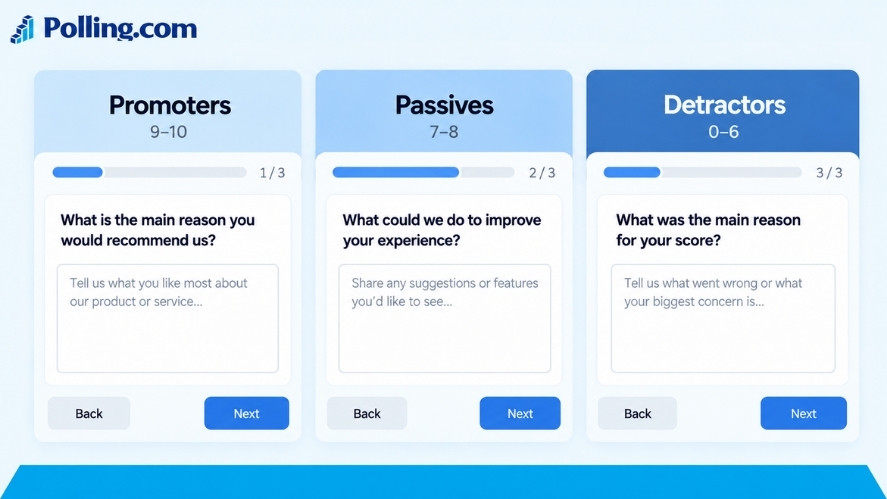
For example, you can build three paths from a single NPS rating question.
Starting question:
“How likely are you to recommend us on a scale of 0 to 10?”
Path A: Promoters (9–10)
“What is the main reason you would recommend us?”
Path B: Passives (7–8)
“What one improvement would make your experience better?”
Path C: Detractors (0–6)
“What was the main reason for your rating?”
Each customer answers only the question that matches their score.
This can help you keep surveys short and relevant.
For another example of how this works, read What Is Display Logic in Surveys and When Should You Use It?.
Best Practices for Writing Effective NPS Follow-up Questions
Good NPS questions should be easy to read, simple to answer, and free from bias.
Here are some ways to improve your survey.
Keep Questions Short, Clear, and Neutral
Avoid questions that tell customers how they should feel.
For example:
Weak: “How much did you enjoy our excellent customer support?”
This assumes that the support was excellent.
Better: “How would you describe your experience with our support team?”
The second version allows customers to share positive or negative feedback.
Another example:
Weak: “Why was our product difficult and frustrating to use?”
Better: “Did you have any trouble using our product?”
Simple, neutral wording gives customers more freedom to answer.
Ask One Meaningful Question at a Time
Long surveys can tire customers and reduce their willingness to finish.
Start with one useful follow-up question.
For example:
“What is the main reason for your score?”
If you need more details, add one optional question.
Also, avoid asking about several topics at once.
Instead of asking customers to rate pricing, delivery, support, and product quality in one question, focus on a single topic.
This makes the answers easier to understand.
Choose the Right Time to Send NPS Surveys
Survey timing can affect the feedback you receive.
There are two common approaches.
Transactional NPS
This asks for feedback after a specific event, such as:
- Completing a purchase
- Contacting customer support
- Finishing onboarding
- Receiving a delivery
The goal is to learn how a recent experience affects the customer’s willingness to recommend your business.
Relationship NPS
This asks about the customer’s overall relationship with your business.
You might send these surveys at planned points during the customer lifecycle.
An NPS calendar can help your team schedule surveys and avoid sending too many requests.
For either approach, give customers enough experience to provide a useful answer.
Keep the timing and audience consistent when you compare results over time.
Make Follow-up Questions Easy to Answer
Customers should not struggle to finish a short survey.
Use these practices:
- Write clear questions without technical jargon.
- Make sure answer choices work on mobile devices.
- Use readable text and clear labels.
- Keep optional answers clearly marked.
- Avoid long blocks of instructions.
- Make sure survey controls work with keyboards and assistive tools.
Also, test your survey before sharing it.
Try answering on both a desktop and a phone. Check that the questions, buttons, and answer fields are easy to use.
How to Create NPS Surveys With Follow-up Questions Using Polling.com
Polling.com provides tools for creating online surveys and collecting customer feedback.
Its documented logic branching features can guide respondents through different survey paths based on their answers.
Here’s how to plan an NPS survey with follow-up questions.
Set Up Your NPS Survey
First, decide what you want to measure.
For example, you may want feedback about your product, customer support, or overall customer relationship.
Next, create the standard recommendation question:
“On a scale of 0 to 10, how likely are you to recommend our company to a friend or colleague?”
Use a rating scale from 0 to 10.
Label the endpoints:
- 0: Not at all likely
- 10: Extremely likely
Then, add a simple follow-up question:
“What is the main reason for your score?”
This gives you both the rating and the reason behind it.
For more survey tips and examples, explore the Polling.com Blog.
Customize Follow-up Questions for Each Customer Group
You can make your NPS survey more relevant by using different questions for each group.
For example:
Promoters: “What do you value most about our service?”
Passives: “What one improvement would help you most?”
Detractors: “What was the main reason for your rating?”
Polling.com’s survey logic branching documentation explains how to create rules based on previous answers.
The documented setup includes:
- Open the survey builder and select the source question.
- Select Logic.
- Choose Add Logic and set the needed rule.
- Save the rule.
- Preview the survey and test each path.
For an NPS survey, plan how each score range should lead to its matching follow-up.
Check all three paths before publishing.
If your chosen question setup does not support the rule you need, you can still ask the same neutral follow-up question to every respondent.
Review Feedback and Identify Opportunities
After collecting responses, group customers by their NPS scores.
Then, review the follow-up answers.
Look for:
- Promoters: Features and experiences customers praise.
- Passives: Needs or expectations that are not fully met.
- Detractors: Problems that may need attention.
For example, an online retailer might find that promoters praise product quality, passives request more delivery options, and detractors report late orders.
These findings tell the retailer where it can improve.
Next, decide which team should review each issue and what action makes sense.
How to Analyze NPS Follow-up Responses and Take Action
Collecting feedback is useful, but acting on it matters more.
Your NPS results should help your team decide what to improve, which problems to solve first, and whether those changes work.
Categorize Feedback by Common Themes
Start by grouping customer comments into clear categories.
You can assign a tag to each comment, such as billing, support, or product quality.
This process helps you find issues that appear often.
You can also review the tone of each response.
For example, a customer might say:
“I love the product, but the billing process is confusing.”
This comment includes both praise and a concern.
Do not let a simple positive or negative label hide useful details.
Prioritize Improvements Based on Customer Feedback
Not every suggestion needs the same level of attention.
Consider three factors.
1. Frequency
How often do customers mention the issue?
A repeated complaint may show that many people face the same problem.
2. Severity
How serious is the issue?
A billing error may need urgent attention, even if only a few customers report it.
3. Business impact
Could fixing the issue improve customer retention, reduce support requests, or make an important task easier?
Use these factors to decide which problems need quick action and which belong in longer-term plans.
Close the Feedback Loop With Customers
Closing the feedback loop means responding to feedback and sharing updates when appropriate.
- For promoters, you might send a thank-you message.
- For passives, you could share news about an improvement they requested.
- For detractors, you may need to offer support or explain how their issue is being handled.
- For example, customers might report that account permissions are hard to understand.
After improving the settings page, your business could let those customers know what changed.
However, avoid promising that every suggestion will become a new feature.
Tell customers what you can do and give them clear updates when possible.
As Bain explains in its discussion of NPS, the value of customer feedback goes beyond the score itself.
Track NPS and Customer Experience Trends Over Time
Review your NPS results over time to see how customer feedback changes.
Useful measures include:
- Overall NPS
- Percentage of promoters, passives, and detractors
- Common complaints and requests
- Support resolution rates
- Customer satisfaction results
- Customer retention and churn
- Follow-up response rates
These measures can help you track progress.
For example, suppose your NPS improves after a new onboarding process launches.
That is a useful sign, but it does not prove the change caused the improvement.
Your results may also reflect changes in who answered the survey or when it was sent.
For a clearer picture, compare similar customer groups over time and review other results, such as onboarding completion or support requests.
Common Mistakes to Avoid With NPS Follow-up Questions
Even a short NPS survey can produce weak feedback if the questions are poorly planned.
Here are seven mistakes to avoid.
1. Asking Every Customer the Same Question
One neutral question can work for everyone.
However, using score-based questions may help you learn more about each customer group.
For example, promoters can tell you what works, while detractors can explain what needs attention.
2. Using Leading Questions
Avoid wording that suggests the answer you want.
Instead of asking:
“Why do you love our service?”
Ask:
“What influenced your opinion of our service?”
This allows customers to respond freely.
3. Asking Too Many Follow-up Questions
Extra questions increase the time needed to finish the survey.
Start with one useful question and add more only when needed.
4. Ignoring Customer Feedback
Survey results lose value when no one reviews them.
Give your team clear tasks for tracking feedback, investigating issues, and following up.
5. Treating NPS as the Only Measure of Loyalty
NPS measures stated willingness to recommend.
It does not tell you everything about customer satisfaction, future purchases, or retention.
Use it alongside other customer experience measures.
6. Making Assumptions Based on Scores
Two customers with the same score may have very different opinions.
Read their comments before deciding what action to take.
7. Focusing Only on Higher Ratings
A higher score should not be the only goal.
Instead, focus on improving customer experiences.
Better ratings may follow, but meaningful changes matter more.
Frequently Asked Questions About NPS Follow-up Questions
What Is the Best Follow-up Question for NPS?
A useful starting point is:
“What is the main reason for your score?”
This question is short, clear, and neutral.
It also works for promoters, passives, and detractors.
You can use more specific questions when you want feedback about a certain issue.
How Many NPS Follow-up Questions Should You Ask?
Start with one targeted question after the NPS rating.
You can add another question if you need more details.
However, avoid making the survey longer than necessary.
Each question should help you understand or improve the customer experience.
What Should You Ask NPS Promoters?
Ask promoters what they value most.
For example:
- What do you like most about our product?
- Which part of your experience stood out?
- Why would you recommend us?
These answers can reveal your strengths and help you understand customer loyalty.
What Should You Ask NPS Passives?
Ask passives what could make their experience better.
For example:
- What could we improve?
- What one change would help you most?
- Was anything missing from your experience?
Focus on unmet needs without assuming the customer is unhappy.
What Should You Ask NPS Detractors?
Ask detractors questions that help you understand their concerns.
For example:
- What was the main reason for your score?
- Did you face any difficulties?
- What could we do to improve your experience?
If they report a serious problem, give them a clear way to request support.
Should NPS Follow-up Questions Be Open-ended?
Open-ended questions work well when you want detailed feedback in the customer’s own words.
Multiple-choice questions work well when you want to group and compare responses.
You can combine both formats if you need structured data and extra context.
How Often Should You Send NPS Surveys?
There is no single schedule for every business.
Relationship NPS surveys can be sent at planned intervals.
Transactional surveys can follow key customer interactions.
Choose a schedule that fits your customer journey and avoids sending too many surveys.
Can NPS Follow-up Questions Help Reduce Customer Churn?
They can help you find issues that may increase churn risk.
For example, repeated complaints about billing, support, or product reliability may signal problems that need attention.
However, a low score does not prove that someone will leave.
Check other signs, such as customer activity, renewal history, and support requests.
What Is the Difference Between NPS and Customer Satisfaction Surveys?
NPS measures how likely customers are to recommend your business.
Customer Satisfaction Score (CSAT) surveys ask how satisfied customers are with a product, service, or experience.
Customer Effort Score (CES) surveys focus on how easy or difficult it was to complete a task.
Each measure answers a different question.
Using them together can give you a clearer view of customer experience.
Conclusion: Turn NPS Follow-up Questions Into Useful Customer Insights
NPS follow-up questions help you understand the reasons behind customer ratings.
Promoters can show you what your business does well. Passives can reveal unmet needs. Detractors can point to issues that need attention.
However, asking questions is only part of the process.
You also need to review the answers, find common themes, and make changes that improve the customer experience.
Start with one clear question. Match it to the customer’s score when useful, and keep your survey short.
Most importantly, use the feedback to guide real improvements.
Ready to collect more useful customer feedback? Explore Polling.com and its survey tools to build surveys that help you better understand your customers.