
How Survey Researchers Use Survey Apps to Collect Reliable Data

Survey researchers play a vital role in helping organizations understand people’s opinions, behaviors, and preferences. In today’s digital environment, collecting reliable data has become faster and more efficient than ever before. Instead of relying only on paper forms, phone interviews, or in-person questionnaires, many professionals now rely on digital survey tools to simplify the entire research process.
Survey research has evolved significantly over the past decade. Researchers today must gather insights quickly, reach large audiences, and analyze information accurately. Because of these growing demands, survey apps have become essential tools that help researchers design questionnaires, distribute surveys, track responses, and perform survey results analysis in one place.
At the same time, online survey platforms have made the methodology of survey research more accessible and scalable. Tools such as Polling.com allow professionals to conduct a survey, collect responses in real time, and generate meaningful insights without complex manual processes.
In this article, we will explain survey research, explore what survey researchers do, and examine how modern survey apps help them collect reliable data. We will also look at common survey research methods, best practices, and the tools researchers use to manage survey responses effectively.
Who Are Survey Researchers and What Do They Do
Before discussing digital tools, it is important to understand the role of survey researchers and how they contribute to research projects.
To begin with, a simple survey research definition describes it as a systematic method of collecting information from a group of people through structured questions. Researchers analyze the collected responses to identify patterns, trends, and insights.

Survey researchers specialize in designing and managing these studies. Their goal is to ensure that the data collected is accurate, unbiased, and useful for decision making.
Many organizations depend on survey research to guide strategy, improve products, understand customer behavior, and evaluate public opinion.
Key Responsibilities of Survey Researchers
The responsibilities of survey researchers extend across several stages of a research project. From planning the study to analyzing results, their work ensures that the data reflects real-world opinions and behaviors.
Here are the main tasks involved in survey research.
Designing questionnaires
One of the first steps is creating a well-structured questionnaire. Survey researchers carefully write questions that are clear, neutral, and easy to understand.
Good questions are essential because poorly written questions can lead to misleading answers. Therefore, researchers often test questions before launching the survey to ensure respondents interpret them correctly.
Selecting sampling methods
Another key responsibility involves selecting the right sample of respondents. The sample must represent the population being studied.
For example, if a company wants feedback from young consumers, the survey should target participants in that age group. Choosing the right sampling method ensures that survey responses reflect the broader audience.
Collecting and managing data
Next, researchers must collect responses efficiently and securely. In the past, this process involved manual data entry and large teams of interviewers.
However, survey apps now automate much of this work. These tools allow researchers to distribute surveys digitally and gather responses in real time.
Analyzing results and producing insights
Finally, researchers analyze the collected data to generate meaningful conclusions. This stage often includes survey results analysis, which involves identifying trends, comparing responses, and interpreting patterns.
Researchers then present the findings through reports, charts, and visualizations that help organizations make informed decisions.
Industries That Rely on Survey Researchers
Survey researchers work across many industries because nearly every organization needs reliable feedback.
Below are some of the most common fields that depend on survey research.
Market research
Businesses frequently use surveys to understand customer preferences, buying habits, and brand perception. Market research surveys help companies improve products and marketing strategies.
Political polling
Another well-known application is political polling. Researchers gather opinions about candidates, policies, and public issues to understand voter sentiment.
Customer experience and NPS
Companies also use surveys to measure customer satisfaction and loyalty. Net Promoter Score surveys are a common method used to evaluate how likely customers are to recommend a brand.
Academic and social science research
Universities and research institutions often conduct surveys to study social behavior, public health trends, and economic conditions.
Product and UX research
Technology companies rely on surveys to evaluate user experiences. Feedback helps teams improve app interfaces, product features, and usability.
Because of these diverse applications, survey researchers must use efficient tools that help them manage data accurately and quickly.
Why Survey Researchers Use Survey Apps
Over time, the tools used in survey research have changed dramatically. Traditional methods such as phone interviews and paper questionnaires are still used in some cases. However, digital survey platforms now dominate most research workflows.
There are several reasons for this shift.
Faster Data Collection
One major advantage of survey apps is speed.
In traditional survey research methods, collecting responses could take weeks or even months. Interviewers had to contact participants individually, and responses had to be manually recorded.
Today, digital survey apps allow researchers to distribute surveys instantly. Respondents can complete surveys online using computers or smartphones.
As a result, researchers can receive hundreds or thousands of responses within hours.
Real time data collection also allows researchers to monitor trends while the survey is still active. If necessary, they can adjust the study or expand the audience.
Improved Data Accuracy
Another important benefit is improved data accuracy.
Manual data entry often introduces errors. For instance, researchers might misread handwritten answers or accidentally input incorrect values.
Survey apps reduce these risks by collecting responses automatically. Many platforms also include built in validation rules that prevent respondents from entering invalid answers.
For example, a survey question asking for age can restrict responses to numerical values within a specific range.
Because of these safeguards, the quality of collected data improves significantly.
Scalable Research
Survey apps also make research much more scalable.
Traditional surveys often required large teams of interviewers and significant logistical planning. As a result, reaching large audiences was both difficult and expensive.
Digital tools solve this problem by allowing researchers to distribute surveys to thousands of participants at once.
Online surveys can also reach participants across different countries and time zones. This makes it easier to conduct global studies and compare responses from diverse populations.
In other words, researchers can now conduct a survey on a much larger scale than before.
Cost Efficiency
Another major advantage of survey apps is cost savings.
Traditional surveys often require printing materials, hiring interviewers, and manually entering data. These processes increase both time and operational expenses.
Digital survey tools eliminate many of these costs. Researchers can design questionnaires, distribute them online, and collect responses automatically.
As a result, organizations can perform more studies without significantly increasing their research budgets.
How Survey Researchers Use Survey Apps in Practice
Now that we understand the benefits of survey apps, it is helpful to explore how researchers actually use them during the research process.
From designing surveys to analyzing responses, these tools support every stage of survey research.
Designing Digital Surveys
The first step in any survey project is creating the questionnaire.

Survey apps provide user friendly interfaces that allow researchers to design surveys quickly. Instead of manually formatting questions, researchers can select from multiple question types and customize them easily.
Common question formats include:
- Multiple choice questions
- Rating scales
- Open ended text responses
- Likert scale questions
- Ranking questions
In addition, modern survey platforms include advanced features that support the methodology of survey research.
These features include:
Question logic
Survey logic allows researchers to show or hide questions based on previous answers. This ensures that respondents only see questions relevant to them.
Multiple question types
Different types of questions help researchers capture both quantitative and qualitative insights.
Skip patterns
Skip patterns allow respondents to bypass questions that do not apply to them.
Survey branching
Branching creates personalized survey paths depending on how participants respond.
Because of these features, researchers can design surveys that feel more natural and engaging for participants.
Distributing Surveys to Target Audiences
Once the questionnaire is ready, the next step is distribution.
Survey apps offer multiple ways to share surveys with respondents. This flexibility helps researchers reach the right audience for their study.
Some common distribution methods include:
Email surveys
Researchers can send surveys directly to participants through email invitations.
Embedded website surveys
Organizations often embed surveys on websites to collect feedback from visitors.
Mobile surveys
Since many people use smartphones regularly, mobile friendly surveys significantly increase response rates.
Social media distribution
Researchers may also share surveys through social media platforms to reach broader audiences.
Each distribution channel helps researchers reach participants where they already spend their time online.
Collecting and Monitoring Responses
After distributing a survey, the next important step is monitoring how participants respond. In traditional survey research, researchers often had to wait until the entire survey period ended before reviewing results. However, survey apps now allow researchers to track activity in real time.
Real time dashboards provide a clear overview of how the survey is performing. Researchers can see how many people have opened the survey, how many completed it, and how many abandoned it halfway through.
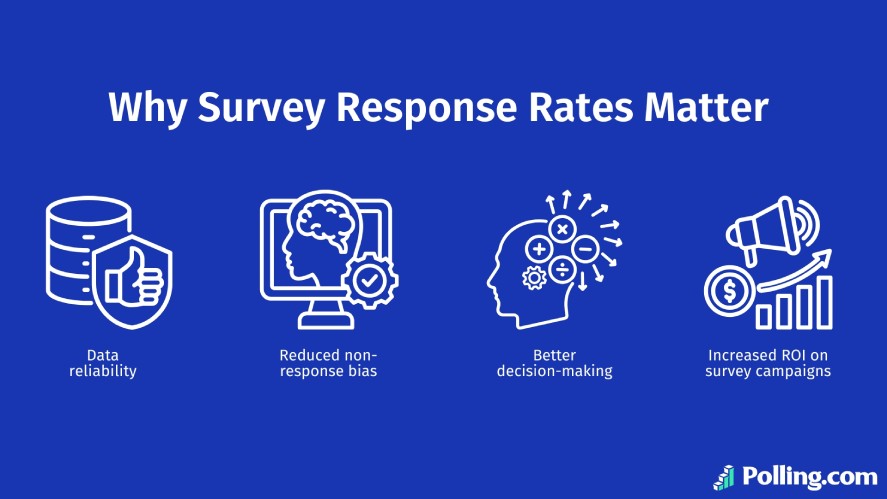
Monitoring responses in real time helps survey researchers make adjustments during the data collection process. For example, if response rates are lower than expected, researchers can send reminders or distribute the survey through additional channels.
Another benefit of modern survey tools is response tracking. Researchers can easily monitor the number of survey responses coming from different sources such as email invitations, social media links, or website embeds.
Completion rate monitoring is also an important metric. If a large number of participants stop answering halfway through the questionnaire, this may indicate that the survey is too long or confusing. Researchers can then revise the questionnaire for future studies.
Overall, digital tracking tools give researchers much greater control over how surveys perform and how data is collected.
Analyzing Survey Data
Collecting responses is only one part of the process. The real value of survey research comes from analyzing the data and extracting insights.
Survey apps often include built in analytics tools that make survey results analysis much easier. Instead of manually compiling spreadsheets, researchers can instantly view summaries of the collected responses.
Common analysis features include:
- Response distribution charts
- Cross tabulation of demographic groups
- Average ratings and scores
- Trend analysis across questions
These features allow researchers to quickly understand patterns in the data.
For example, a company conducting customer experience research might discover that satisfaction scores vary by age group or location. These insights help businesses make informed decisions about their services or products.
Many platforms also allow researchers to export data to external tools such as Excel, R, Python, or statistical software packages. This allows deeper statistical analysis when needed.
Data visualization is another valuable feature. Charts, graphs, and dashboards help researchers present results clearly to stakeholders.
When survey results are easy to interpret, organizations can act on the insights more quickly.
Best Survey Apps for Survey Researchers
Because digital surveys are now widely used, there are many survey platforms available. However, some tools are specifically designed to support the workflow of survey researchers.
Choosing the right platform depends on the complexity of the research, the size of the audience, and the level of analysis required.
Polling.com
Polling.com is a platform designed specifically for modern survey research and polling. It focuses on helping survey researchers design, distribute, and analyze surveys efficiently.

One of the main advantages of Polling.com is its simple survey creation process. Researchers can quickly build questionnaires using multiple question formats, logic rules, and branching paths.
The platform also supports flexible distribution methods. Surveys can be shared through email, web links, and embedded website forms. This allows researchers to reach their audience through multiple channels.
Another key feature is advanced analytics. Polling.com provides real time dashboards and reporting tools that help researchers interpret survey responses quickly.
Because the platform focuses on polling insights and research workflows, it is particularly useful for organizations that conduct surveys frequently.
In addition, the platform is scalable. Both small research teams and large organizations can use it to conduct surveys with thousands of participants.
Other Popular Survey Platforms
While Polling.com focuses on research driven surveys, several other platforms are also widely used.
SurveyMonkey
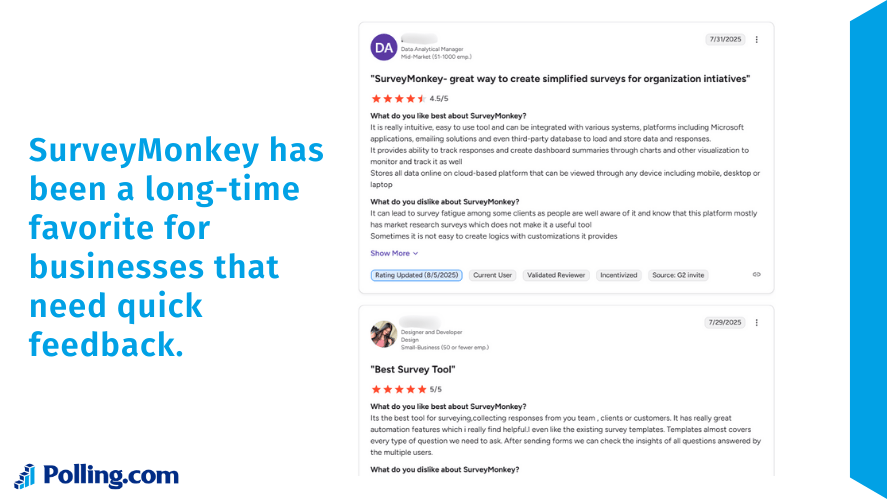
Review excerpts sourced from publicly available third-party review platforms.
SurveyMonkey is one of the most well known survey tools. It provides templates, question libraries, and basic analytics features. Many businesses use it for quick feedback surveys.
Google Forms
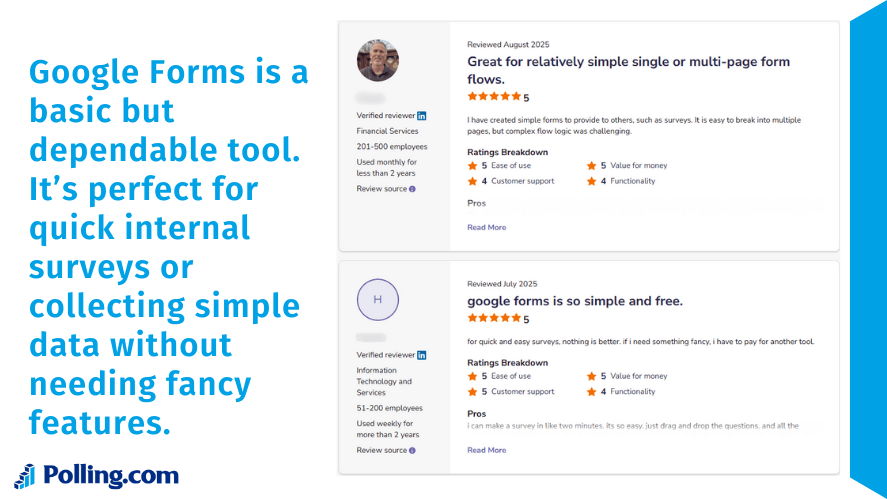
Review excerpts sourced from publicly available third-party review platforms.
Google Forms is a simple and free tool that allows users to create surveys and collect responses quickly. It integrates easily with Google Sheets for basic data analysis.
Typeform
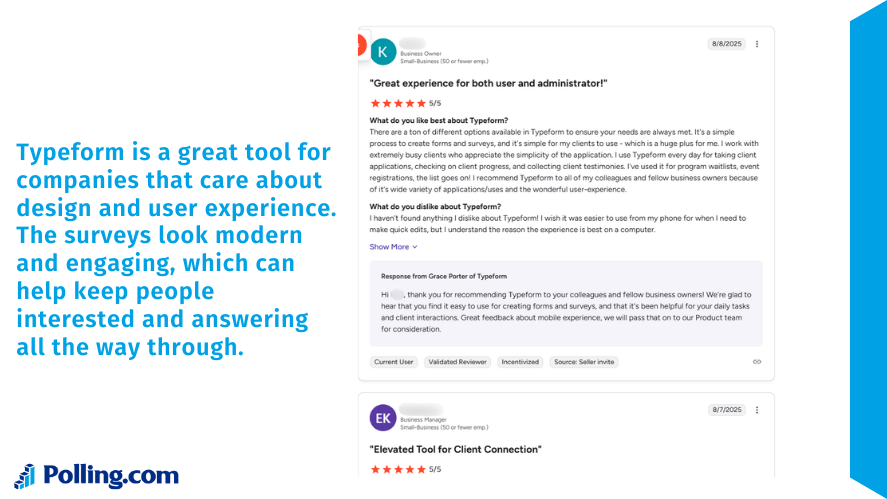
Review excerpts sourced from publicly available third-party review platforms.
Typeform is known for its interactive and visually appealing survey design. The platform focuses on creating engaging surveys that feel conversational.
Qualtrics

Review excerpts sourced from publicly available third-party review platforms.
Qualtrics is an advanced research platform often used by universities and large enterprises. It provides sophisticated analytics, audience targeting, and complex survey logic.
Although these platforms offer useful features, Polling.com is specifically designed for polling insights and streamlined research workflows. This focus can make it especially useful for professionals conducting detailed survey studies.
Key Features Survey Researchers Should Look for in Survey Apps
Not all survey platforms offer the same capabilities. Therefore, survey researchers should carefully evaluate tools before choosing one for their projects.
Several key features can significantly improve the effectiveness of survey research.
Advanced Survey Logic
Advanced logic is essential for creating dynamic and personalized surveys.
Conditional questions allow researchers to display questions only when certain conditions are met. This keeps surveys relevant for each participant.
Dynamic surveys also reduce survey fatigue because respondents only answer questions that apply to them.
For example, if a participant indicates they have never used a particular product, the survey can automatically skip follow up questions about that product.
Data Visualization and Reporting
Clear reporting tools are important for presenting research findings.
Good survey apps provide charts, graphs, and dashboards that summarize responses automatically.
These visualizations make it easier for researchers to identify patterns and communicate results to stakeholders.
Automated reporting can also save time. Instead of creating reports manually, researchers can generate summaries instantly.
Sample Targeting Capabilities
Targeting the right audience is essential in survey research methods.
Some platforms allow researchers to filter participants based on demographics, location, interests, or behavior.
Audience segmentation helps ensure that the survey results represent the correct population.
For instance, a company researching a new product might target surveys specifically to people who have purchased similar products before.
Integration With Analytics Tools
Survey data is often combined with other data sources.
Therefore, it is helpful when survey apps integrate with analytics platforms, customer relationship management systems, and marketing tools.
These integrations allow researchers to connect survey results with broader business data.
Exporting data in multiple formats is also important for researchers who use statistical software for deeper analysis.
Challenges Survey Researchers Face With Survey Apps
Although survey apps offer many advantages, they also introduce certain challenges that researchers must manage carefully.
Understanding these challenges helps researchers design better studies and collect more reliable data.
Survey Fatigue
Survey fatigue occurs when participants feel overwhelmed by too many surveys or long questionnaires.

When this happens, respondents may abandon surveys before completing them or provide rushed answers.
To avoid this problem, survey researchers should keep surveys concise and engaging.
Short surveys with clear questions are more likely to maintain participant attention and produce accurate responses.
Sampling Bias
Sampling bias is another challenge in survey research.
If the participants selected for a survey do not represent the broader population, the results may be misleading.
For example, conducting an online survey may exclude people who rarely use the internet.
To address this issue, researchers must carefully design sampling strategies and ensure that diverse groups are included.
Data Privacy and Compliance
Data privacy regulations are becoming increasingly strict around the world.
Researchers must ensure that surveys comply with privacy laws such as the General Data Protection Regulation.
Participants should clearly understand how their data will be used and stored.
Secure data storage and transparent consent practices are essential for maintaining trust and protecting respondents.
Best Practices for Survey Researchers Using Survey Apps
Even with powerful tools, successful survey research depends on thoughtful design and execution.
Following best practices can significantly improve response rates and data quality.
Keep Surveys Short and Clear
Long surveys often discourage participation.
Keeping questionnaires concise increases the likelihood that respondents will complete the entire survey.
Clear and simple language also improves accuracy because participants understand the questions more easily.
Use Logic to Personalize Questions
Survey logic helps create a more relevant experience for respondents.
When participants only see questions related to their experiences, they are more likely to stay engaged and provide thoughtful answers.
Personalized surveys also reduce frustration and confusion.
Test Surveys Before Launch
Before distributing a survey widely, researchers should conduct a pilot test.
Testing helps identify unclear questions, technical issues, or logic errors in the survey design.
Fixing these problems early prevents inaccurate data and improves the overall quality of the study.
Analyze Data Regularly
Researchers should review incoming data regularly rather than waiting until the survey ends.
Early analysis helps identify trends, unusual response patterns, or potential problems with the questionnaire.
This proactive approach allows researchers to adjust their strategy if necessary.
Conclusion
Survey researchers play a crucial role in helping organizations understand people’s opinions, behaviors, and experiences. Through structured questionnaires and careful data analysis, they transform individual responses into valuable insights.
However, the process of collecting reliable data has changed dramatically with the rise of digital tools. Survey apps now allow researchers to design questionnaires, distribute surveys to large audiences, and perform survey results analysis more efficiently than ever before.
Modern platforms simplify many aspects of survey research methods. From automated response tracking to built in analytics, these tools make it easier to conduct a survey and interpret the results.
Platforms such as Polling.com highlight how specialized survey tools can support the entire research workflow. By combining survey creation, distribution, and analysis in one place, researchers can focus more on insights and less on manual processes.
As digital research continues to expand, survey apps will remain essential tools for survey researchers. With the right methodology of survey research and the right technology, organizations can gather accurate feedback and make informed decisions based on real data.