
Data Collection Methods in Survey: A Complete Guide for Researchers

In surveying and research, data collection methods refer to the ways researchers gather information from people, systems, or existing sources to answer specific questions.
The method you choose directly affects the quality, reliability, and usefulness of your results.
Well-chosen data collection techniques in research, including data collection techniques in qualitative research, lead to accurate insights and confident decisions, while poorly matched methods can produce biased, incomplete, or misleading data.
Selecting the right methods and techniques of data collection isn’t just a technical choice.
It depends on what you’re trying to learn, who your target population is, what resources you have available, and whether you need quantitative data or qualitative data.
Platforms like Polling.com data collection support these methods by helping researchers design, distribute, and manage surveys efficiently while maintaining data quality.
In this guide, we’ll walk through the most common data collection methods used in surveys and research, explain their strengths and limitations, and offer practical guidance on how to choose the right approach for your study.
What Are Data Collection Methods?
Data collection methods are the systematic processes used to gather and measure information from various sources in order to answer research questions, test hypotheses, or evaluate outcomes.
These methods ensure that the data collected is relevant, consistent, and suitable for analysis.
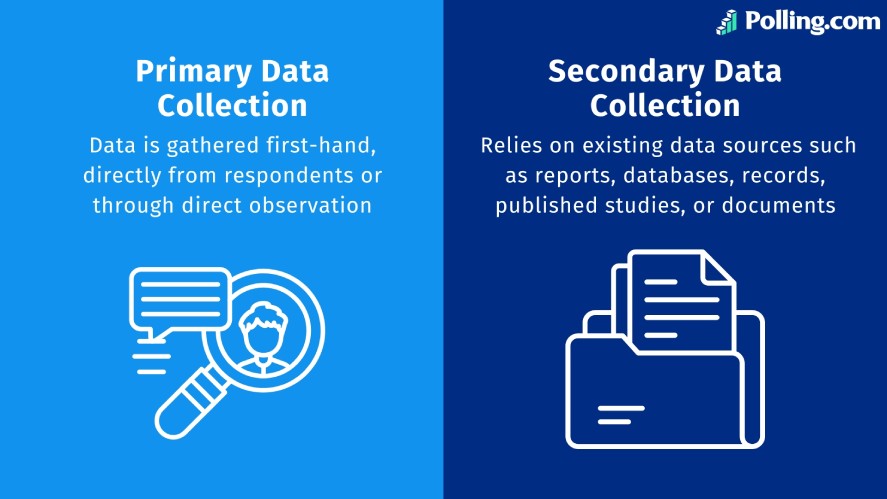
Broadly, data collection falls into two categories:
- Primary Data Collection: Where data is gathered first-hand, directly from respondents or through direct observation, including primary data collection techniques. Examples include surveys, interviews, focus groups, and behavioral observation.
- Secondary Data Collection: Which relies on existing data sources such as reports, databases, administrative records, published studies, or historical documents.
Data collection methods can also be used to gather different types of data.
Quantitative methods focus on numeric and measurable data, such as ratings, counts, or frequencies.
Qualitative methods capture descriptive insights, themes, and explanations, helping researchers understand the “why” behind behaviors and survey responses.
The choice of method depends on the research goals and the type of insight required.
Common Survey‑Based Data Collection Methods
Researchers use a range of survey-based and related methods to collect data, each suited to different goals, populations, and types of insight.
Below are the most common approaches, along with their strengths and limitations.
Surveys/Questionnaires
Pros
- Can reach large populations quickly
- Cost‑effective (especially online)
- Easy to standardize and analyze
- Scalable
Cons
- May suffer from low response rates and non-response bias
- Limited depth (especially with closed-ended questions)
- Risk of misinterpretation or disengagement
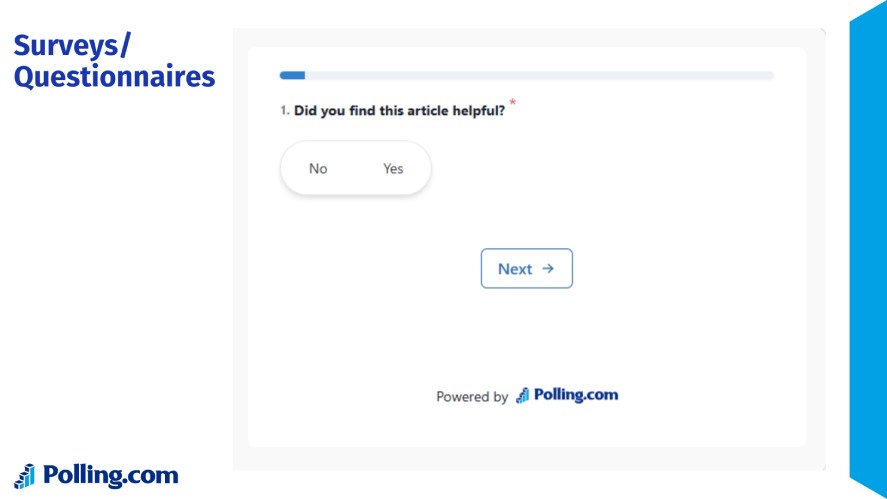
Surveys and questionnaires are among the most widely used survey methods of data collection.
They consist of structured sets of questions distributed to respondents in a consistent format, making them ideal for collecting standardized data at scale.
Surveys can be delivered in several ways, including online surveys, face-to-face interviews, telephone surveys, and paper-based questionnaires.
Online Polling.com surveys, in particular, are popular due to their speed, low cost, and ease of distribution.
Interviews (Structured/Semi-structured/Unstructured)

Pros
- Rich, in-depth qualitative data
- Flexibility to probe, clarify, and explore complex issues
- Food for understanding motivations, opinions, and behaviors
Cons
- Time-consuming, resource-intensive, and harder to scale
- Potential for interviewer bias
- More difficult to standardize
Interviews involve one-on-one or small group conversations designed to collect detailed information directly from participants.
Depending on structure, interviews can follow a fixed script, a flexible guide, or an open conversational format.
They can be conducted in person, over the phone, or through computer-assisted methods such as video calls, CAPI, or CASI.
Observation

Pros
- Reduces reliance on self-report (so less bias from memory or social desirability)
- Can observe real behavior
- Good for contextual, behavioral data
Cons
- May be intrusive
- Observer bias
- Time-consuming
- Ethical/privacy concerns
- May not capture internal motivations or beliefs
Observation involves systematically watching and recording behaviors, events, or phenomena, often without directly interacting with participants.
This method is useful when actual behavior is more reliable than self-reported data or when studying people in natural settings.
Focus Groups/Group Discussions

Pros
- Rich discussion, diverse perspectives
- Participants can bounce ideas off each other
- Good for brainstorming, concept testing, and exploring group dynamics
Cons
- Difficult to manage group dynamics
- May lead to dominant voices overshadowing others
- Mot ideal for sensitive topics
- Harder to generalize
Focus groups are moderated discussions with a small group of participants, designed to explore opinions, attitudes, and experiences.
They are commonly used in exploratory research, concept testing, and early-stage product or messaging development.
Secondary Data/Document & Record Review

Pros
- Cost-effective, less time-consuming
- Allows historical comparisons
- Good for triangulation and context
Cons
- Might not fit the exact research questions
- Data may be outdated, incomplete, or biased
- Limited control over how data was collected originally
Secondary data collection relies on pre-existing sources such as documents, administrative records, published statistics, databases, and archival data.
Rather than collecting new data, researchers analyze information that already exists.
Choosing the Right Data Collection Methods: What to Consider
Selecting the right data collection method is a strategic decision that directly affects data quality, reliability, and how actionable your findings will be.
There is no universally best method, and the right choice depends on several key factors.
Research objectives should come first when defining methodology and survey method.
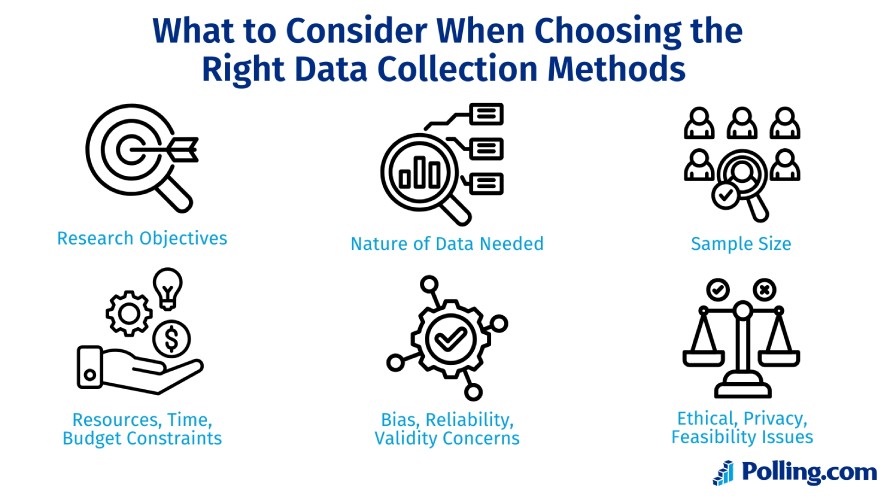
Are you testing specific hypotheses, exploring attitudes, measuring observable behavior, or probing deeper motivations?
Clear goals help determine whether structured surveys, interviews, observations, or a combination of methods are most appropriate.
The nature of the data needed also matters.
Quantitative data (such as frequencies, ratings, or numerical measures) is typically best collected through surveys or structured instruments using quantitative research data collection techniques.
On the other hand, qualitative data (opinions, experiences, motivations) is often better captured through interviews, focus groups, or open-ended survey questions.
Sample size and population reach influence feasibility.
For large or geographically dispersed populations, surveys, especially online surveys, are efficient and scalable.
For smaller, targeted groups or when depth is more important than breadth, interviews or focus groups may be more effective.
Resources, time, and budget constraints play a practical role.
Interviews and observations require more time, trained staff, and coordination, whereas surveys and secondary data collection are generally faster and more cost-effective.
Finally, consider bias, reliability, validity, and ethical concerns. Every method has trade-offs, such as response bias, non-response bias, or observer bias.
Ethical issues like privacy, consent, and data security are especially important when using observation or secondary records.
In many cases, a mixed-method approach helps balance these challenges and strengthens overall research outcomes.
Mixed‑Method Approaches: Why and How to Combine Methods
A mixed-method approach combines two or more data collection methods (typically quantitative and qualitative) to produce more complete and reliable research insights.
Instead of relying on a single source of data, researchers use multiple methods to balance out the limitations and biases inherent in any one approach.
In practice, this often means using surveys for breadth and qualitative methods for depth.
For example, an online survey can measure trends, frequencies, or satisfaction levels across a large population, while follow-up interviews help explain why respondents answered the way they did.
Similarly, survey results can be strengthened by reviewing documents or administrative records, or by pairing self-reported data with observational insights to validate actual behavior.
The key benefit of mixed-method data collection is triangulation: cross-checking findings from different sources to confirm patterns and reduce uncertainty.
This leads to improved validity, richer context, and a more nuanced understanding of complex research questions.
By combining numbers with narratives, researchers can move beyond surface-level metrics and uncover the motivations, constraints, and real-world factors that drive observed outcomes.
Common Pitfalls & Challenges in Data Collection
Even well-planned studies can suffer if common data collection challenges are not addressed early.
One of the most frequent issues is low response rates, which can lead to non-response bias and reduce the reliability of results.
Disengaged respondents may rush through questions or abandon the survey entirely, weakening data quality.
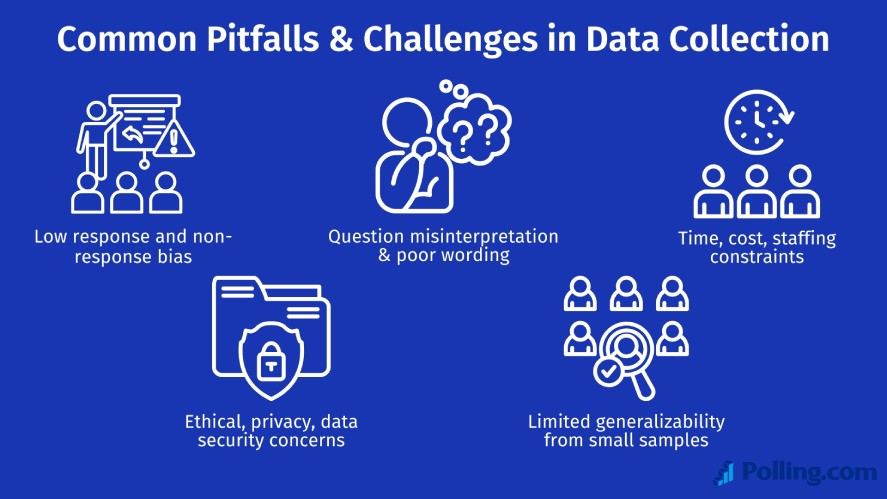
Another major risk is misinterpretation of questions.
Poorly worded, leading, or ambiguous questions can confuse respondents and produce misleading answers, regardless of how robust the analysis may be.
Resource constraints are also a practical concern.
Interviews, observations, and focus groups require more time, budget, and trained staff, making them harder to scale than surveys or secondary data review.
Ethical and privacy considerations must not be overlooked, particularly when using observational methods or existing records.
Researchers need to ensure informed consent, confidentiality, and secure handling of sensitive data.
Finally, some methods, such as focus groups or convenience samples, may limit generalizability.
While this is partly a sampling issue, it’s important to recognize how data collection choices influence how broadly findings can be applied.
Conclusion
Choosing the right data collection method is critical to producing high-quality, valid, and actionable survey results.
There is no one-size-fits-all approach: effective method selection depends on research objectives, the type of data required, available resources, and ethical considerations.
When possible, mixed-method approaches can help balance strengths and weaknesses, providing both scale and depth.
With clear objectives, thoughtful design, and careful execution, researchers can ensure their data collection survey process supports meaningful and trustworthy insights.